
.png)
Need direction cycle

Updated: Feb 16
Do you feel others trying to blame you for not fulfilling their needs? Do you feel overwhelmed by all that’s demanded from you now? Do you feel that you must fight to get others to bend their needs to serve yours? Can anyone change what they need on demand?
Objective fact of your core needs 0:18
Every need exists as an objective fact. Which you subjectively experience only after the fact. Only then do your feelings suggest what you could do to restore your objective functioning. What you then do in response is separate from the objective need itself.
This is the foundational principle establishing the new social science of anankelogy—the study of need. The objective fact of needs allows us to predict many aspects of our needs, and put them under the magnifying glass.
You objectively need water. Your body requires the proper level of water for you to healthily function. The further outside that optimal level, the less you can predictably function. As an objective fact, independent of your awareness.
You objectively need others. Your life cannot continue for long if left completely isolated. The more isolated from those whom your life requires to optimally function, the less well you predictably become.
You objectively need times of solitude. You cannot function well if completely smothered by others imposing on your personal space. The less room to assert your own capabilities, the less you can optimally function. Predictably.
Need direction cycle 1:35
Consider how each of your needs prompt you to move from an uncomfortable red zone into a green zone of improved functioning. In a predictable cyclic pattern.

You experience pain or discomfort whenever something objectively exceeds an ideal threshold. Apart from perceiving such a threatening excess, you feel no pain.
By removing whatever is in excess, you feel relief. You can then objectively function better.
When dropping too low, or what your life requires to function gets too depleted, you feel desire. Apart from such depletion, you feel no desires.
By adequately replenishing what your life requires to objectively function, you feel some pleasure. And back around again.
You recognize removing excess and replenishing what’s depleted are both GOOD. These restore your functioning. Objectively.
You realize depletion and excess are both BAD. These diminish your functioning. Objectively.
Relate to your discomforts 2:35
Consider how this applies to your objective need for fluid balance.
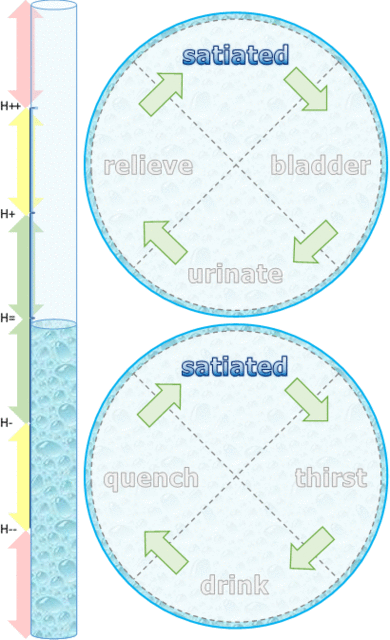
You feel discomfort when realizing your bladder is full.
You feel relief when relieving your bladder.
You feel thirsty when your body signals your fluid level has depleted below an optimal level.
You feel quenched after drinking enough water to restore that level.
Now apply this to an emotional need.
Sometimes you feel smothered in a crowd, and seek solitude.
You find relief when finding the free or personal space to be alone.
You suffer feelings of loneliness when completely isolated from others.
You enjoy closeness after befriending others who respond to you.
Sometimes a need only covers half of this cycle. Like when you hurt your hand. And find relief when your hand heals. There is no depletion in the sensation of touch.
Or when you desire self-expression and find pleasure when understood.
All of your needs spin through this cycle.
Painful reality of your unmet needs 3:41
Your every need exists as an objective fact. Every need of others also exists objectively. You can never change what they objectively require to function, so why try?
You cannot choose not to be thirsty, nor can they. Or to not be smothered. Or not to require support from caring others. You cannot refuse to require self-determination, nor can they. You cannot deny your innate necessity to remain secure, nor can they.
We can challenge what we do about such needs. And question how others address such needs, especially if negatively impacting our own. But it is utterly pointless to challenge the needs themselves. We cannot avoid the pain of suffered insecurity. Or evade the persisting desire of hindered self-determination. Not without addressing the objectively existing needs that prompts such pain or desire in us all.
Equal under the sun 4:34
No one’s needs are more important than the objectively existing needs in others. No one’s urgency to remove some painful threat or to fulfill some noble desire exists as more important than similar needs of others.
Anankelogy establishes how all core needs sit equal before nature, by demonstrating how resolving such needs empirically “improves” anyone’s capacity to function, to measurably improve their wellbeing. And how all unresolved needs “reduces” anyone’s capacity to function, in ways that measurably compromise their wellness. Equally applicable to everyone.
Need-response challenges the ethical quandary of obstructing other’s chance to resolve their inflexible needs. Especially those who then exploit any reduced wellness to serve their own interests—even if such interests appear noble on the surface. Such as offering pain relief without addressing the inflexible need prompting that pain.
Short-term pain relief may be essential to restore focus. But perpetual pain relief risks trapping you in persisting pain by ignoring the inflexible needs such pain exists to report. Opposing others considered the source of your pain also can trap you in more pain, by provoking them into defensiveness to guard their inflexible needs.
A better way 5:54
Instead of opposing each other’s objectively occurring needs, we could first affirm them in each other. Everyone requires security and self-determination, for example, and opposition to such objectively occurring needs predictably provokes mutual defensiveness, predictably prompts pushback—sometimes with violent force—and predictably always fails. Inflexible needs always refuse to “flex”, or change, to suit anyone’s resistance to their objective reality.
Affirm the needs, and only then can we effectively question how that affects our own needs. It’s better to honor the needs of others as one’s own than to provoke mutual defensiveness that predictably prevents resolution of such needs. Then traps you in the pain of our unmet needs, which risks distorting your thinking.
Instead of wasting precious resources preventing each other from resolving their inflexible needs—because we don’t like how they do it—it’s better to support one another to resolve their inflexible needs. And to mutually negotiate how to resolve such needs with minimal negative impacts on one another. It’s best not to try to hold each other down, but to encourage each other to excel and thrive by fully resolving each other’s inflexible needs.
You know, there’s a word for this radically different approach: ‘love’.


Comments