
.png)
quantifiable evil
- Steph Turner
- May 17
- 17 min read

Since needs and affected functionality exist as objective fact, we can now quantify evil
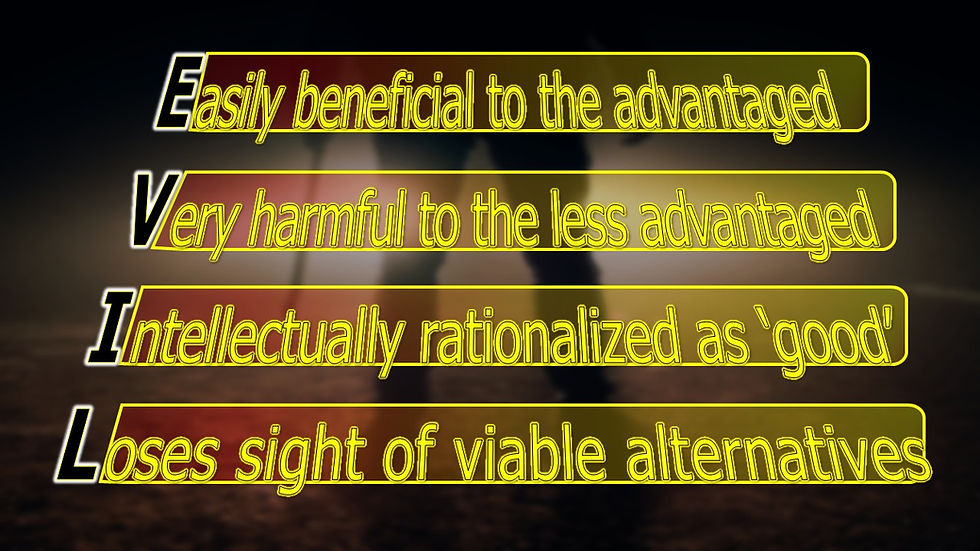
Anankelogy recognizes the objective fact of needs and level of functioning from how well such needs get resolved. As social science can separate these from subjective experience and from social and cultural norms, the very idea of evil can now be quantifiably measured.
Anankelogy stipulates such quantifiable evil include two necessary components:
Identifiable benefit(s) to the one committing the evil.
Identifiable harm(s) to oneself or to others.
Two more conditions may be necessary yet not sufficient:
Diminished awareness that the benefits exacts harm.
Viable alternative(s) to properly address the underlying needs.
Identifiable benefits(s)
Cui bono?
Who benefits? What specific gain does the powerholder receive?
Identifiable harm(s)
Harm runs the span from infringing upon one's wellbeing's full potential to the death of that person. Anankelogy recognizes a spectrum of wellbeing, or levels of functioning.
Harm occurs along a range from mild and reversible to severe and permanent damage. Quantifiable evil includes mild harm that pulls the impactee down into lower levels of functioning. That can be from peakfunction down to high level symfunction, or from mid or low level symfunction down into dysfunction.
What specific harm do you suffer from a powerholder?
Diminished awareness
Whatever can clear cognitive dissonance, or allow one to rationalize to themselves this gaining from others loss.
These also speak to the factors of toxic legalism. For example, overgeneralizing and avoidance diminish awareness of one's own impacts on others.
Biased assumptions
Powerholders can hold many inaccurate beliefs with little if any accountability, and then act upon them with damaging impacts upon the relatively powerless.
Privileged avoidance of what feels uncomfortable to face, along with normalizing overgeneralizations as the best option, can make these assumptions appear attractive. These contribute to the diminshed awareness of quantifiable evil.
Each of these task Gemini AI to critique the given assumption. Use any AI tool of your choice to unpack any assumption.
conflicts are a zero-sum outcome in which only one side can win
emotions bias our thinking (actually, desperate needs prioritize relief-seeking, conveyed in emotions, which then prioritizes our emotions and thinking)
empathizing with both sides of a debate is bothsidesism or false moral equivalency
mental health occurs primarily in one's mind and in one's chosen behaviors
morality is relative, so individuals must decide what is right and wrong on their own
people choose their political values from rational choice reasoning
people would lie, cheat and steal if it wasn't for law enforcement
political platforms will provide satisfying results for my life
the adversarial judicial system rarely convicts an innocent person
we must have law and order to keep our depraved natures in check
wellness can be achieved by relieving pain without trying to understand what prompted the pain
you can change someone's political stance with the right persuasive argument
Biased adversarial justice
When prosecutors select jurors during voir dire, do they exploit the naivete of prospective jurors who may accept any of these assumptions biasing the power of the state against the relatively powerless innocent defendant?
an innocent person would not confess to a crime that they did not do
defendants in the criminal judicial process typically get a fair trial
eyewitness identification provides reliable evidence of an identified person’s culpability
felons who maintain their innocence are in denial and trying to avoid the punishment they are due
forensic evidence like that shown in CSI shows provide compelling proof of a defendant’s guilt
physical evidence provided by state crime labs provides impartial evidence of a defendant’s guilt
police testifying at a trial against a criminal defendant provides a trustworthy testimonial
the United States has one of the best judicial systems in the world
Cognitive biases
This list of cognitive biases is from Wikipedia. The entry organizes its list “based on the task-based classification proposed by Dimara et al. (2020).” It organizes the list around these helpful sub-categories.
Association: a connection between different pieces of information
Baseline: comparing something to a perceived standard or starting point
Inertia: the reluctance to change something that is already in place
Outcome: how well something aligns with an expected or hoped-for result
Self-perspective: influenced by one's own personal point of view
Estimation
In estimation or judgement tasks, people are asked to assess the value of a quantity.
Association
Travis syndrome
Baseline
Interoceptive bias or hungry judge effect
Conservatism or regressive bias
Systematic bias
Unit bias
Inertia
Outcome
Exaggerated expectation
Hedonic recall bias
Self-perspective
Association
Dread aversion
Non-adaptive choice switching
Prevention bias
Baseline
Compromise effect
Phantom effect
Inertia
Doubling-back aversion
Outcome
Self-perspective
Hypothesis assessment
In hypothesis assessment, people determine whether a statement is true or false.
Association
Outcome
Causal attribution
In a causal attribution task, people are asked to explain the causes of behavior and events.
Outcome
Form function attribution bias
Self-perspective
Defensive attribution hypothesis
Experimenter's or expectation bias
Group attribution error (negativity effect)
Recall
In a recall or memory task, people are asked to recall or recognize previous material.
Association
Consistency bias
Cue-dependent forgetting context effect
Humor effect
Lag effect
Mood-congruent memory bias (state-dependent memory)
Persistence
The Perky effect
Positivity effect (Socioemotional selectivity theory)
Processing difficulty effect
Suffix effect (recency effect)
Tip of the tongue phenomenon
Verbatim effect
Baseline
List-length effect
Negativity bias or Negativity effect
Positivity effect
Inertia
Continued influence effect
Stereotype bias or stereotypical bias
Outcome
Self-perspective
Gender differences in eyewitness memory
Generation effect (Self-generation effect)
Placement bias
Opinion reporting
In an opinion reporting task, people answer questions regarding their beliefs or opinions on political, moral, or social issues.
Association
Moral credential effect
Inertia
Outcome
Misinterpreted-effort hypothesis
Self-perspective
Propaganda techniques
Identify if the powerholder uses any of these messaging techniques. And determine if the results effectively undermines your capacity to properly resolve needs.
Advertising
Assertion
Cherry picking (also called card-stacking)
Obfuscation, intentional vagueness, confusion
Stereotyping, name calling or labeling
Sources:
Loaded language
Identify if the powerholder uses any of these loaded terms. And determine if the results effectively undermine your capacity to properly resolve needs, trap you in pain, and hold down your wellbeing in ways that benefit them.
Alpha male: reduces human social dynamics into rigid, competitive hierarchies
Anchor baby: implies non-citizen parents use their children to secure legal status
Antisemite; antisemitism: when abusing IHRA working definition, conflating any critique of Zionism or of the Israeli government with loathing of Jews as an ethnicity
Bipolar: describing any unpredictable, moody, or irrational behavior
Clueless: pejoratively implies someone is inherently incapable of grasping reality
Colorblind: claiming to “not see race” to ignore systemic inequalities endured by People of Color
Crazy: “Crazy” we say out of hand when too lazy to fully understand
Crime: conflates violation of arbitrary statutes with objectively offensive behaviors; e.g., it is not a crime or illegal to overbill a patient into medical debt but it is illegal for the patient to refuse to pay
Criminality: suggesting someone is inherently lawless, overlooking social dynamics undermining their behavior choices in the moment; see justice
Crushed: ostensibly losing an argument; see destroyed
Debate: what is actually an argument without any intent of learning the truth
Democracy: despite the lack of actual “people power”
Destroyed: ostensibly losing an argument; see crushed
Dog whistle: when applied to any innuendo
Dummy: derogatory insult to question one’s intelligence or common sense; see idiot
Empower: assumes some have the power to give to others assumed powerless
Exotic: casts what is not familiar to own culture as suspiciously strange
Extremist: By who’s standard? William Lloyd Garrison was an extremist in his day for daring to oppose slavery.
Far-left: subjectively applied by those on the right to almost anyone on the left they dislike
Far-right: subjectively applied by those on the left to almost anyone on the right they dislike
Freedom fighter: asymmetric warrior one likes; otherwise disparaged as a terrorist.
Fresh: food label without date or time of preparation; see organic
Fundy: pejorative for fundamentalists
Gaslighting: buzzword to dismiss alternate perspectives
Gender confused: suggests the observer understands more about the trans experience than trans people themselves
Guilty: when subjectively asserted contrary to exculpatory evidence
Hamas: as a slur meaning terrorist.
Hero: subjective marker overlooking evidence to the contrary
Homeless: dehumanizing those without their own shelter, with assumptions of addiction and criminality
Idiot: derogatory insult to question one’s intelligence or common sense; see dummy, moron, or stupid
Illegal alien: undocumented immigrant, applied to inhabitants residing in an area prior to laws qualifying who is a citizen
Influencer: by what measure? monetizing an audience? coercing the vulnerable to sacrifice their dignity? persuading the naïve to oppose their own self-interests?
Insane: stripped from its original clinical meaning, it can mean whatever the speaker seeks to negatively or even positively convey
Islamist: weaponized in Western and Middle Eastern discourse to conflate mainstream political activism with violent extremism
Jerk: insult to reprimand others in a way that seeks to spark social condemnation
Jew hater: when applied to critics of the Israeli government or critics of Zionist actions; see antisemite
Justice: emphasizing personal responsibility while ignoring social injustices undermining capacity to remain prosocial; see criminality
Karen: privileged white women who appear insensitive to others
Lefty: to delegitimize liberal or progressive ideas by casting them as too radical for the majority of the population
Legal: when illicit activity gets protected under color of law
Liar: dismissing honest expression as unreliable without critical thinking
Libtard: pejorative from some conservatives dismissive of progressives
Loser: smearing someone or a group as worthy of social rejection
Mentally ill: reduces one’s clinically identifiable struggles to a medical diagnosis and its social stigma that assumes personal fault and neglects social context
Moron: derogatory insult to question one’s intelligence or common sense; see dummy, idiot or stupid
No offense, but: to evade inevitable critique when overgeneralizing a sensitive matter
OCD: misapplying Obsessive-Compulsive-Disorder to any habit
Organic: food label or other desirable items without processing information; see fresh
Panic attack: describing casual nervousness in ways that trivialize those suffering clinically defined panic attacks
Palestinian: as a euphemism for Muslim terrorist
Patriot: ideologically claiming the moral high ground of love of country while overlooking less attractive elements of parochial nationalism
Queer: demeaning LGBTQ+ people as abnormal, unnatural, or deviant
Race: ethnic differences when defined in biased terms favoring the majority white population
Radical left: weaponized label to characterize progressives as too similar to communists
Right-winger: weaponized label to characterize conservatives as authoritarian, as fascist, or too extreme
Safe space: when exaggerated into guarded settings that can stifle academic freedom and free speech
Sick: usage has morphed into various meanings for different contexts, from admiration to disgust
Smart Alec or smarty pants: dismissing an intelligent person as a know-it-all not to be taking seriously
Snowflake: denigrating others as `prone to melt under pressure, suggesting they are oversensitive, easily offended, and perhaps too entitled
Stupid: when applied to those overwhelmed with pain and consequently cannot think clearly
Terrorism: when applied to asymmetric warfare tactics that do not deliberately target noncombatants yet some get injured in the crossfire
Thug: applied mainly to Black men as something of an alternative to the N-word
Tone-deaf: regard one as insensitive to the needs of others, while risking adding stigma to the hearing impaired
Traumatized: when really meaning stressed, trivializing those suffering PTSD
Urban: coded racial euphemism for city dwellers of mostly Black and Brown backgrounds emphasizing poverty, crime, and systemic disadvantage
Victim: imposes the stigma of helplessness that others must empower; contrast with survivor
Voiceless: paternalistically giving voice to an ostensibly silenced population in ways that easily deny their agency
Whistleblower: used derogatively as if disloyal, a “rat”, or a disruptive troublemaker seeking attention, instead of courageously speaking truth to power
Woke: originally meant being aware of social injustices
Zionist: as an antisemitic dog whistle, conflating left-wing peace activism for Jewish self-determination to right-wing expansionist nationalism that risks negating self-determination of non-Jews
There are many more, including glittering generalities. See propaganda techniques above.
Sources:
Loaded Language in Media Guide
Gemini AI prompt: how the term tone [TERM] used as a loaded term
Defense mechanisms
Powerholders, along with those the powerholder impacts, can diminish awareness of unpleasant experiences with what Sigmund Freud identified as defense mechanisms. This material comes from 20 Defense Mechanisms We Use to Protect Ourselves along with some edits from other sources which are linked.
Does the powerholder manifest any of these defense mechanisms? Does any side use any of these defense mechanisms?
Acting out: Coping with stress by engaging in actions rather than acknowledging and bearing certain feelings. For example, instead of telling someone that you are angry with them, you might yell at them or throw something against the wall.
Aim inhibition: Accepting a modified form of their original goal. An example of this would be becoming a high school basketball coach rather than a professional athlete.
Altruism: Satisfying internal needs through helping others. For example, someone recovering from substance use might volunteer to help others in recovery as a way to deal with drug cravings.
Avoidance: Refusing to deal with or encounter unpleasant objects or situations. For example, rather than discuss a problem with someone, you might simply start avoiding them altogether so you don't have to deal with the issue.
Compensation: Overachieving in one area to compensate for failures in another. For example, someone who feels insecure academically might compensate by excelling in athletics.
Denial: probably one of the best-known defense mechanisms, is an outright refusal to admit or recognize that something has occurred or is currently occurring. It functions to protect the ego from things with which the person cannot cope and is often used to describe situations in which people seem unable to face reality or admit an obvious truth (e.g., "They're in denial").
Displacement: Have you ever had a really bad day at work, then gone home and taken out your frustration on family and friends? If you answered yes, you have experienced the ego defense mechanism of displacement. Displacement involves taking out our frustrations, feelings, and impulses on people or objects that are less threatening. Displaced aggression is a common example of this defense mechanism. Rather than express your anger in ways that could lead to negative consequences (like arguing with your boss), you instead express your anger toward a person or object that poses no threat (such as your spouse, children, or pets). NOTE: Powerholders are at high risk of displacing their angst onto vulnerable underlings.
Dissociation: Becoming separated or removed from your experience. When dealing with something stressful, for example, you might mentally and emotionally disengage yourself from the situation.
Fantasy: Avoiding reality by retreating to a safe place within your mind. When something in your life is causing anxiety, you might retreat to your inner world, where the cause of the stress cannot harm you.
Humor: Pointing out the funny or ironic aspects of a situation. An example of this might be cracking a joke in a stressful or traumatic situation.
Intellectualization: Reduces anxiety by viewing events in a cold, clinical way. This defense mechanism allows us to avoid thinking about the stressful, emotional aspect of the situation and instead focus only on the intellectual component. For example, a person who has just been diagnosed with a terminal illness might focus on learning everything about the disease in order to avoid distress and remain distant from the reality of the situation and their feelings about it.
Passive-aggression: Indirectly expressing anger. Instead of telling someone that you are upset, for example, you might give them the silent treatment.
Projection: A defense mechanism that involves attributing your own unacceptable qualities or feelings to others. For example, if you have a strong dislike for someone, you might instead believe that they do not like you. Projection allows the expression of desire or impulse in a way the ego cannot recognize, thereby reducing anxiety.
Rationalization: A defense mechanism that involves explaining an unacceptable behavior or feeling in a rational or logical manner, avoiding the true reasons for the behavior. For example, a person who is turned down for a date might rationalize the situation by saying they were not attracted to the other person anyway. A student might rationalize a poor exam score by blaming the instructor rather than admitting their own lack of preparation. Rationalization not only prevents anxiety, but it may also protect self-esteem and self-concept.
Reaction formation: Reduces anxiety by taking up the opposite feeling, impulse, or behavior. An example of reaction formation would be treating someone you strongly dislike in an excessively friendly manner in order to hide your true feelings. Why do people behave this way? According to Freud, they use reaction formation as a defense mechanism to hide their true feelings by behaving in the exact opposite way.
Regression: When confronted with stressful events, people sometimes abandon coping strategies and revert to earlier behavioral patterns. Anna Freud called this defense mechanism regression and suggested that people act out behaviors from the stage of psychosexual development in which they are fixated. For example, an individual fixated at an earlier developmental stage might cry or sulk upon hearing unpleasant news.
Repression: Acts to keep information out of conscious awareness. However, these memories don't just disappear; they continue to influence our behavior. For example, a person who has repressed memories of abuse suffered as a child may later have difficulty forming relationships.
Suppression: Sometimes you might repress information consciously by forcing it out of your awareness. This is known as suppression. In most cases, however, this removal of anxiety-provoking memories from awareness is believed to occur unconsciously.
Sublimation: A defense mechanism that allows us to act out unacceptable impulses by transforming them into more acceptable forms. For example, a person experiencing extreme anger might take up kickboxing to vent their frustration. Freud believed that sublimation is a sign of maturity and allows people to function normally in socially acceptable ways.
Undoing: Trying to make up for what you feel are inappropriate thoughts, feelings, or behaviors. For example, if you hurt someone's feelings, you might offer to do something nice for them to assuage your anxiety or guilt.
There can be more, but these serve as a solid start. Learn more from the article in Wikipedia and from googling list of ego defense mechanisms. Click here for 31 Psychological Defense Mechanisms Explained.
Logical fallacies
Does the powerholder manifest any of these logical fallacies? Does any side use any of these logical fallacies?
1. The A Priori Argument
2. Ableism
3. Actions have Consequences
4. The Ad Hominem Argument
5. The Affective Fallacy
6. Alphabet Soup
7. Alternative Truth
8. The Appeal to Closure
9. The Appeal to Heaven
10. The Appeal to Nature
11. The Appeal to Pity
12. The Appeal to Tradition
13. Appeasement
14. The Argument from Consequences
15. The Argument from Ignorance
16. The Argument from Incredulity
17. The Argument from Inertia
18. The Argument from Motives
19. Argumentum ad Baculum
20. Argumentum ad Mysteriam
21. Argumentum ex Silentio
22. Availability Bias
23. The Bandwagon Fallacy
24. The Big Brain/Little Brain Fallacy
25. The Big "But" Fallacy
26. The Big Lie Technique
27. Blind Loyalty
28. Blood is Thicker than Water
29. Brainwashing
30. Bribery
31. Calling "Cards"
32. Circular Reasoning
33. The Complex Question
34. Confirmation Bias
35. Cost Bias
36. Default Bias
37. Defensiveness
38. Deliberate Ignorance
39. Diminished Responsibility
40. Disciplinary Blinders
41. Dog-Whistle Politics
42. The "Draw Your Own Conclusion" Fallacy
43. The Dunning-Kruger Effect
44. "E" for Effort.
45. Either/Or Reasoning
46. Equivocation
47. The Eschatological Fallacy
48. Esoteric Knowledge
49. Essentializing
50. The Etymological Fallacy
51. The Excluded Middle
52. The "F-Bomb"
53. The False Analogy
54. Finish the Job
55. The Free Speech Fallacy
56. The Fundamental Attribution Error
57. Gaslighting
58. Guilt by Association
59. The Half Truth
60. Hero-Busting
61. Heroes All
62. Hoyle's Fallacy
63. I Wish I Had a Magic Wand
64. The Identity Fallacy
65. Infotainment
66. The Job's Comforter Fallacy
67. Just Do it
68. Just Plain Folks
69. The Law of Unintended Consequences
70. Lying with Statistics
71. Magical Thinking
72. Mala Fides
73. Measurability
74. Mind-reading
75. Moral Licensing
76. Moral Superiority
77. Mortification
78. Moving the Goalposts
79. MYOB
80. Name-Calling
81. The Narrative Fallacy
82. The NIMBY Fallacy
83. No Discussion
84. Non-recognition
85. The Non Sequitur
86. Nothing New Under the Sun
87. Olfactory Rhetoric
88. Oops!
89. Othering
90. Overexplanation
91. Overgeneralization
92. The Paralysis of Analysis
93. The Passive Voice Fallacy
94. Paternalism
95. Personalizaion
96. The Plain Truth Fallacy
97. Plausible Deniability
98. Playing on Emotion
99. Political Correctness
100. The Pollyanna Principle
101. The Positive Thinking Fallacy
102. The Post Hoc Argument
103. The Pout
104. The Procrustean
105. Prosopology
106. The Red Herring
107. Reductio ad Hitlerum
108. Reductionism
109. Reifying
110. The Romantic Rebel
111. The "Save the Children" Fallacy
112. Scapegoating
113. Scare Tactics
114. "Scoring"
115. The Scripted Message
116. Sending the Wrong Message
117. Shifting the Burden of Proof
118. The Shopping Hungry Fallacy
119. The Silent Majority Fallacy
120. The Simpleton's Fallacy
121. The Slippery Slope
122. The Snow Job
123. The Soldiers' Honor Fallacy
124. The Standard Version Fallacy
125. Star Power
126. The Straw Man
127. The Taboo
128. They're All Crooks
129. The "Third Person Effect"
130. The "Thousand Flowers" Fallacy
131. Throwing Good Money After Bad
132. TINA
133. Tone Policing
134. Transfer
135. Trust your Gut
136. Tu Quoque
137. Two-sides Fallacy
138. Two Truths
139. Venting
140. Venue
141. We Have to Do Something:
142. Where there’s Smoke, there’s Fire
143. The Wisdom of the Crowd
144. The Worst-Case Fallacy
145. The Worst Negates the Bad
146. Zero Tolerance
Sources:
Viable alternative(s)
What viable alternatives does the powerholder appear to neglect? Need-response offers some better solutions.
Exaction invoice
Earned legitimacy


Comments