
.png)
3 epistemic reliance levels
- Steph Turner
- Apr 7
- 12 min read

Updated: Jun 14
Are you more of a "truster" or "faither" or "beliefer"? What do these even mean?
TLDR Summary
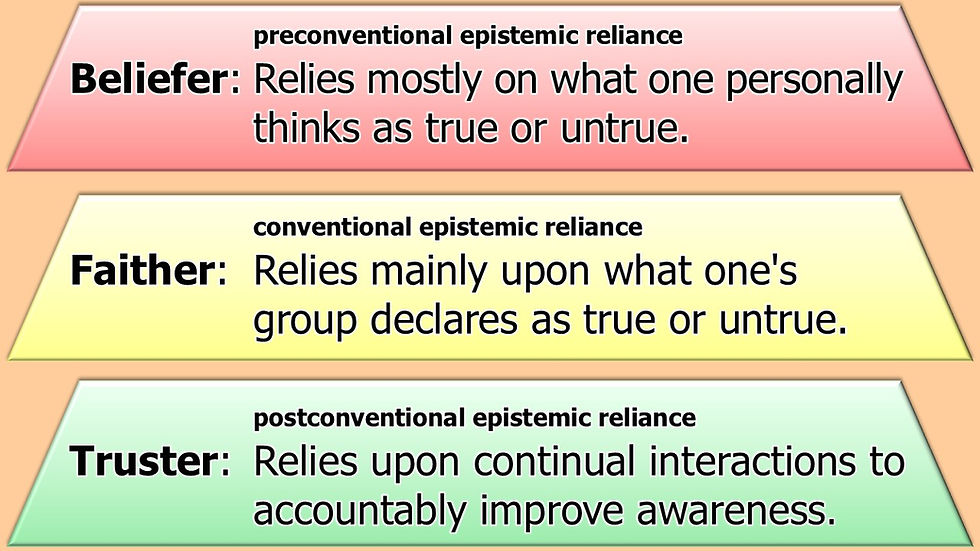
Individual belief: Rely upon what one personally thinks as true or not true.
Organized faith: Rely upon what one's group declares as true or untrue.
Dynamic trust: Rely upon continual interactions to accountably improve awareness.
beliefer | faither | truster | |
FOCUS | guard self, avoid pain, relieve pain | address what group declares as important | properly resolve needs, reach full potential |
FEATURES | low to no engagement | socially approved engagement | high engagement |
CERTAINTY | low tolerance of ambiguity, craves certainty | tolerance by consensus, prefers shared certainty | high tolerance of ambiguity, embraces discovery |
MATURITY | low maturity, not at full functioning capacity | modest maturity, reach more of one's capacity | high maturity, reaching much of full capacity |
CONTENTS
Different realms in epistemic reliance
Anankelogy, the discipline study of need, recognizes how not all “believing” or epistemic reliance is the same. Dependence on whatever one finds true or untrue mirrors the three levels of moral development.
Consider Kohlberg’s three main levels of moral development.
Preconventional. Moral reasoning relies on avoidance of punishment and seeking rewards. It tends to be egocentric.
Conventional. Moral reasoning relies on social norms, as agreed upon by the collective of one’s social universe. It tends toward social conformity.
Postconventional. Moral reasoning relies on universal principles that can transcend individuals and cultures. It tends to lead toward human flourishing.
These reliance levels, or "reliability taxonomy", mirror Kohlberg’s three levels.
Beliefing. Guarding what one thinks as true or untrue, and typically defensive toward any challenge of such views. It too tends to be egocentric. “Beliefer”. Those who defensively guard what they hold as true, while avoiding relating to details that could disconfirm their conclusions. Trusts generalizations as an end.
Faithing. Accept as true or untrue based largely on social cues, such as what one’s group accepts as true and untrue. Also tends toward social conformity. “Faither”. Those who hold as true and dependable what others in their tribe or social circles also hold as true and dependable. Shares generalizations as an end.
Trusting. Vulnerably relying on the most dependable over which one has no control, such as a Supreme Being, while ready to question whatever can be found as not fully dependable. It likewise points toward human flourishing. “Truster”. Those who humbly rely upon what they encounter as more trustworthy, while exposing what they think is temporally true to helpful critique and correction. Besides universal principles, uses generalizations as a starting point to explore further.
These levels also mirror the levels of functionality.
Trusters tend to sustain peakfunctionality, as they cultivate ways to relate to others and themselves in ways that enable them to promptly resolve their needs.
Faithers gravitate into symfunctionality, as they primarily ease their needs according to the accepted social norms guiding their understanding and behavior.
Beliefers risk descending into dysfunctionality. as they cope with pain from unresolved needs, and cling to oversimplified conclusions that work against resolving needs.
Anankelogy unpacks how we rely on others, or how we have confidence in what we think as true or untrue, in different areas of our lives.

Different realms in epistemic reliance

These apply in different realms. One could be a truster in their role as a spiritual leader in a faith tradition. Then be a faither in their political ideology, going along with other partisans. While being an adamant beliefer in the criminal judicial system, avoiding its disconcerting imperfections.
It's more likely, perhaps, that one would gravitate to just one of these three levels in all realms in their life. The more mature with wisdom would gravitate toward being a truster. The less mature and unwise would slide toward being a beliefer.
These three epistemic reliance levels mirror Lawrence Kohlberg's levels of moral development.

FOCUS. The beliefer tends to focus mostly upon the self. A list of unresolved needs prompts so much emotional pain that they tend to become self-absorbed.
For example, the alcoholic (or shopaholic, drug addict, sex addict) typically cling to their beliefs that offer the quickest relief. Which can be far from the actual truth.
FEATURES. The beliefer defensively guards what they think is true or untrue, actively resisting critique,
For example, when pseudoscience aficionados denounce any helpful critique. As they identify with their ungrounded beliefs, any critique feels like a personal attack on them.
CERTAINTY. The beliefer typically demonstrates a low tolerance for ambiguity. Their high level of emotional pain, from unresolved needs, prompts them to crave certainty.
For example, an extremist political activist feels their ideological views must be right. They simply cannot afford any room to doubt their political convictions or biases.
MATURITY. A beliefer is likely dysfunctional. They typically prioritize relieving the pain of their many unmet needs. Which hinders their personal development.
For example, the self-righteous partisan depends on their underdeveloped view of the world. Dissenters fit neatly into their overgeneralized category as the "bad" people.
FOCUS. The faither tends to focus more upon the social realm. What they rely upon as true is best confirmed by others in their social groups.
For example, the devoted partisan of any political party finds assurance when others of similar views affirm their beliefs. This can be a good thing, when fellow partisans they trust have carefully examined their views. But can also be a case of the blind leading the blind.
FEATURES. The faither gravitates towards what others in their group find reliable. They often evade critique from others outside of their group. Groupthink abounds.
For example, the guilt-ridden churchgoer assumes we all fail at times to make responsible moral choices. Then regards as too liberal to admit the times we can be stuck with poor quality options. Which pulls us into symfunctionality.
CERTAINTY. The faither craves shared certainty over putting up with any ambiguity. Some uncertainty can be endured when shared with others in their groups. Otherwise, any doubt feels like a sin.
For example, litigants in a court battle may cling to what they find familiar, as they both sink into mutual defensiveness. Which limits their scope. The less aware in their legalist myopia, the further they slide uncontrollably into the abyss of symfunction capture.
MATURITY. A faither is primarily symfunctional. They tend to prioritize easing their needs in ways that never fully resolve such needs.
For example, ethnocentric club members who oppose outsiders grow accustomed to never fully resolving their needs. And likely blame their emotional pain on outsiders.
FOCUS. The truster tends to focus primarily upon deeper unity. What they hold as true points to universal principles unshakable in any circumstance.
For example, the deeply spiritual person relies more on principles like humility, empathy, grace and love. They intuitively realize how applying such principles will almost always result in more resolved needs, more wellness and less pain.
FEATURES. The truster humbly relies on trustworthy others. They invite their helpful critique. They know the limits imposed by their own biases. They remain open to learning.
For example, the effective investigator relies on tools to check their biases, and their untested assumptions. They will be slow to act on beliefs they have little to no evidence to support.
CERTAINTY. The truster demonstrates high tolerance for ambiguity. They promptly embrace pain to identify what threat prompts such a painful warning. Then they remove the threat, or themselves, which faithfully removes such pain.
For example, the martial artist flows through space like water. They quickly note the movement of others. They rapidly move through the air with sharpened intent. Contact with a foe bounces of a deeper reality. They move toward their pain and embrace it. They face any discomfort honestly, and let it go. Pain is not a foe but a fleeting gift.
MATURITY. A truster may reach peakfunctionality. They will prioritize properly resolving needs. Which enables them to promptly restore wellbeing and remove pain. Not only for themselves, but potentially also for others.
For example, a spiritual guru regards the needs of others as equally important if not more so than their own. They shape their life to avoid negatively impacting others. They encourage and even inspire all to reach more of their full potential.

Beliefers rarely engage, and instead often barricade themselves inside a cocoon of presumed safety.
Faithers rarely engage on a personal level, preferring to follow group leaders who do the risky engaging first.
Trusters more openly engage, and risk the unknown, as they endure the discomfort for the likely reward of spiritual growth.
Beliefers crave certainty. They present a low tolerance for ambiguity.
Faithers share uncertainty. They present a low to high tolerance of ambiguity.
Trusters embrace uncertainty. They present a high tolerance for ambiguity.
Like Socrates, they are judiciously agnostic to remain open to learning. Trusters welcome disconfirming information. They welcome the discipline of not acting on their own unchecked biases.
Beliefer - nothing else matters to consider; haughtiness, ambiguity intolerance, avoid exposing vulnerabilities.
Faither- other matters to consider but can't be relevant; impression managed humble front, certainty with group, myth following.
Truster - other matters to consider that could be relevant; humility, grace, honesty.
Beliefers prioritize the self.
"My needs matter more than your needs."
"My wellbeing matters more than your wellbeing."
"My beliefs and feelings matters for than your beliefs and feelings."
Faithers prioritize the group.
"Our needs matter more than their needs."
"Our wellbeing matters more than their wellbeing."
"Our beliefs and feelings matters for than their beliefs and feelings."
Trusters prioritize all humanity equally.
"No one's needs matter more than anyone else's needs."
"No one's wellbeing matters more than anyone else's wellbeing."
"No one's beliefs and feelings matter more than anyone else's beliefs and feelings."

Beliefers can recall a deep spiritual experience they once had, but tend to credit it to their beliefs (what they hold as true or not). They may have actually experienced a moment of vulnerable trust they found rewarding, but misinterpret the degree of their own agency.
For example, a neophyte Christian verbally credits their "born again" experience to citing the sinner's prayer to God, or to Jesus, and regards their choice of words and parochial attitude as playing a significant or central role in their conversion experience.
Such beliefers gravitate toward dogmatic views. For them, things must be a certain way in order to get back to that rewarding experience. Right and wrong are categorized into simple terms. Nuance can be seen as risking appeasement, or slipping into illicit compromises.
For example, that new Christian may guard traditional gender norms as absolute in order to remain in the good graces of a wrathful God. To socially mingle with others who defy such norms risks watering down God's "truth" and then backsliding.
Such beliefers may cling to their religiosity and reasoning skills to cope with the mounting pain of their unresolved needs. They tend to prefer familiar pain over the unknown pain of challenging spiritual growth.
For example, the young Christian interprets salvation as a way to escape intensifying emotional pain. Instead of recognizing how such pain warns of unmet needs, they become viscerally attached to the familiarity of how they handle these painful emotions.
Faithers interpret their spiritual experiences through the lens of similar others and group consensus. Fluid spiritual experiences readily congeal into religious dogma.
For example, a recent convert looks to earlier converts to get some bearing. They may dismiss their skepticism as not knowing enough yet to assess the group's views. The more satisfied with the group while seeking belonging, the less they assert their individuality. Critical thinking can take a back step to save room for group cohesion.
Some faithers rise to a role of lay leader or even a top position such as a head pastor, priest, iman, or rabbi, and (knowingly or unknowingly) exploit the beliefers in their midst. Often from a "democratic" mindset of attracting followers by appealing to lowest common denominator instincts.
For example, an imam tries to inspire the faithful to fully appreciate tawheed in their spiritual lives, but many take this oneness of God as a shared cognitive belief and miss vulnerably relying upon God alone for what they specifically need right now.
Many faithers gravitate toward sharing a consensus of what matters most to them. They champion the conventional norms of their faith tradition, while not sure what to do with the more unconventional practices or principles espoused in their scriptures or traditions.
For example, as the adherent of a cult identifies more with its dogma, they may rely on the group's support in opposing those outside the group with contrary views. They feel special in a way they likely never felt before.
Faithers who remain socially and intimately connected to trusters can evidence more cognitive and spiritual maturity than faithers tapped only into other faithers. Crowdsourced wisdom works best when fueled with a source of accountable wisdom, and not left to the devices of groupthink.
For example, a priest at a local parish may provide needed perspective to those new to the faith. He may inspire his flock to empathize with non-Catholics. To not judge others, and to maintain the wisdom of learning from others in humility.
Trusters entertain the possibility that much of what they assumed as true is not so true. Not that they swing to the opposite extreme of assuming it all must be false, but to stay open to exploring nuanced details previously overlooked.
For example, the maturing Daoist lives the opening verse of the Tao Te Ching, "The Way that can be described is not the eternal Way". They stay open to improving their awareness. Not for the sake of mere knowledge, but to tap into the fullness of life.
Trusters rely less on things, like doctrines, and focus more on the innate value of people. They recognize, at least intuitively, that all beliefs include errors. They don't value their views as much as they value people, to stay open to learning what's most relevant in life. They demonstrate the supremacy of love, of honoring the needs of others as one's own.
For example, the evangelical missionary shares the love she experienced with her trust in God. If that requires her to drop her familiar messaging norms to adopt local cultural tropes, then so be it. The connection means more than insisting on cultural familiarity.
Such trusters tend to be interspiritual. They typically remain independent of any single faith tradition, as they draw from all spiritual wisdom. They may be misinterpreted by faithers as people-pleasing chameleons. Thy prioritize deep connection over social cohesion.
For example, an imam can tap into the Jewish wisdom of "wrestling with God" to find deeper truths, while applying Buddhist teachings about the Middle Way, then capture a Christian understanding of personal sacrifice for others. All while remaining true to the core tenants of Islam.
Spiritually mature trusters respond more than react to challenges in life. They turn such challenges into opportunities for growth, for maturity, and for creating shared value.
For example, an interspiritual Sikh can absorb the harsh judgments from a beliefer Hindu while also not reacting to an inconsiderate faither Muslim. They will look for some way to identify and relate to their inflexible needs. They will bee sure not to add to their problems. They will try to turn the challenge into opportunity for shared development.

Love remains the ideal of honoring the needs of others as one's own.

Beliefers are often too self-absorbed to positively regard the needs of others. Many beliefers improperly or properly relieve the pain of their many unmet needs. They slip into dysfunction.
Faithers gravitate toward social conformity. Hence, many faithers improperly or properly ease their needs without fully resolving them. Which pulls them in a state of symfunctionality.
Trusters are in a better position to properly resolve needs. The more their own needs fully resolve, the easier to regard the needs of others. They reach moments of peakfunctionality.
REACT or RESPOND
Now visualize a continuum of beliefers who primarily REACT to the pain of unmet needs to trusters who effectively RESPOND and resolve needs to remove the pain.
Beliefers and many faithers can be characterized as REACTIVISTS. They habitually give kneejerk reactions to problems. They tend to overgeneralize their situations, avoid any discomfort, as they gravitate toward indulgent side-taking.
For example, reactivists use labels like terrorist or militant without context of asymmetrical blowback or negatively impacted inflexible needs. They're beliefers or maybe faithers. They easily drift into warmongering that feeds the military industrial complex. They champion the path to hostilities and mutual defensiveness, easily sinking into hate and war. Pain begets more pain.
Trusters and some faithers can be characterized as RESPONSIVISTS. They routinely respond thoughtfully to the needs around them, without imposing their own. They see the relevant nuance in situations, embrace any discomfort that warns of threats, as they step beyond self-serving adversarialism to mutually understand and respect each other's needs.
For example, responsivists recognize the urgency of the affected needs of so-called terrorists or militants, while ready to challenge or condemn the reactive violence that spring from desperately trying to redress such needs with force. They're trusters. They support all affected to return to thriving, to human flourishing, where any use of force is limited and a last resort. They champion the path to meaningful peace and love.
Grace exists as that universal principle of meeting you where you’re honestly at. If you honestly fit these less than laudable descriptions of a beliefer or a faither, then you need not be shamed for it.
Life has put you in a dreadful spot where your options to fully resolve needs often gets limited. As a natural consequence, you cannot function to your full potential.
In other words, you must resort what you find available. You prefer to take table crumbs than nothing at all.
If painfully isolated from others, you understandably gravitate toward relying on what you can individually think as true or not. If surrounded by similar others whose view resonate with your experiences, then you understandably rely on what your group holds as true.
If you rely upon continual engagement of what you can perceive, and welcome accountability for what you think is true or untrue, then you might feel quite different from most of those around you. “Wide is the gate” for beliefers and faithers.
With anankelogy recognizing the object fact of natural needs, we can do better to understand each other. To appreciate where each other is at, with grace. And then to love others by honoring their needs as our own—even if they do not reciprocate.
Awareness of being valued for who you honestly are is worth far more than mere knowledge about things. Let this wisdom inspire you to be loved and give more love. We all need love.
Belief: Rely upon what one personally thinks as true or not true. Prone to much error, which easily prompts more emotional pain.
Faith: Rely upon what one's group declares as true or untrue. Vulnerable to groupthink, which can steer them toward quiet desperation.
Trust: Rely upon continual interactions to accountably improve awareness. Risks indecision if not cultivated wisely.

Comments