
.png)
Trans = spiritually compelled gender holism
- Steph Turner
- Mar 30
- 26 min read

Updated: Mar 31
Nature insists on filling a void. Including the many voids within ourselves. And those voids between others and oneself, prompting intimacy. Gender serves as a key dynamic nature uses to compel us toward balance.

Which do you generally find most agreeable?
Gender differences are all socially constructed.
OR
Gender differences are created by God.
OR
Gender organizes our outward and inward attention to attend to our needs.
When I came out as trans in the early 1990s, there were still lively discussions about the cause or etiology of transgenderism. What would make someone born in one gender to seek to be the other gender?
One idea arose suggesting this could be a gift. Instead of feeling ashamed for not fitting into gender norms, perhaps nature or even God compelled the trans person to move beyond stifling gender norms. That the trans phenomenon was nature's way of filling a void.
That idea was swatted down. It seemed to assert trans people are special, when many on the right were complaining how LGBTQ+ people wanted special rights. Other trans folks keep this notion alive, but the dominant narrative emerged that the reason for feeling compelled to transcend one's birth ascribed gender was because of having a different gender identity.
I went along with the ride, for survival. But it never fit me fully. You see, at the same time, I was also embracing my indigenous heritage and "Native American" spirituality. Interpreted words did not matter as much as the power of nature to resolve needs.
Spirituality as a force of nature
For a moment, I flirted with the idea of identifying myself as two-spirit. But that did not fit either. Instead, I now see myself as a "transspirit": spiritually compelled to transcend stifling norms in order to connect more deeply with life's full potential. This covers not only gender norms but any socially constructed norm congealing into barriers to fully resolving needs.
It could be characterized as interspiritual, transcending religious beliefs that compromise full spiritual connection. Yes, think of being trans as spiritual. Wherever social norms impede full spiritual growth, nature compels some to transcend those barriers. Gender perhaps is simply the most salient aspect of this phenomenon.
Gender organizes aspects we regard as more masculine or more feminine. Gender differences begin around a seed of natural complementary distinctions. The less mature we become, those subtle differences can solidify into rigid barriers to mature spiritual growth.
Gender balancing act
Think of the trans experience as countering this imposing solidification of gender norms, and then returning us to reach more of our full potential. What starts with gender drives much deeper into the full spectrum of life.
Let's look at a series of complementary gender traits and how they can slip into conflicting extremes. Then see how the trans thing spiritually compels balance to optimize both gender-associated traits. (Click the 'GO' after each listed pairing to dive deeper.)
Balancing masculine rationality with feminine emotionality [ GO)]
Balancing masculine objectivity with feminine subjectivity [ GO )
Balancing masculine protection with feminine nurturance [ GO )
Balancing masculine independence with feminine dependence [ GO )
Balancing masculine competition with feminine cooperation [ GO )
Balancing masculine aggression with feminine passivity [ GO )
Balancing masculine decisiveness with feminine reflectiveness [ GO )
Balancing masculine forcefulness with feminine gracefulness [ GO )
Let's dive into each of these. First, a word about this spiritual dimension. And how spirituaility serves our needs to fully function.
Spiritually compelled balance involves gender-associated traits
Almost every need involves an inward focus and an outward focus. Your need or water, for example, prompts you to find a source of water outside of yourself, to draw into yourself this natural resource to restore your body's fluid and temperature equilibrium.

This lateral inward-outward dimension intersects with a vertical dimension. You're either need-responsive and find water to fully resolve your thirst, or you're feel-reactive when gulping down a sweet drink to placate but not fully satisfy your bodily need for water.
Gender generally organizes these internal and external components of our experiences.
Masculinity generally covers the external or outward emphasis.
Femininity generally covers the internal or inward emphasis.
And both applies to all. We all experience both sets of these gender-organized qualities.

The more your outward and inward foci can blend, the generally more responsive you can be to the needs you encounter—both yours and other's. The more you can properly resolve needs, the more you draw closer to human flourishing.
When focusing more on inward than outward, or more on outward than inward, you cannot adequately address your needs. The less your needs resolve, the less you can function and the more you suffer pain.
You become prone to vacillate between extremes. You become more feel-reactive than need-responsive. You slip into disconnection. Into mounting pain. Into a debilitating void.
Nature seeks to fill the resulting void. Nature propels you toward balance, whether you agree to go along for the right or resist such compulsive balancing with all your might. This compelled integration of these gender-ascribed internal and external directions can be understood as spiritual, as compelling a deeper connection with human potential.
Spirituality as a force of nature
Anankelogy defines "spiritual" as relating to almost all that exists outside of oneself as connected in some need-impacting way with almost all that exists within oneself. Various thinkers, theologians and faith leaders likely use a more expansive definition, or simpler one. But anankelogy must keep its use of spirituality to what can be empirically measured.
While ostensibly subjective, this disciplined understanding of the objective fact of needs utilizes the tools of social science to isolate the more objective components of such phenomenon. For example, a scale to self-report one's degree of experiencing themselves connected "with the universe" could be correlated with their level of resolving such inflexible needs as:
"having a sense of purpose in life",
"finding meaning in suffering", and
"actualizing love as encountering the needs of others as vital as one's own".
Anankelogy recognizes nature as a powerful force compelling us to redress such needs. Once evoked, you tend to address your needs within a pattern of gender-ascribed traits. Of your outward and inward attention. These traits either complement or compete, depending how balanced or imbalanced you experience them.
Gender holism as a balancing act
Nature pulls us with the emotional power of desire and pain to reach more of our full potential for comprehensive wellness. Which anankelogy labels as peakfunctionality.
Many inward psychological and outward sociological factors emerge during life to prevent us from sustaining a peakfunctional level. Between social barriers to essential resources and personal habits that neglect resources, we slip into what anankelogy calls symfunctionality. We slide into a lower level of wellness. Accompanied by mounting pain.
Too many of us get trapped in what anankelogy calls symfunction capture, which tends to pull us into comforting generalizations. When entertained, these generalities pull us into contrasting extremes.
Vacillating between opposing extremes
To cope with the never-ending despair, we vacillate between extremes. We gravitate toward the myth that relief can be gained at the other side's expense. Which guarantees we remain imprisoned in pain.

Balancing complementary sides
Transspirituality melts those barriers to essential resources. With the power of love, which honors the needs of others as our own. Emotional desire to satisfy own wants evolves into desire to see what's best for each other.
Where an excessive inward focus for self-interest compromised wellbeing, a complementary outward focus on what others need brings some needed balance. Same with any other gender ascribed trait slipping into clashing sides. Transspirituality insists a balance of both inward and outward foci. Slowly at first.
Oscillating toward a balanced center
Transspirituality compels balancing these complementary gender traits, to reach more of our potential wellness. An inward focus moves toward an outward focus, to experience more of the rich depths that life has to offer.
Frustrations gives way to clarity. Despair melts into joy. Meaningless dissolves into purpose. As wellness improves, pain fades as the threats to wellness slip way. Wholeness can be glimpsed right around the corner.
Encountering the holistic center
Transspirituality compels wellness, by prioritizing properly resolving needs. Which includes balancing inward and outward foci on access essential resources to resolve needs.
Such spiritual compulsion comes with a profound sense of oneness with the whole universe. Whatever I do to another, I intuitively recognize, I ultimately do to myself. The more I love them for who they authentically are, the more I love myself for who I authentically am.
Resistance from the conventional minded
For those trapped experiencing these gender traits as contradictory, and only encountered during moments of sex, this transcendence of gender norms feels strange. And viscerally unacceptable.
Reactive norm enforcers target two kinds of people. Those who violate the law for selfish gain and those who transcend the law for universal gain.

I am of the latter. (click the arrow at the left to find how.)
I am spiritually compelled to properly resolve needs ahead of considerations of law. Needs exist as objective fact, inflexible to law. Laws exist largely as social facts, flexible to the reality of inflexible needs.
In 1993, while coming out as transgender to Janet, my trans sibling, a young lesbian took curious interest in Janet. If only she could be as boldly open as Janet.
When caught not being home on time by her apparently homophobic mother, this young lesbian fabricated a story of being abducted and assaulted. It would show she was not there on her own accord, although she was.
I fully understand her urgency not to be outed as a lesbian to her homophobic parents. I can see how she twisted her parents' homophobia toward her favor. Her claim of being assaulted fed into popular transphobic tropes of the time, especially the one casting LGBTQ aduls as child recruiting predators.
Learn more about transphobic tropes...
Transphobic tropes are recurring, harmful narratives in media and culture that vilify or mock transgender people. Common tropes include framing trans individuals as deceptive predators, focusing solely on tragic narratives, using cross-dressing for comedy, presenting transition as a joke, or portraying trans characters as mentally ill or violent. www.geekmelange.com +4
Common Transphobic Tropes and Narratives:
The Deceptive Subject: Trans people are portrayed as engaging in "dishonesty" or fraud, usually involving a hidden, sexualized reveal meant to disgust or humiliate others.
The Dangerous/Psycho Villain: Popularized by movies like Silence of the Lambs and Psycho, this trope links trans identity with extreme violence, insanity, and murderous intent, often confusing cross-dressing or, in these cases, misogynistic pathology with being transgender.
The Tragic Victim/Tragic Existences: Trans characters are frequently killed off, victims of violent crime, or depicted as having no option but a miserable life, reducing their existence to trauma.
The "Tr*nny" or "Shocked Reaction" Trope: Comedy or drama that uses the existence of a trans person as the punchline, or focuses on the violent, horrified, or vomit-inducing reaction of a cisgender person finding out someone is trans.
"Born in the Wrong Body" Narrative: A limiting trope that suggests all trans people hate their bodies and that transitioning is only about fixing a "broken" body rather than social, legal, or other personal aspects of identity.
The "Predator in Restrooms" Fearmongering: A political trope often referred to as the "trans agenda," which baselessly positions trans people as threats to children or women, particularly in bathrooms, say GLAAD reports.
Mockery of Pronouns/Appearance: Focusing entirely on whether a trans person "passes" or intentionally using incorrect pronouns and names (deadnaming).
Trans People Are Mentally Ill: Characterizing being transgender as merely a mental illness, delusion, or "trend," rather than a valid identity.
"They are Indoctrinating Children": Suggesting that trans visibility is a "coordinated effort" to harm children or influence them, according to GLAAD reports.
These tropes, as discussed by organizations like GLAAD and TransActual, serve to dehumanize, reinforce transphobia, and justify discrimination. GLAAD +2
Ractive norm enforcers then punished me under the guise that I violated the law for selfish sexual gain. This fed their confirmation bias, to not consider alternatives. If a prosecutor can indict a ham sandwich, and no corroborating evidence is necessary for convicting sexual misconduct, this was a slam dunk.
Any law official failing to identify and address the needs involved risks losing legitimacy.
To these defenders of conventionality, life is full of zero-sum games. In any conflict, one must take a side. You're either a winner or a loser to the latest battle.
They will more likely seek to
relieve pain
than
remove cause for pain
when they do not seek to resolve the underlying needs prompting the pain. Their limited perspective denies them the wisdom to appreciate these balancing dynamics between complementary gender traits.

Transgender as compelled gender balance
Think of the transgender phenomenon as nature filling the void that occurs when slipping into contradictory gender sides. Wherever the masculine trait is dominant, the feminine trait tends to get neglected. Wherever the feminine trait is dominant, the masculine trait tends to get neglected.
Imbalance emerges and often gets normalized. We cannot reach our full human potential without integrating our masculine and feminine qualities. By letting one side dominate to the neglect of the other, we fit neatly into social norms as "men" and as "women" so we can adequately function with each other. Being cisgender is largely "symfunctional".
REACT - masculine trait OR feminine trait as dominant - symfunctionality (Sf)
The cisgender typically experience sexual attraction to someone of the opposite gender as the key path toward gender trait balance. They remain dependent on the other person to complement their own one-sided gender trait. This is the traditional gender norm.
If failing to complement each other, they risk sliding into gendered extremes. Where the masculine trait allows no room for feminine potential, or where the feminine trait excludes space for masculine potential, wellbeing can collapse into dysfunction.
OVERREACT - masculine trait OR feminine trait as exclusive - dysfunctionality (Df)
As this symfunction or dysfunction of conflicting gendered sides gets culturally normalized, wellbeing typically declines. Such cisgender may cling to the cultural familiarity of clashing gender sides, further trapping them in dysfunction.
Ironically for the transphobic, less is somehow more. To be absent of the opposite gender trait means they can be more of a normal person. This tends to correlate with increased sexual energy to compel them toward gender balance. Which some project onto the trans person they do not adequately understand.
RESPOND - masculine trait & feminine trait integrated together - peakfunctionality (Pf)
Nature compels the transperson to transcend such arbitrary barriers to full potential, by internally integrating these complementary gender traits. They can independently reach more of their full potential without waiting for another person to "complete" them. Embracing both gender sides can become an exhilarating experience of profound oneness.
Such a trans person may be initially compelled by sexual energy, much as the cisgender. But after taking responsibility for this initial sexual pull toward intrinsic gender fullness, they promptly experience a deep sense of peace. Of oneness. Of deep connection.
The more the trans person integrates their gender sides into a holistic oneness, the role of sexual energy to compel this union naturally subsides. Cisgender observing this from the familiarity of their own gender disunity may project their own sexualized experience, and misinterpret the trans experience is some kind of sexual expression.
Trans are not motivated by sexual desire to "crossdress" as commonly assumed by many cisgender. Rather, the trans person yearns for this peace which they find when integrating both gender traits, toward human peakfunction potential. To resolve more needs to reach greater wellbeing and remove more pain.
Let's apply this to a dozen gender pairings.
1. Balancing masculine rationality with feminine emotionality
Do you see yourself championing rationality to keep your emotional impulses at bay? Or do you experience yourself as emotionally intelligent, who's wisely in touch with your own feelings?

REACT - Sf: rational OR emotional
Outward looking rationality sits in tension with inward looking emotionality. Some situations call for more of one than the other. In novel situations, you best stop and reflect before you act. In familiar situations, you can reliably trust your gut feelings.
OVERREACT - Df: unemotional OR irrational
Whether through lazy thinking, slipping into poor habits, or cut off from what you need, we sometimes overcompensate. We react to cold unemotionality with irrational outbursts. Then squash such irrationality with blunt suppression of our emotions.
We go to extreme of either repressing our emotions or acting on our emotions irrationally. And then miss our life's full potential.
RESPOND - Pf: reasonable & intuitive
The more these complementary traits split into contrasting sides, with mounting tension, the more nature steps in somewhere to fill the void. Transspirituality blends being reasonable and being intuitive toward greater wholeness and sustainable wellness.
Click here to dive deeper into this pairing
It's good to hold onto being reasonable and not let go of being intuitive. For the one who integrates both can resolve far more needs, remove more pain, and reach more of life's potential.
2. Balancing masculine objectivity with feminine subjectivity
Do you strive to remain or at least appear objective in your pronouncements? Or do you embrace the subjective realm of your personal experiences?

REACT - Sf: objective OR subjective
Outward looking objectivity sits in tension with inward looking subjectivity. Some situations call for more of one than the other. In novel situations, you best stop and reflect before you act. In familiar situations, you can reliably trust your gut feelings.
OVERREACT - Df: intellectualized OR emotionalized
When slipping down the rabbit hole of coping behaviors, we sometimes overcompensate. We react to stilted intellectualizing with emotionally rich answers. Then rationalize our emotional outbursts with biased arguments.
We go to the extreme of either intellectualizing our emotions or emotionalizing our reactions. And then miss our life's full potential.
RESPOND - Pf: reasoned & sensitive
The more these complementary traits split into contrasting sides, with mounting tension, the more nature steps in somewhere to fill the void. Transspirituality blends being reasoned and being sensitive toward greater wholeness and sustainable wellness.
Click here to dive deeper into this pairing
It's good to hold onto being objective and not let go of being subjective. For the one who integrates both can resolve far more needs, remove more pain, and reach more of life's potential.
3. Balancing masculine protection with feminine nurturance
Do you seek to fulfill the role of protector of your loved ones? Or do you fit more into a role of being their nurturer?

REACT - Sf: protecting OR nurturing
Taking a protective approach may contradict with taking a nurturing approach. Sometimes you must first protect your loved ones from threats. Other times you best nurture your loved ones, so they can develop the capacity to protect themselves.
OVERREACT - Df: domineering OR smothering
When slipping away from optimal performance, we tend to overcompensate. Our attempt to protect others morphs into dominating over them. Or our attempt to nurture others morphs into smothering them as we invade their personal spaces.
We go to the extreme of either dominating over overs or smothering others. And then miss our life's full potential.
RESPOND - Pf: safeguarding & cultivating
The more these complementary traits split into competing sides, with mounting tension, the more nature steps in somewhere to fill the void. Transspirituality blends safeguarding and cultivating toward greater wholeness and sustainable wellness.
Click here to dive deeper into this pairing
It's good to hold onto being protective and not let go of being nurturing. For the one who integrates both can resolve far more needs, remove more pain, and reach more of life's potential.
4. Balancing masculine independence with feminine dependence
Do you strive for self-sufficiency to maintain your autonomous independence in life? Or do you cultivate meaningful dependence that can enrich your closest social connections in life?

REACT - Sf: independent OR dependent
On the surface, seeking independence seems at odds with encouraging dependence. Some occasions require you to do things completely on your own. Other times you must count on others for their help or cooperation.
OVERREACT - Df: detached OR attached
When sliding away from proper responses, we tend to overcompensate. Independence becomes detachment, as we avoid getting too close to others. Or dependence becomes attachment as we cling to closely to others.
We go to the extreme of either alienating detachment or infringing attachment. And then miss our life's full potential.
RESPOND - Pf: trustworthy & trusting
The more these corresponding traits diverge into clashing sides, with mounting tension, the more nature steps in somewhere to fill the void. Transspirituality blends being trustworthy and being trusting toward greater wholeness and sustainable wellness.
Click here to dive deeper into this pairing
It's good to hold onto being independent and not let go of being dependent. For the one who integrates both can resolve far more needs, remove more pain, and reach more of life's potential.
5. Balancing masculine competition with feminine cooperation
Do you try to compete with others to prove your mettle? Or do you try to negotiate for cooperation among conflicting sides?

REACT - Sf: competitive OR cooperative
Adopting a competitive outlook ostensibly leaves little room for a cooperative approach. If you must win at all costs, then of course you will try to compete the best you can. If the only way to gain what you need is through others getting their share, then cooperation proves a better course.
OVERREACT - Df: cutthroat OR placating
When sliding down the path of convenient normality, we may overcompensate. Being competitive becomes a cutthroat attempt to win at any cost. Or being cooperative sinks into placating others without addressing actual concerns.
We go to the extreme of either cutthroat competition or placating negotiation. And then miss our life's full potential.
RESPOND - Pf: initiative & mutual benefit
The more these compatible traits compete with each other, with mounting tension, the more nature steps in somewhere to fill the void. Transspirituality blends being initiative and mutual benefit toward greater wholeness and sustainable wellness.
Click here to dive deeper into this pairing
It's good to hold onto being competitive and not let go of being cooperative. For the one who integrates both can resolve far more needs, remove more pain, and reach more of life's potential.
6. Balancing masculine riskiness with feminine caution
Do you take risks to try to get ahead? Or do you remain cautious to avoid costly mistakes?
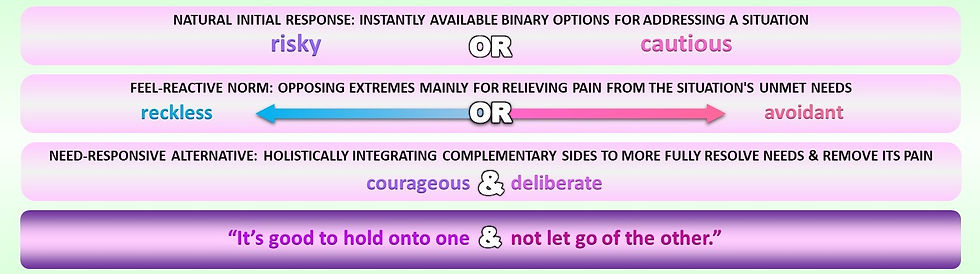
REACT - Sf: risky OR cautious
Taking bold risks pits itself as opposite to playing it safe by remaining cautious. Sometimes you can see you have a good chance to overcome any possible threats. Other times you realize you best proceed cautiously.
OVERREACT - Df: reckless OR avoidant
When gravitating toward what seems easiest to reach, we tend to overcompensate. Taking informed risks slips into less informed reckless behavior. Or proceeding with caution slips into not proceeding at and then getting stalled in avoidant behavior.
We go to extreme of either reckless risk taking or avoidant behaviors. And then miss our life's full potential.
RESPOND - Pf: courageous & deliberate
The more these interrelated traits start to oppose each other, with mounting tension, the more nature steps in somewhere to fill the void. Transspirituality blends being courageous and being deliberate toward greater wholeness and sustainable wellness.
Click here to dive deeper into this pairing
It's good to hold onto being risky and not let go of being cautious. For the one who integrates both can resolve far more needs, remove more pain, and reach more of life's potential.
7. Balancing masculine aggression with feminine passivity
Do you tend to get aggressive when confronted? Or are you prone to remain passive to avoid becoming a target?

REACT - Sf: aggressive OR passive
Getting aggressive amidst conflicts contrasts with being passive to minimize reactions. if faced with a threat requiring prompt resolution, you may opt for a forceful approach. But if you can slow down and consider the impact of your likely actions, you may prefer a more passive approach.
OVERREACT - Df: violent prone OR victim prone
When options seem limited, and often are, we tend to overcompensate. Starting out by being aggressive can slip into violent outbursts, targeting others with one's own violence. Starting out by being passive may slip into becoming victim prone, as a target for another's violence.
We go to extreme of either being violent prone or victim prone. And then miss our life's full potential.
RESPOND - Pf: assertive & durable
The more these complementary traits seem oppositional to each other, with mounting tension, the more nature steps in somewhere to fill the void. Transspirituality blends being assertive and being durable toward greater wholeness and sustainable wellness.
Click here to dive deeper into this pairing
It's good to hold onto being aggressive and not let go of being passive. For the one who integrates both can resolve far more needs, remove more pain, and reach more of life's potential.
8. Balancing masculine control with feminine complaint
Do you try to control a troubling situation? Or do you complain about a troubling situation to compel others to act as expected?

REACT - Sf: controlling OR complaining
Trying to control an unpleasant situation sits at odds with complaining about an unpleasant situation. If you can, you take control of a bad situation. If not, you express your complaint to summon support to address the bad situation.
OVERREACT - Df: dictating OR nagging
When falling into to the trap of what seems easiest, we may overcompensate. Trying to control a situation slips into trying to control others' behavior, to dictate their actions. Or complaining about a situation slips into coercing others' behavior, to incessantly nag them.
We go to extreme of either dictating over overs or nagging others. And then miss our life's full potential.
RESPOND - Pf: incentivizing & negotiating
The more these interdependent traits impose on each other, with mounting tension, the more nature steps in somewhere to fill the void. Transspirituality blends incentivizing and negotiating toward greater wholeness and sustainable wellness.
Click here to dive deeper into this pairing
It's good to hold onto being in some control and not let go of being able to complain. For the one who integrates both can resolve far more needs, remove more pain, and reach more of life's potential.
9. Balancing masculine boldness with feminine shyness
Do you assert yourself with boldness in novel situations? Or are you more inclined to stay in the shadows and feel shy in less familiar situations.
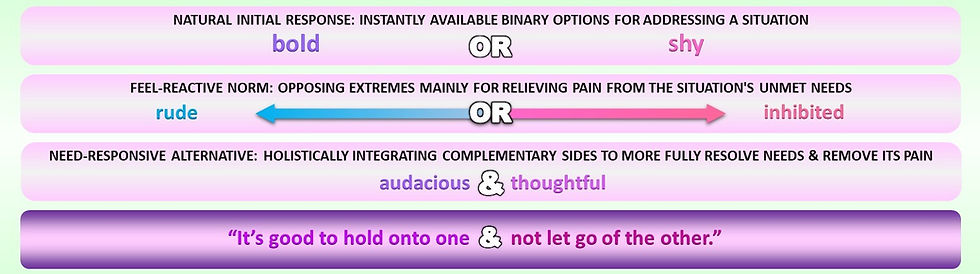
REACT - Sf: bold OR shy
You typically are bold or shy in social situations. When you can be confident, you step forward boldly. When not so confident, you approach shyly.
OVERREACT - Df: rude OR inhibited
When options seem limited, we may go to extremes. Being acceptably bold turns into being unacceptably rude. Or being socially shy turns into being socially inhibited.
We go to extreme of either rudeness or inhibition. And then miss our life's full potential.
RESPOND - Pf: audacious & thoughtful
The more these compatible traits start to oppose each other, with mounting tension, the more nature steps in somewhere to fill the void. Transspirituality blends being audacious and being thoughtful toward greater wholeness and sustainable wellness.
Click here to dive deeper into this pairing
It's good to hold onto being firm and bold and not let go of being vulnerably shy. For the one who integrates both can resolve far more needs, remove more pain, and reach more of life's potential.
10. Balancing masculine decisiveness with feminine reflectiveness
Are you more decisive when having to promptly choose between different options? Or are you more likely to pause and reflect so you can reliably choose the best option?

REACT - Sf: decisive OR reflective
You can be decisive and charge ahead or be reflective and improve your chances for a successful outcome. Sometimes you have the facts to make a bold choice. Sometimes you must caution your choice by first collecting vital pieces of information.
OVERREACT - Df: rash OR procrastinating
When options contract and become less available, we tend to overreact and go to opposing extremes. Being decisive becomes being rash. Being reflective slips into procrastination.
We go to extreme of either being rash or procrastinating. And then miss our life's full potential.
RESPOND - Pf: proactive & attentive
The more these contrasting traits contradict each other, with mounting tension, the more nature steps in somewhere to fill the void. Transspirituality blends being proactive and being attentive toward greater wholeness and sustainable wellness.
Click here to dive deeper into this pairing
It's good to hold onto being decisive and not let go of being reflective. For the one who integrates both can resolve far more needs, remove more pain, and reach more of life's potential.
11. Balancing masculine annoyance with feminine anxiety
Do you get easily annoyed by others acting offensively? Or are you more likely to feel anxious about others acting offensively?

REACT - Sf: annoyed OR anxious
You get annoyed when expecting others to fix the problem but get anxious when expecting yourself to fix the problem. When you have every good reason to demand others to change something, you gravitate toward annoyance. When others have good reason to demand you make the necessary change, you gravitate toward anxiety.
OVERREACT - Df: irresponsible OR over-responsible
When we cannot access optimal primary resources to resolve our needs, we likely go to readily available extremes. Getting annoyed slides into irresponsible behavior, as we quickly blame others and deny our own agency in our problems. Or getting anxious slides into over-responsible behavior, as we get boxed in by assuming we have more agency over our problems than we honestly have.
We go to extreme of either being irresponsible or over-responsible. And then miss our life's full potential.
RESPOND - Pf: watchful & careful
The more these competing traits get pitted against each other, with mounting tension, the more nature steps in somewhere to fill the void. Transspirituality blends being watchful and being careful toward greater wholeness and sustainable wellness.
Click here to dive deeper into this pairing
It's good in some moments to be anxious while not letting go of moments of being annoyed. For the one who integrates both can resolve far more needs, remove more pain, and reach more of life's potential.
12. Balancing masculine forcefulness with feminine gracefulness
Are you primarily forceful when needing to get something important done on time? Or are you more graceful to be sure what must be done works best with all involved?

REACT - Sf: forceful OR graceful
You can be forceful when something must be done, or you can be graceful to make room for what is also best for others. If you must act now and can ask questions later, you can be more forceful to fix a problem. If you sense that it is better for you to ask for forgiveness than ask for permission or to push ahead, you tend to be more graceful.
OVERREACT - Df: disorderly OR aimless
When actual choices dry up, we're prone to go the extremes of more readily available opposing options. When being forceful fails to work, we become disorderly as we overreact to situations getting out of control. Or when being graceful no longer works, we become aimless as we overreact to situations beyond our control.
We go to extreme of either being disorderly or aimless. And then miss our life's full potential.
RESPOND - Pf: strong & agile
The more these balancing traits clash with each other, with mounting tension, the more nature steps in somewhere to fill the void. Transspirituality blends being strong and being agile toward greater wholeness and sustainable wellness.
Click here to dive deeper into this pairing
It's good to hold onto being strategically forceful and not let go of being aptly graceful. For the one who integrates both can resolve far more needs, remove more pain, and reach more of life's potential.
Gender Holism Recap
Gender occurs along a continuum from biologically grounded distinctions to socially constructed gender norms. The more humanity drifts from its potential to blend complementary gender sides, which manifests in divisive social norms, the more nature fills the void.
Most will experience this when sexually incentivized to connect with others who can likely complement their own gender side. A few will experience this when spiritually compelled to transcend divisive gendered extremes, toward embracing gender holism.

Most of us initially feel compelled to balance these complementary qualities through a force of nature called sexuality. We find ourselves attracted to those who present some desirable qualities seemingly lacking in ourselves. We connect with them on an intimate level.
Their intimate affection permits us to draw out more and more of these hidden qualities within ourselves. We get to know ourselves more fully. We slip less into extremes. We encounter a love that brings us more in touch with our full human potential.
Others of us experience a more profound realm of nature compelling such balance.
How do I know any of this?
Asexual
While most organize their lives as either dominantly masculine or dominantly feminine, I as a transspirit am spiritually compelled to continually integrate my masculine and feminine sides into a holistic balance. This blossoms independent of sexual motivation. As such, I do not feel any sexual attraction to a complementary other.
Most of us first feel some sexual attraction to someone we find attractive. I never did. I had to first cultivate a deep emotional connection before feeling any arousal toward her. I had to first trust she intimately knew me first.
Most people are allosexual, otherwise known as zedsexual. By contrast, I am demisexual.
Allosexual attraction (norm) | Demisexual attraction (strange) |
|---|---|
physical attraction -> emotional attraction | emotional attraction -> physical attraction |
Physical intimacy leads to emotional intimacy | Emotional intimacy leads to physical intimacy |
I recognize my unique sexuality, of requiring deep connection prior to desiring any physical intimacy, flows from my gender-transcendent spirituality. I also recognize how this leaves me vulnerable to allosexuals who project their sexual angst onto me. I am not alone.
Like the Apostle Paul, I do not burn with any romantic desire toward another. While younger, I was demisexual. I had to first establish an emotional bond grounded in a mutual spiritual connection. That occurred only once, with my then-wife. I have since become fully asexual, with no desire for any sexual partner whatsoever.
The deep connection I once enjoyed with my wife was violently disrupted after being falsely accused of transphobic tropes, and then wrongly convicted of a crime that never occurred. Gender norm defenders easily projected their sexual anxieties onto my sexual innocence.
Defending divisive norms
Overreaction
The immaturity of divisive norm defenders manifest in criminal investigations, and subsequent convictions, based in confirmation bias that ignores all evidence of innocence. Worse, it punishes the very one with the spiritually compelled wisdom to resolve needs, remove pain, and restore greater wellbeing on a personal and collective level.
Divisive norm defenders intentionally protect what they find familiar, even if that includes normalization of what's unwise and unhealthy for us all. Consequently, they typically knee-jerk oppose the mature direction of transspirituality. They tend to prefer the pain they feel over the discomfort of facing the unknown path to greater yet demanding wellness.
Shooting the prophetic messenger
Rejected
Their fear of the unknown outcasts me. The wisdom I offer that transcends toxic legalism is widely dismissed and patently ignored. Problems needlessly persist.
In fact, most reactions to problems reinforce problems. That too gets easily ignored when guarding what's more familiar. Legalists rely on divisive norms expressed in many gender trait extremes.
Clashing gender sides tends to be more familiar than gender holism independent of sexual norms. Likewise, settling for pain relief from our unresolved needs tends to be guarded as more familiar and trustworthy than removing such pain by resolving the underlying needs.

In short, legalism compromises our full human potential. Solzhenitsyn said as much back in 1978.
Transspirituality compels a return to our untapped full potential. By replacing cold laws with the incentives of love, of honoring the needs of others as our own.
Perhaps my existence as a need-resolving transspirit gets picked up as a competitive threat to pain-relieving legalists. Perhaps that helps explain why norm defenders, who are now accustomed to compromised wellbeing with pain coping mechanisms, perceive me as a threat.
All my life, I have been scapegoated, dismissed, and routinely avoided. My liberating wisdom ignored, regarded as too unfamiliar to take seriously. Others shame me for their own pain, as they somehow blame my invisible fullness for their painful lack of fullness.
Rejecting the healer they neeed

Conformity is overrated where love is underperformed. As more of us slip into symfunction that hinders our full potential, a life aspring to full peakfunction potential can seem unacceptably strange.
The more emotionally attached to what they find reliably familiar, the less tolerant they tend to be toward those instinctively challenge those norms. They prefer to feel the familiar emotional pain from their dysfunction or symfunction than the less familiar discomfort of disciplined growth. From that perspective, a gifted healer like me must be outcasted.
They perceive my gender-transcendence as being less of a person. They view someone like me who exhibits both feminine and masculine qualities as somehow being less. They do not recognize how such gender holism can enable humanity to reach more of its untapped potential.
To them, I must be some kind of sexual degenerate. They cannot see beyond their own myopic perspective. They cannot get to the root of their pain, which is unresolved needs. Reacting to their pain with more conformity tends to leave them in more familiar pain.
They overlook the benefits of owning both feminine and masculine qualities, independent of sexual encounters. They may even misinterpret me as conventionally transgender, which I am not.
I never claimed to have a feminine identify, but a misunderstood spiritual identity. Much of the transgender narrative never accurately fit my gender-transcendent experience. In fact, I no longer think of myself as conventionally transgender.
Think of me as "post-transgender"

Post-trans: Trans but not conventionally transgender
I am transgender, but not transgender in the conventional sense. I do not identify as having a gender identify different from ascribed at my birth. Rather, I am more like the "two-spirits" of indigenous cultures.
Not because I am Oneida by birth. But raised by my Oneida mother who grounded me in appreciating the centrality of nature in life.
Indigenous spirituality grounds me to the necessity of balance, including gender balance. Such balance is vital to resolve more needs, to raise more wellbeing and remove more pain.
I do not balance gender traits to express a gender identity. Rather, I naturally integrate these complementary sides to reach more of life's full potential. Not merely for me, but for us all.
Balance for us all
That is why I can unpack politics to spot its roots in a different priority of needs. And recognize the limits in the adversarial approach to seeking justice.
Those legalistic approaches fail to effectively address our inflexible needs. We cannot properly resolve needs by pitting us against each other in either a court battle or a ballot contest.

Integrating our gender traits enables us to resolve more needs, to reach more of our life's full potential. Which includes our potential to love each other more, to honor each other's needs as we would have the other honor our own. Toward need-resolving holism.
Need-resolving holism
Gender holism equips me to integrate the four levels of human functionality with left-right political spectrum.

Another way to view this integrates the vertical spectrum of nuanced specifics (top) to overgeneralizing exaggerations (bottom).
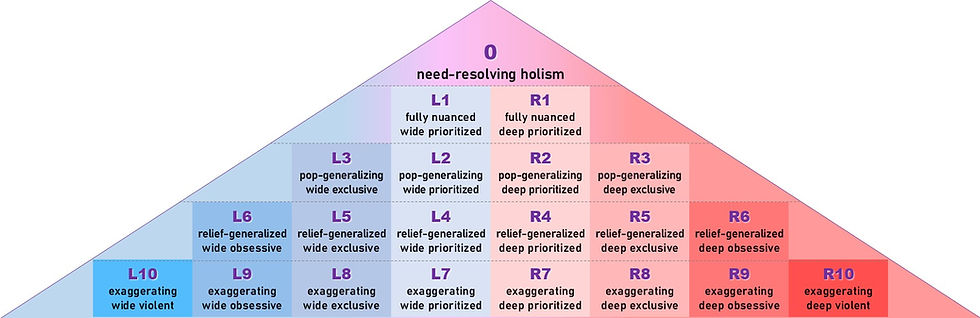
I could go on and cover these in details, but instead I will wrap this up. This is already a lot to take in. If you absorb anything from this article, consider this takeaway.
Takeaway (TLDR)
Nature compels those like me to transcend contrasting norms that no longer serve, to connect deeply with the untapped human potential in us all.
This can seem strange and even unacceptable to many. Especially for those who lack vision to see beyond their legalistic framework.
We cannot solve our specific problems from the level of generalizing that created them. Including all those overgeneralizing divisive gender norms.
We can solve our problems by resolving needs with love, by honoring the needs of others as our own. That's exactly what need-response is for.


Comments