
.png)
Public Exoneration of Steph Turner part 1 of 2
- Steph Turner
- May 24
- 38 min read

Updated: Jun 19
Impartially establishing innocence independent of biased adversarial law
Public Exoneration of Steph Turner – in brief
After coming out as trans, Steph Turner was falsely accused and wrongly convicted in 1993.
Steph consistently maintains their innocence and has no other history of criminality.
Steph repeatedly finds the adversarial legal process unresponsive to the need for justice.
The wrongful conviction has trapped Steph in poverty, unable to use their talent and degrees.
Steph unpacks the hidden threat to wellness from power differentials.
PART 2:
Steph proactively addresses the needs for which laws ostensibly exist to serve.
Steph raises the standard for justice to measurably improved wellness outcomes for all.
Steph now holds all accountable to this higher standard, anchored in love.
Steph welcomes anyone to engage them to better understand what this can mean for them.
All legitimate personal and public relations with Steph will now expect acknowledgement of these facts.
Acknowledging these facts improves the person's rapport with Steph.
Failure to acknowledge these facts sours the person's rapport with Steph.
Yes, Steph will be keeping score.
Public Exoneration of Steph Turner – full
1. After coming out as trans, Steph Turner was falsely accused and wrongly convicted in 1993.
Steph Turner came out as trans in 1993 to Janet Turner, their older trans sibling. After moving in together, a young girl with lesbian feelings gawked at Janet, apparently inspired by Janet's defiance of gender norms.
When in trouble with her mother for not being home, the young girl accused Janet of snatching her off the sidewalk and dragging her to Janet's apartment to be sexually assaulted. This nascent lesbian could not risk being outed.
Both Janet and Steph were accused of popular anti-trans groomer tropes and then charged with CSC. Later, both were wrongly convicted and sentenced to serve lengthy terms in men's prisons.
Janet died in prison of cancer. Being ineligible for parole for maintaining innocence, Steph finally left prison in 2005. Now required to register as a sex offender for life, the asexual Steph cannot get a meaningful job using their talents, skills and education.
Before being released, Steph switched from identifying as transgender to identifying as a wisdom-dispensing transspirit. While overwhelmed by social problems, Steph aims to help develop some meaningful solutions.
[NOTE: Steph uses gender neutral pronouns primarily because indigenous languages do not have gendered pronouns as with European languages like English. This simple decolonization act also works well with the gender transcendant dimension of Steph's transspirituality, as a secondary purpose for gender neutral language.]
Click for comprehensive details
1.1) Context
Coming out
In February 1993, Steph came out as trans to Janet, Steph's older sibling, who was already out publicly. Both were estranged from each other for 16 years. Janet previously ran afoul of the law, but now law-abiding and more emotionally mature since embracing her transgender self.
Janet then lost her job and apartment in Elkhorn, Wisconsin. So she moved in with Steph in Grand Rapids, Michigan.
Four weeks after moving in, Janet attracted the unwelcomed attention of a young neighbor girl. Later, Steph learned that this young girl was experiencing nacent lesbianism and could not risk being outed to her homophobic parents.
After gawking at Janet throught the apartment front window, Janet naively tried to placate the girl's curiosity about this "man with lipstick" by inviting her inside. Steph remained asleep in the back bedroom.
All hell breaks loose
Steph awoke to hear voices. Leaving the back bedroom, Steph observed Janet talking with a young girl that Steph had never seen before. Leaving the apartment for errands, neither Janet nor the girl acknowledged Steph's presence nor exit.
After returning, Steph saw that the girl was gone. When asking Janet who that was, Janet seemed unwilling to talk about it. Shortly after, the girl's upset mother appeared at the door. She demanded to know what Janet was doing with her daughter.
Janet stepped out to explain. Before Janet could finish, the girl's stepfather rushed at Janet with a crowbar. Janet jumped inside and Steph locked the door. As the man repeatedly beat the door with the crowbar, Steph called 911.
Police arrive
Police get involved. The young girl was interviewed. The officer had Janet and Steph wait in the back of his squad car. Then the officer joined the other officers who were interviewing the girl, who desperately could not be outed to them.
About 20 minutes later, the officer returned. He indicated that both Janet and Steph were now being charged with CSC. Steph asked the officer what CSC stands for.
"Criminal Sexual Conduct," he answered.
"What did the girl say we did?" Steph increduously inquired.
"I think you know," the officer replied, as he drove away to take the two to the county jail.
1.2) Falsely accused of sexual assault on July 7, 1993
CSC 1. Steph Turner was accused of aiding and abetting a sexual assault allegedly committted by Steph's transgender sibling, against a ten year-old neighbor whom Steph has never met.
CSC 2. Steph was also accused of fondling the complainant's chest. The specifics remain unclear, as the charge was cherrypicked from an allegation m we were both being arreested for CSC. ade from an inconsistent testimony apparently coached with leading questions (standard at that time).
Steph soon learned how easily trans folks get overcharged and over-incarcerated compared to most non-trans people. Implicit bias. Steph also had to quickly detransition for survival in the men's jail.

Steph's older trans sibling Janet (deadname Daniel) was accused as the principal. Since Janet died of cancer in prison on October 8, 2001, little else is mentioned of her here.
1.3) Wrongly convicted of CSC charges on December 13, 1993
The trial began on November 30, 1993. Both Janet and Steph were tried together, but each had a separate jury.
Steph expected to be acquitted since the accuations lacked corroborating evidence. Then Steph's defense counsel showed in a Michigan law book that "no corroborating evidence is necessary for a conviction of sexual misconduct". That sank Steph's mood.
Steph's defense counsel believed in Steph's innocence, but had doubts about Janet's innocence. The jury later indicated that if Janet was guilty, then they assumed Steph must also be guilty of the charges.
Neither jury was checked for the propensity to project sexual angst onto asexual trans folks simply because they are different. Amidst a nationwide moral panic of sex abuse hysteria, at a time many believed the transphobic trope of "sexual predators", both were found guilty.
1.4) Sentenced on February 2, 1994 to serve 30 years in a men's prison
The Presentence Investigator expressed her doubt about the conviction, but explained she had to do her job to examine all the relevant details and recommend a sentence as determined by law. Her Presentencing Investigation report recommended sentencing Steph at the low end of the 5 to 10 year minimum range. The maximum was set by statute at 30 years, which Steph did not fully appreciate at the time.
At the sentencing hearing, the prosecutor argued for a minimum closer to 8 years. Steph's defense counsel counter-argued for a minimum closer to 2 years.
After sentencing Janet 30 to 50 years, the judge claimed he had to keep the sentence for Steph proportional to the codefendant. This misapplication of the Milbourn case law later served as an appellate issue. The trial judge departed upward from all the recommendations and sentenced Steph 15 to 30 years.
1.5) Appeal
Steph appealed the conviction prior to sentencing. Steph's appellate counsel found so many appealable issues that the written appeal ran in excess of the 50-page limit. After getting the court's permission, he filed a 60-page appellate brief on Steph's behalf.
The brief was filed on December 27, 1995. The appellate panel returned their unpublished opinion in January of 1998. They threw out the CSC 1 conviction, but then replaced it with a CSC 2 conviction. While grateful for partial relief, Steph remained disappointed that the court failed to recognize and correct its costly mistakes.
The appellate panel traditionally avoids the role of "tryer of fact" as they reserve that function to the trial jury. They granted themselves an exception to interpret the trial transcripts for themselves to decide a jury could find Steph guilty of CSC 2.
The appellate panel remanded the case for resentencing. On February 2, 1999, exactly six years after the fist sentencing hearing, Steph returned before the same sentencing judge.
He resentenced Steph to serve 8 to 15 years. This moved up the maximum outdate from 2023 to September of 2005. And this updated the earliest release date to 2001, if eligible for parole.
1.6) Incarcerated in the MDOC from March 1994 till September 2005
Faithfully maintaining the integrity of their innocence left Steph ineligible for parole. Steph finally discharged fully from state custody on September 22, 2005. And went home.
While grateful to leave prison and be back home, Steph remains hopeful to reverse the wrongful conviction and restore their sullied name.
Thanks in part to Janet taking the lead to embrace their Oneida heritage, Steph shifted from identifying as transgender to recognizing the indigenous aspect of gender holism. By 2002, Steph identified more as a "transspirit".
Steph briefly wondered if the two-spirit tradition best explained their compulsion to transcend gender norms. But digging deeper, Steph realized the term transspirit fit better.
A transspirit is one compelled to transcend divisive norms, like gender norms and hostile political sides, to deeply connect with life's full potential. This now includes transcending hostile adjudication categories of the adversarial process, like accuser and accused, and the overgeneralizing categories of guilt and acquittal.
After initially in shock after asking "why me?", Steph shifted perspective by asking "Why not me? What does God see in me to test and refine my resilience and rise me up to a threat-defying purpose?". Besides being totally innocent of a wrongful conviction, Steph learned to empathize with the plight of not-so-innocent fellow prisoners, who presented many painfully unaddressed social issues.
1.7) Shooting the messenger
Irony
While incarcerated, Steph recognized transspiritual features in the book of Isaiah. When wondering who will step up and find the wisdom to correct such problems in society, Steph stepped forward with "Here am I, send me!" Mirroring the message in Isaiah, Steph soon wondered who will take notice of such of such profound and yet unconventional wisdom. "Who has believed our report? And to whom is the arm of the Lord revealed?"
Transspirituality gifts Steph with the wisdom to both understand the roots of conventional thinking and the its limits if taken too literally. Let these nuggets of wisdom inspire you to see beyond conventional wisdom.
There is no such things as pain apart from unresolved needs.
Pain is not the problem as much as the threats pain exists to report.
We cannot solve our specific problems from the level of generalizing that created them.
Two wrongs don’t make a right, but sometimes they make a law.
There is no greater human authority than resolving needs with love.

It's best to change yourself, conventional wisdom claims, before trying to change society. But what if you have done all you can and must wait for societal changes to enable you to actually change yourself? Hyper-individualism results, which prevents human flourishing.
Be rational, conventional wisdom claims, and check your emotionally charged expressions. Hyperrationality results, which prevents human flourishing.
Don't overthink things, conventional wisdom claims, so you best keep things simple enough for all to understand. Overgeneralizing results, which prevents human flourishing.
You should be happy, conventional wisdom claims, by avoiding uncomfortable matters. Discomfort avoidance results, which prevents human flourishing.
Take a stance on the issues, conventional wisdom claims, so you should oppose those that you know are wrong. Hostile adversarialism results, which prevents human flourishing.
2. Steph empirically demonstrates their innocence and has no other history of criminality.
Steph presents a compelling case of actual innocence. After creating a spreadsheet form with an innocence checklist, to compare an innocence claim to those already exonerated,
At no time has Steph taken a plea deal, or confessed during any investigation or at a parole hearing. At no time prior or after this alleged crime, and no time during state custody, has Steph presented any violence of any criminality.
Instead, Steph as a nonconformist has endured a history of being misunderstood, outcasted, scapegoated and targeted for projected shame of others. As was the young gay complainant, who could not be as open as Janet and Steph. Both Steph and the exploited complainant need the substantive justice of being affirmed for who they authentially are.
Click for comprehensive details
2.1) Estimated Innocence Report
Steph created an interactive spreadsheet tool, called the Estimated Innocence Form, that automatically calculates the viability of an innocence claim. The more the innocence claim includes elements known to contribute to wrongly convicting the innocent, the higher the likely innocence score. Its attached Estimated Innocence Report summarizes the results.

This effectively improves upon the adversarial law’s convenient yet oversimplified categories of guilty or not guilty. This provides a more honest look at each viable innocence claim than normally afforded in the slow motion and biased-riddled adversarial system, hampered by apparent conflicts of interest.
Instead of the oversimplified guilty-or-not-guilty binary massaged from a jury's manipulated perspective, this proactive alternative provides a range of options based upon a testable correlation: The more an innocence claim matches those cases already exonerated, the higher the score attesting to likely actual innocence.

As the first guinea pig, per se, Steph applied this form to their own innocence claim. When compared to cases already exonerated, Steph scores an 89% chance of being actually innocent. (A different scoring arrived at 86%, and another at 92%.)





2.1.1) Synopsis
Asexual person comes out as transgender in early 90s, gets falsely accused as being a "sexual predator" homophobic stereotype. Convicted without evidence. Must register as sex offender for life. Forced into poverty and homelessness.
2.1.2) Hightlights
no criminal history
always maintained innocence
transphobic & homophobic prosecution
no corroborating evidence
climate of sex abuse hysteria
no crime occurred
sensationalized coverage in local media
despite several degrees, no one will hire
2.1.3) Flipside
Prior to accepting herself as transgender, Janet (principal & codefendant) often ran afoul of the law. She appears to have suffered Asperger’s (high functioning autism), so was slow at responding to social cues.
Overcoming shame of being gender different helped her escape cycles of self-defeating behaviors. She overcame dyslexia and other challenges to lead a healthy life, until this happened.
2.1.4) Summary
On July 7th, 1993, Steph Turner awoke to hear voices from the other room. Steph could hear her sister Janet talking to someone. That person left, but later returned with her irate mother to accuse Janet of an incredulous crime. You see, Janet was born male and now openly transgender, long before that was socially acceptable. And Janet had yet to fully transition.
At the height of the sex abuse hysteria in the early-90s, Steph came out as gender-nonconforming transgender. But living in a religiously conservative community, Steph kept it private. Steph soon came out to Janet, years after Janet had.
They shared an apartment to rekindle their newfound bond. Both now freely embracing their feminine sides. Both describe themselves as asexual, as unable to feel erotic attraction unless being fully loved for their full selves. Both felt more drawn to their indigenous spirituality, of transcending the gender divide for deeper connection.
A neighborhood child drew curious, peeping into Janet’s window to gawk at what she called the "man with lipstick." She later came out as gay, but understandably could not risk rejection at home because of her young age. When caught not being home on time, the child leveled bizarre claims of sex abuse unbecoming from a child. Perhaps she was exposed to porn.
The child then dragged Steph into her transphobic-indoctrinated accusations. The child claimed that Janet and Steph had her pose in a photo, with her stabbing Steph in the chest with a jelly-stained butter knife.
She claimed this was to scare her from talking to police, that Janet and Steph would use the Polaroid photo to claim this young girl was the aggressor. Of course, no such photo ever existed. Unbelievable? Not if you already believe trans people are subhuman.
Child testimonies back then were often coached. Trans people were easily vilified. Since no corroborating evidence was necessary back then to convict for sexual misconduct, both transwomen were wrongly convicted. And both sentenced to long terms in men’s prisons. Janet did not survive. In 2001, she succumbed to cancer.
Repeated efforts to overcome their wrongful convictions have failed. After serving a full 12-year sentence, Steph was discharged and finished undergraduate and graduate degrees.
But now Steph must register as a sex offender for life, despite being asexual. This continues to destroy Steph's economic and other opportunities. Your support can help turn this around.
This "Estimated Innocence Report" results from filling out the Estimated Innocence Form which Steph created for anyone with a compelling innocence claim neglected by the legal process.

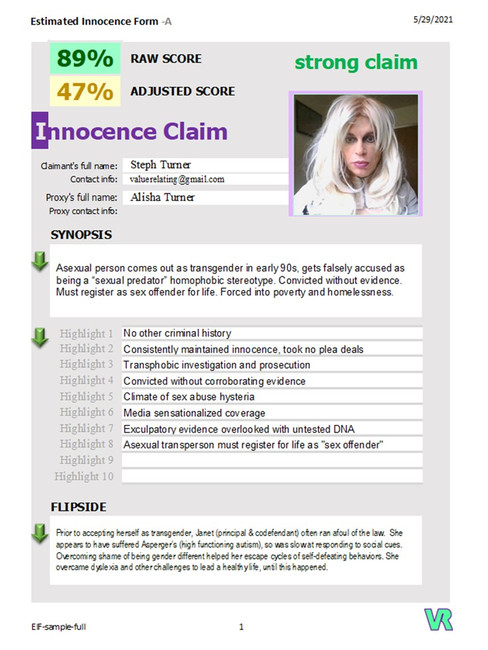

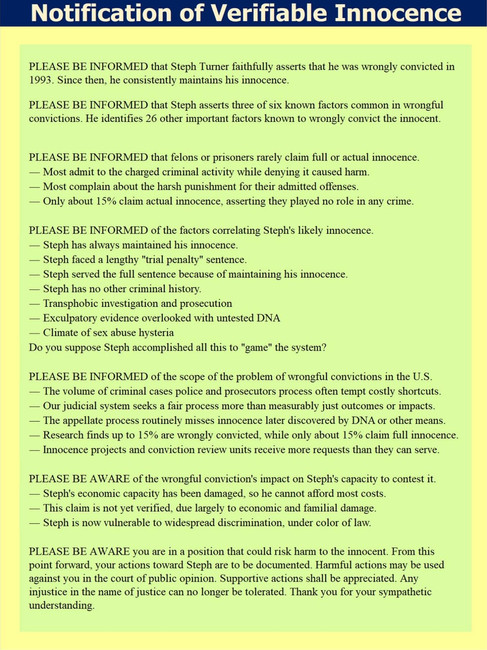
See Steph's full Estimated Innocence Report
2.2) Public Exoneration of Steph Turner
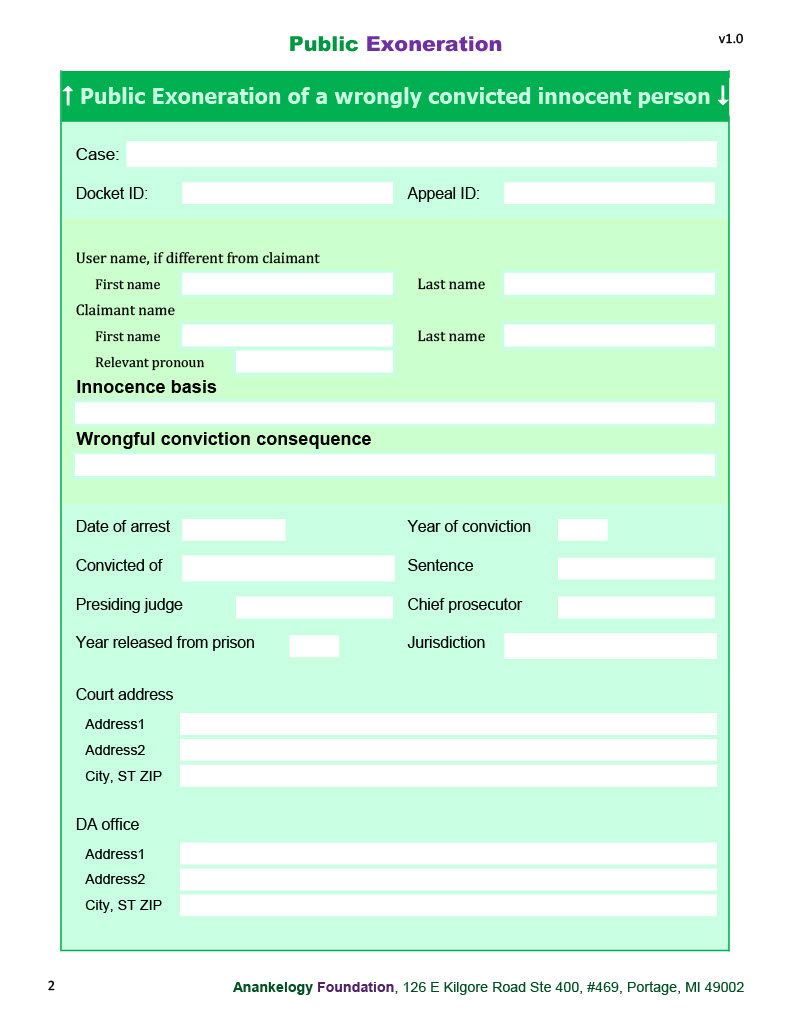
Steph later created "Public Exoneration" for easier processing. The full "EIF" can be overwhelming, and include too much detail for the average person to have time to process.
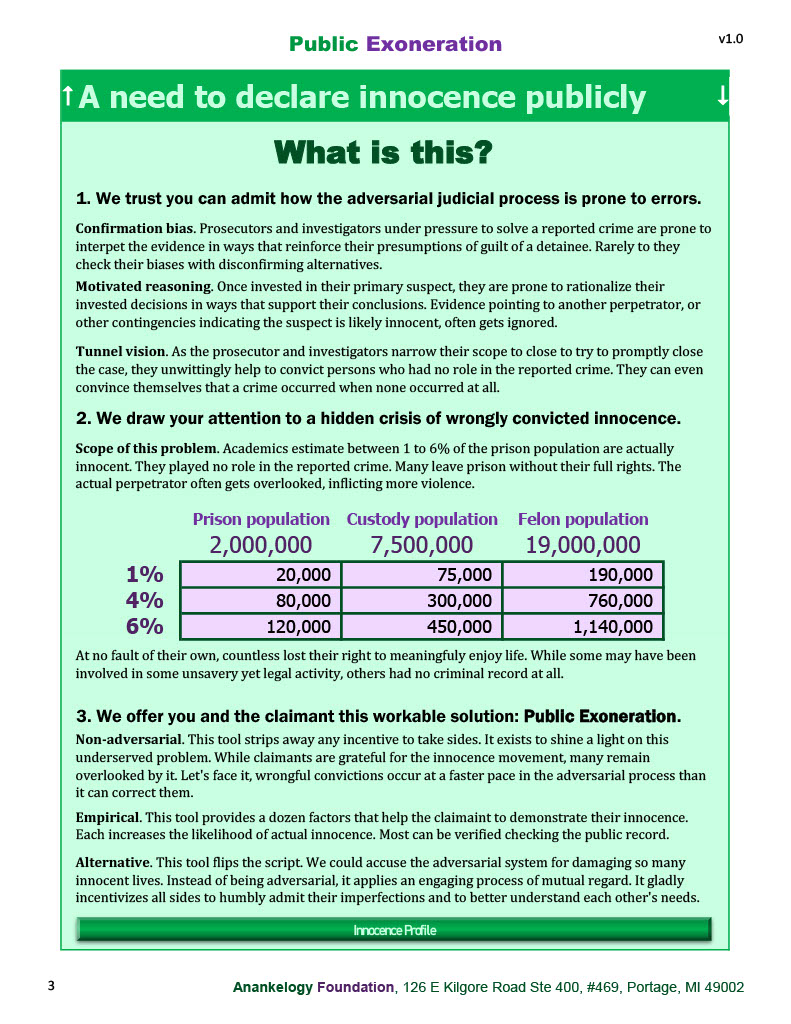
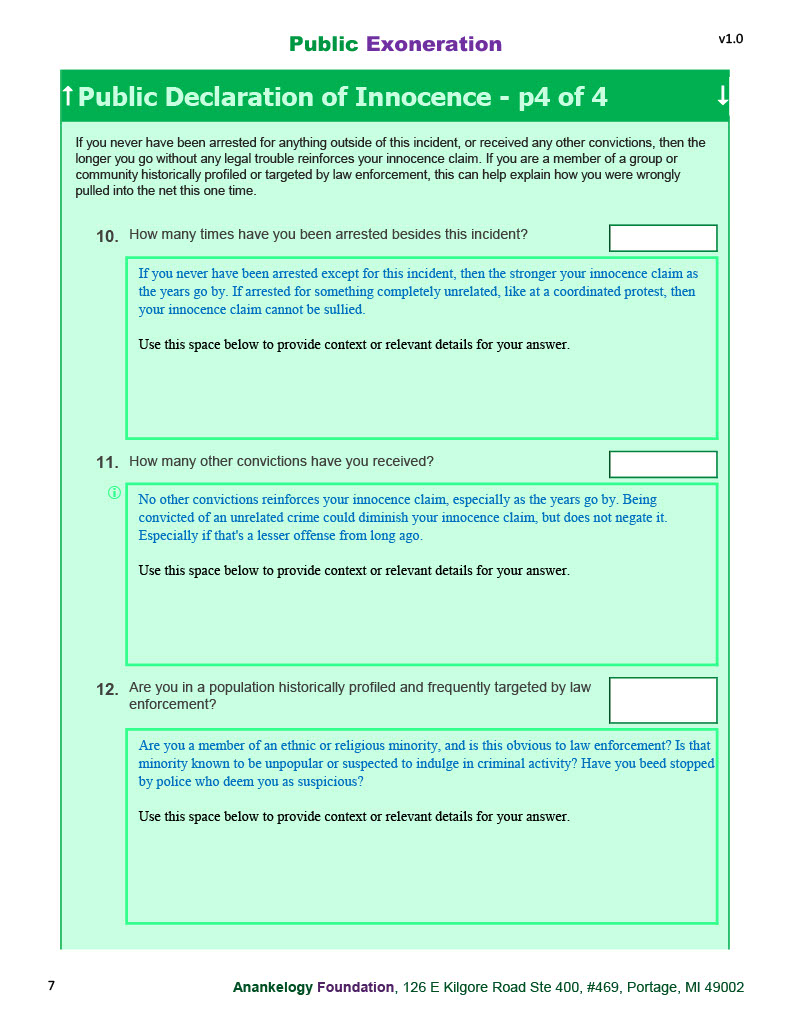
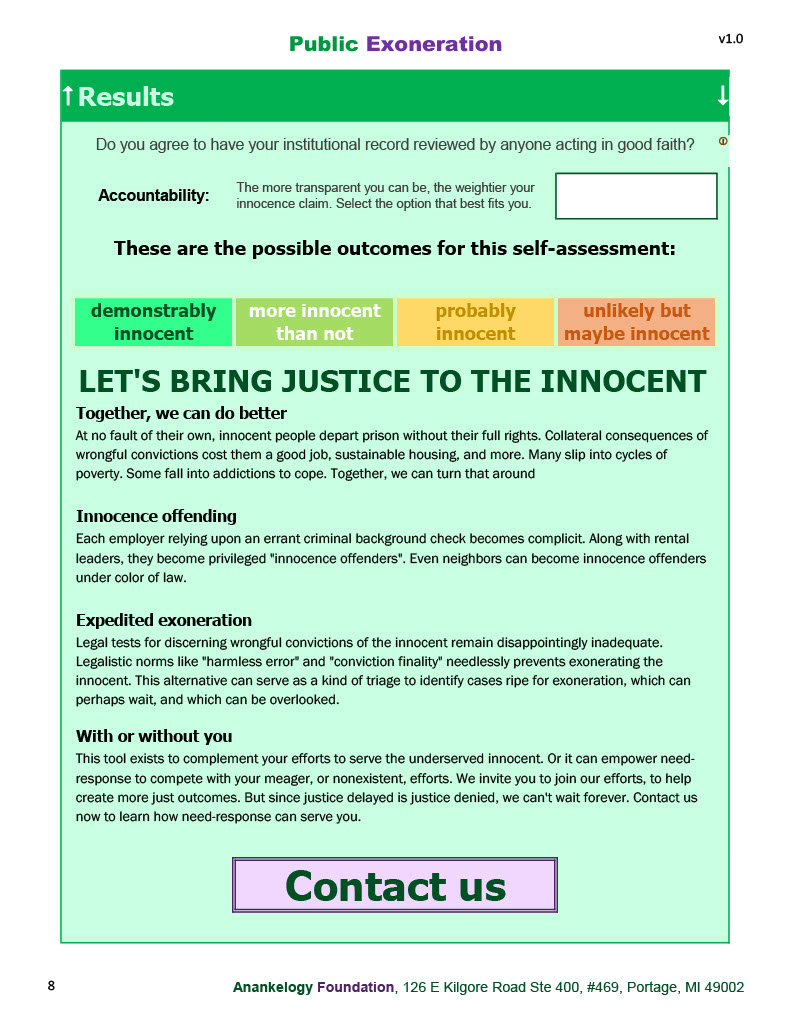
This "TLDR" version provides four outcomes based on answers to a few questions.
demonstrably innocent | more innocent than not | probably innocent | unlikely but maybe innocent |
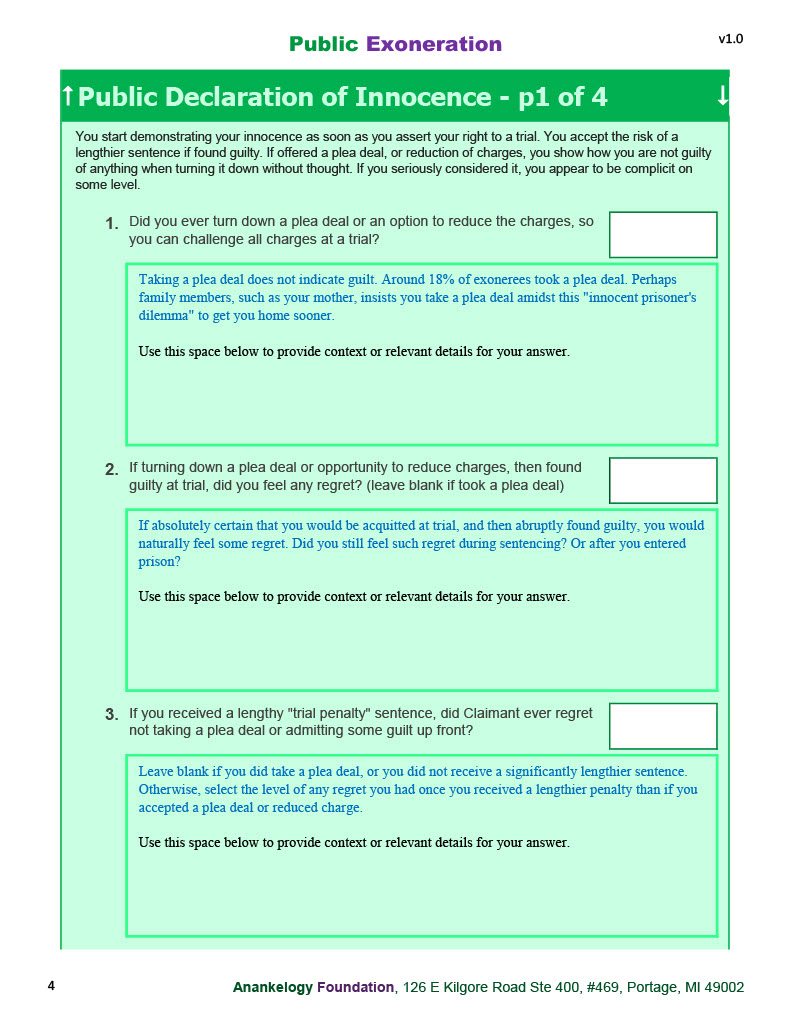
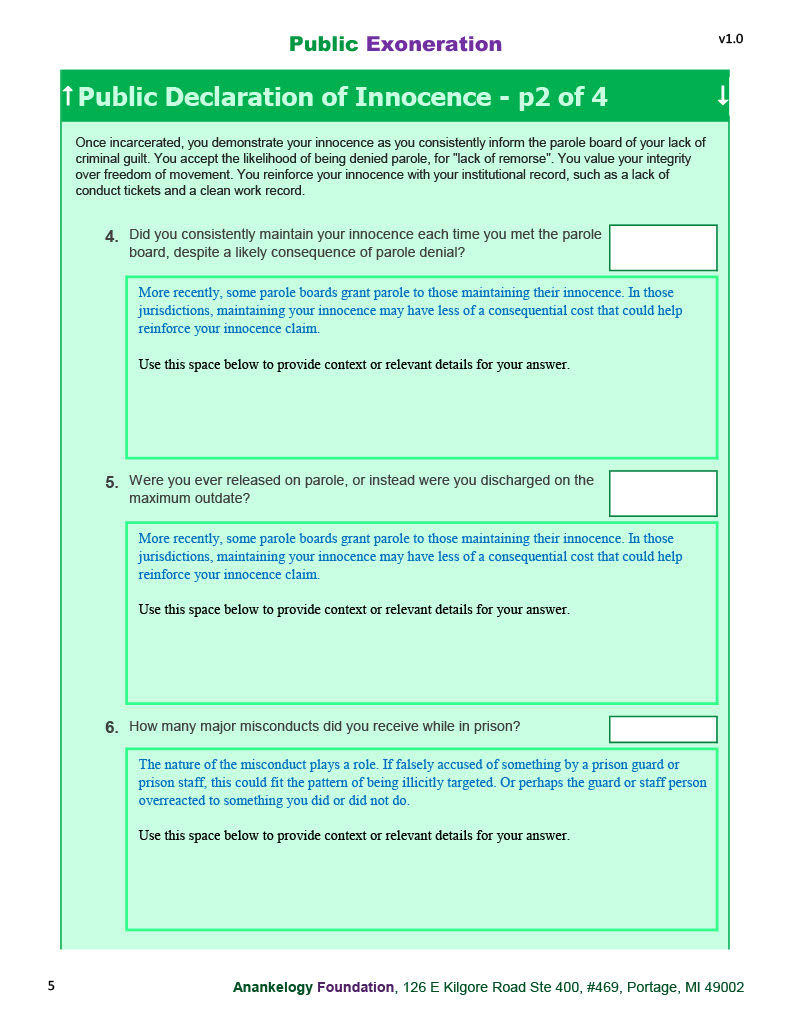
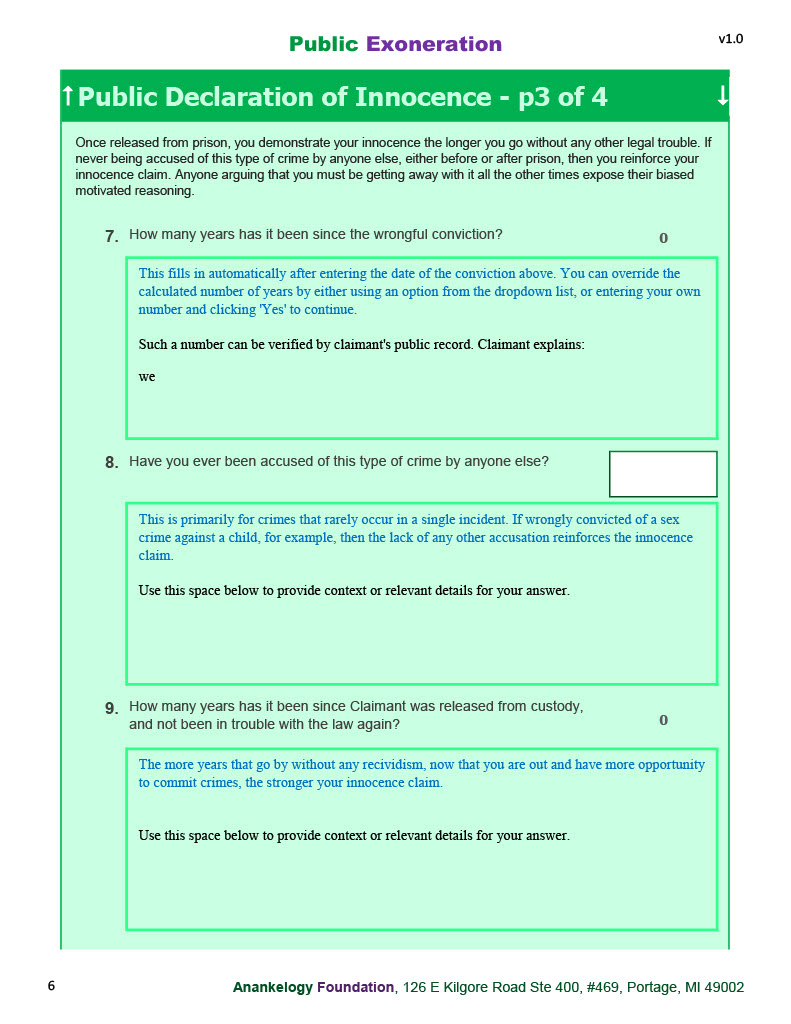
This alternative document only asks a dozen key questions. It's honest answers will indicate the likelihood of innocence. How each answer can be verified is also addressed.
No. | Question | Response |
1. | Did Steph ever turn down a plea deal or an option to reduce the charges, so they can challenge all charges at a trial? | yes |
2. | If turning down a plea deal or opportunity to reduce charges, then found guilty at trial, did Steph express regret? | no regret |
3. | If Steph received a lengthy "trial penalty" sentence, did Steph ever regret not taking a plea deal or admitting some guilt up front? | no regret |
4. | Did Steph consistently maintain their innocence each time they met the parole board, despite a likely consequnce of parole denial? | yes |
5. | Was Steph ever released on parole, or instead was Steph discharged on the maximum outdate? | no parole, full sentence |
6. | How many major misconducts did Steph receive while in prison? | 1 |
7. | How many years has it been since the reported wrongful conviction? | 33 years |
8. | Has Steph ever been accused of this type of crime by anyone else? | no, not by anyone |
9. | How many years has it been since Steph was released from custody, and not been in trouble with the law again? | 21 years |
10. | How many times has Steph been arrested besides this incident? | none |
11. | How many other convictions has Steph received? | none |
12. | Is Steph in a population historically profiled and frequently targeted by law enforcement? | profiled not targeted |
Results: Steph is demonstrably innocent
This includes an attempt to provide this as a service to others with a compelling innocence claim.








2.2.1) Letter to the local DA
Public Exoneration invites the local prosecutor to weigh in to this non-adversarial alternative to their biased adversarial system. Which provides sufficient opportunity to the local district attorney to respond to justice needs apart from the constraints of the adversarial approach.
Along the way, we assess how responsive they are to this raising of the standard to mutual understanding and mutual respect.
17 June 2026 | |
Re: Steph Turner invites you to directly review their presorted innocence claim: Dear [local DA]: Welcome to a new way to identify wrongful convictions of the innocent. We appreciate how you likely lack the time and resources to effectively review each compelling case of wrongful convictions pointing to an innocent defendant. This new service presorts the claims for you. Instead of relying on legal arguments for how this case might be reversed in court, we rely on markers of clear innocence. This case, for example, indicates a high probability of innocence because the claimant consistently maintained their innocence from arrest, trial, parole board hearings, and now. There is no known psychological disorder for such a person to insist they are innocent in the face of inevitable parole denials. We score each innocence claim for its likely innocence. First, they must have played no role in the offense. Second, the more the case includes factors known to contribute to wrongful convictions of the innocent, the higher its viability of innocence score. This claimant was released from prison years ago, but still cannot gain meaningful employment or stable housing due to this wrongful conviction. The greater threat is not recidivism, but the unnecessary disruption of relationships, of lost income, along with consequential dependence upon public assistance, reduced tax revenue, and a heightened risk for survival crimes. You can insist that we go through the standard legal channels, but we question the ethics of vulnerably waiting upon the same adversarial process that produced the error in the first place. We find the adversarial approach needlessly provokes defensiveness, which prematurely shuts down meaningful dialogue. We instead incentivize cooperation with mutual understanding, to support you in serving the public’s interest in safety and justice. To that end, we created the Innocence Index. It provides you a "case preview triage" for quickly spotting cases within you jurisdiction that merits review. Including this case we now bring to your attention. When compared to cases already exonerated, this claimant shows an 89% chance of actually innocent. The cases listed are separated by “public” and “state” status. When accepting this case for review, it shifts from “public” to “state” status. We help you to quickly identify and clear such viable claims of innocence, that could raise your professional profile as a more effective district attorney. If you decline to accept this case for direct review, and insist we work through a defense lawyer or innocence project, we understand. The case retains its “public” status. We then address the public directly, to incentivize them to realize the risk of “innocence offending” when treating the innocent as if guilty. We directly address their needs for safety and justice. We look forward working with you to help separate the chaff of guilty defendants from the wheat of innocent lives. Let’s work together to proactively serve the interests of safety and justice for a better society. Thank you, Steph Turner Anankelogy Foundation |
We assess the responsiveness of the contacted DA to this opportunity to empirically improve their legitimacy. Along a range from bad to excellent responsiveness.

"Public Exoneration" goes both ways. Right now, the criminal justice system is guilty of wrongly convicting countless innocent lives, which compromises its legitimacy. Public Exoneration invites the DA to shift from the tenously ascribed legitimacy of the adversarial process (i.e.,
manipulating juror's perceptions,
only offering relief to the winning side,
objectifying both complainants and defendants with little regard for their affected inflexible needs, which leads to poor outcomes)
to the empirically earned legitimacy of the mutuality process (i.e.,
identifying all affected needs on all sides of a conflict,
incentivizing positive regard for each other's affected needs,
measuring the impacted wellness outcomes of all involved).
Meanwhile, the unresponsiveness of the DA to the public's many justice needs contrasts with Steph's responsiveness to the needs of those involved in this case.
2.3) Responsive Innocence

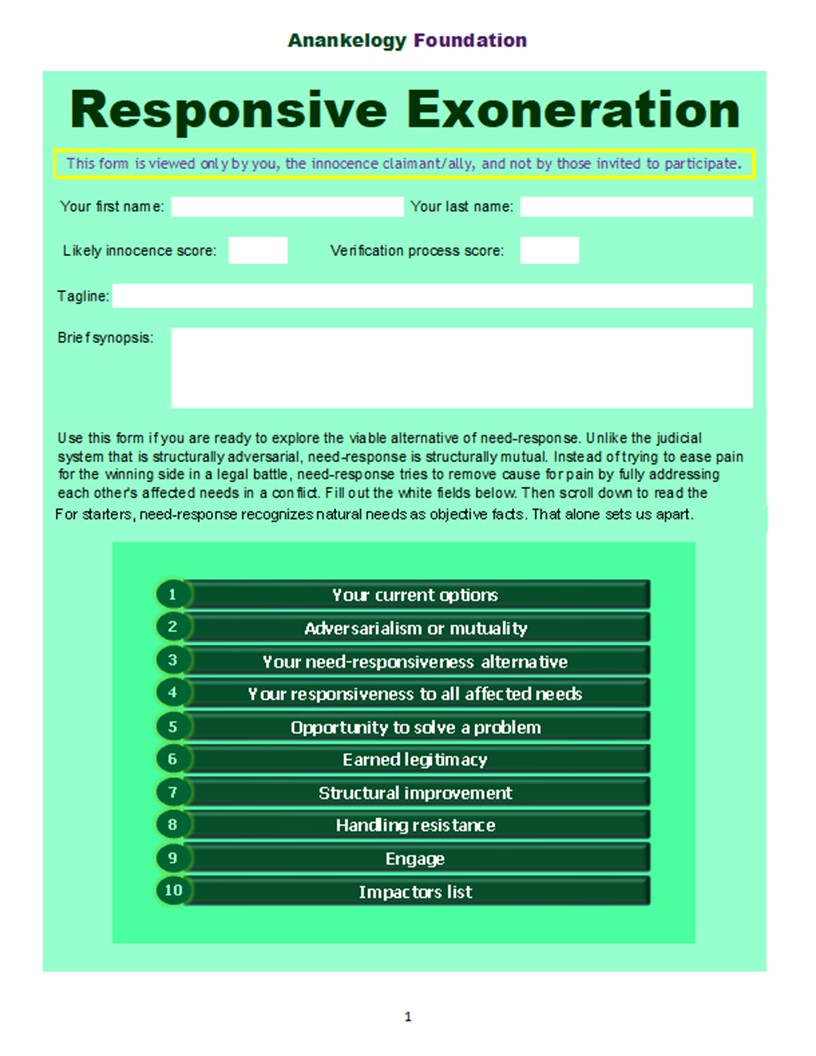

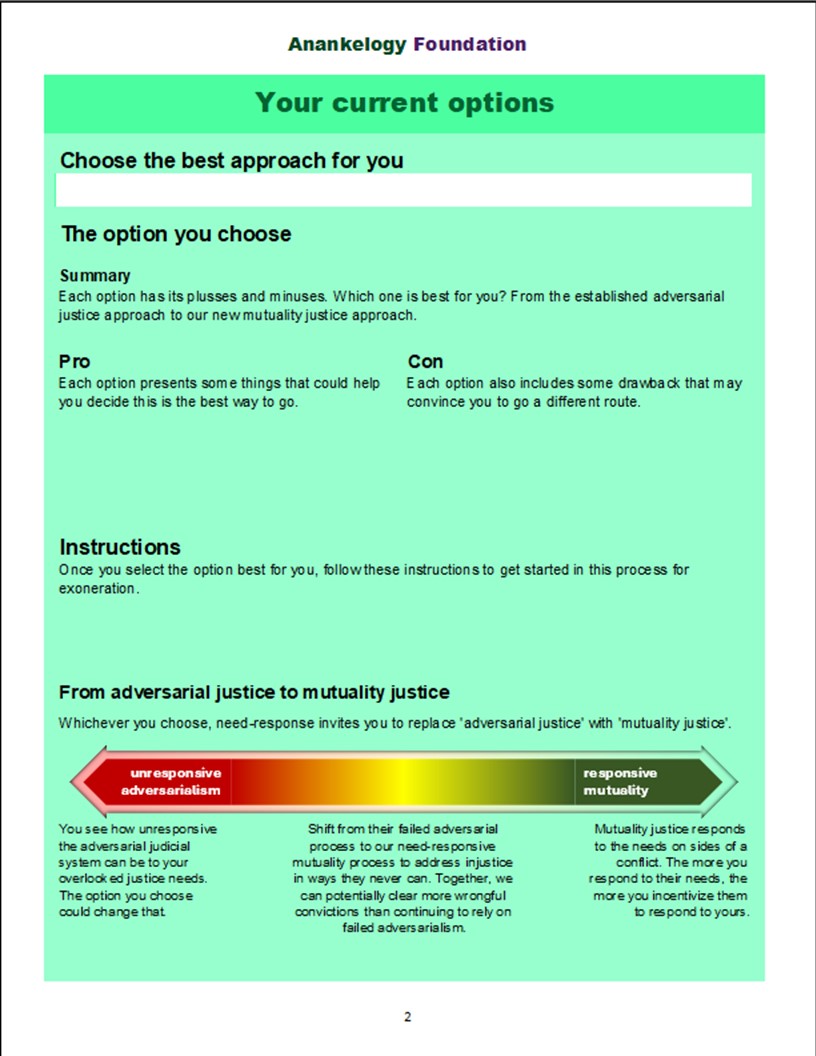

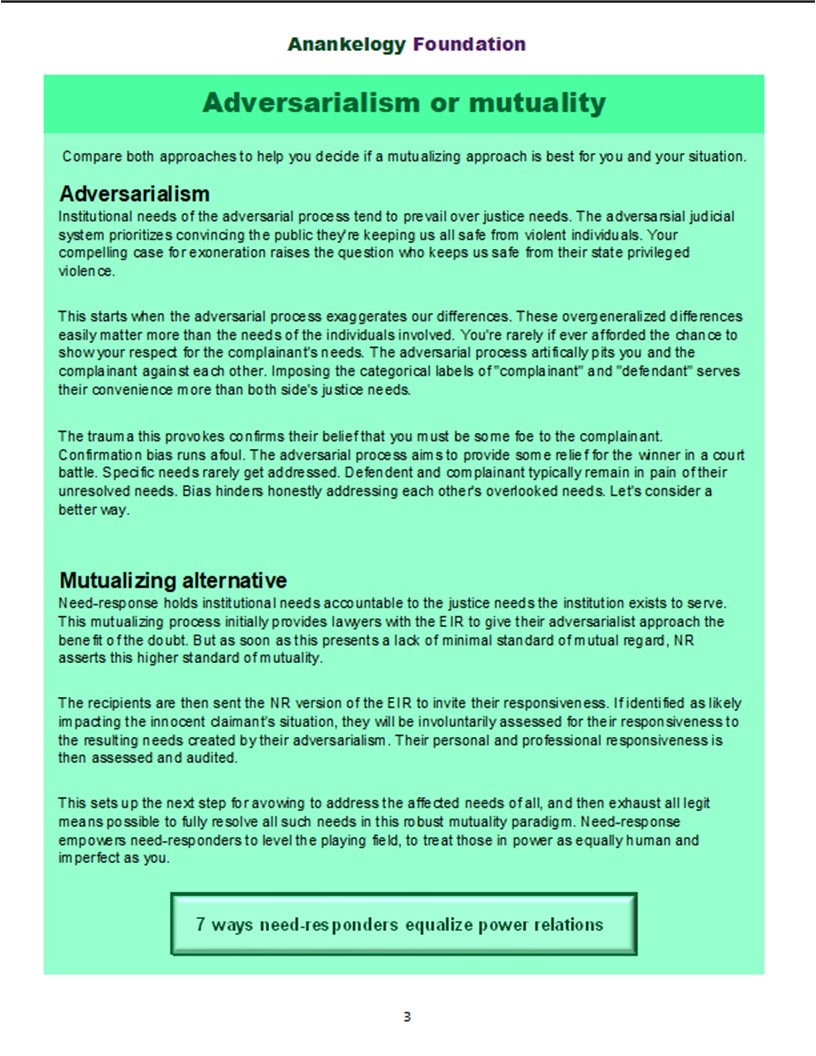

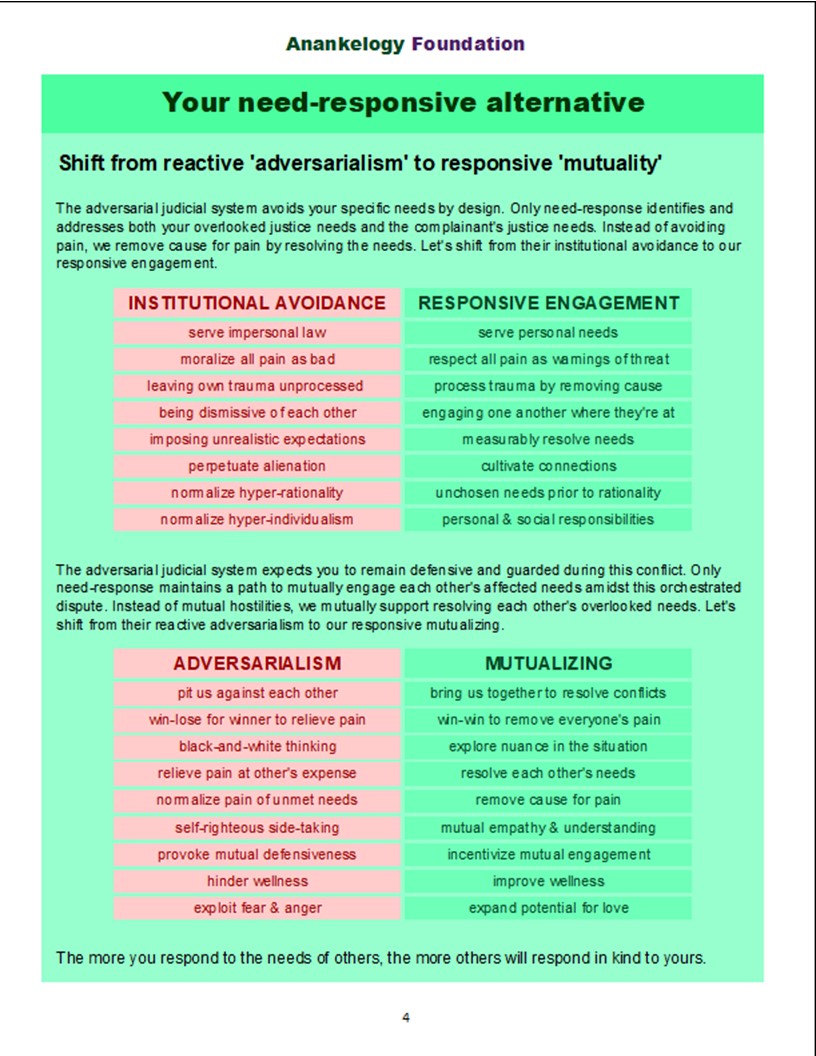

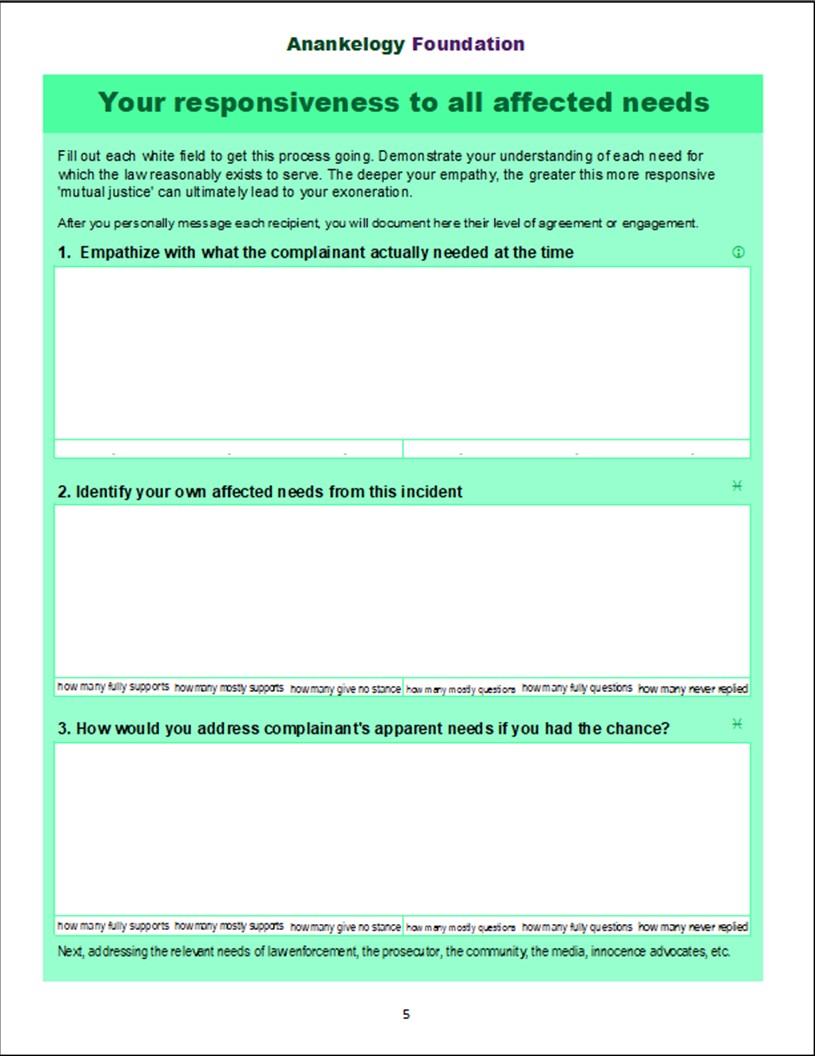

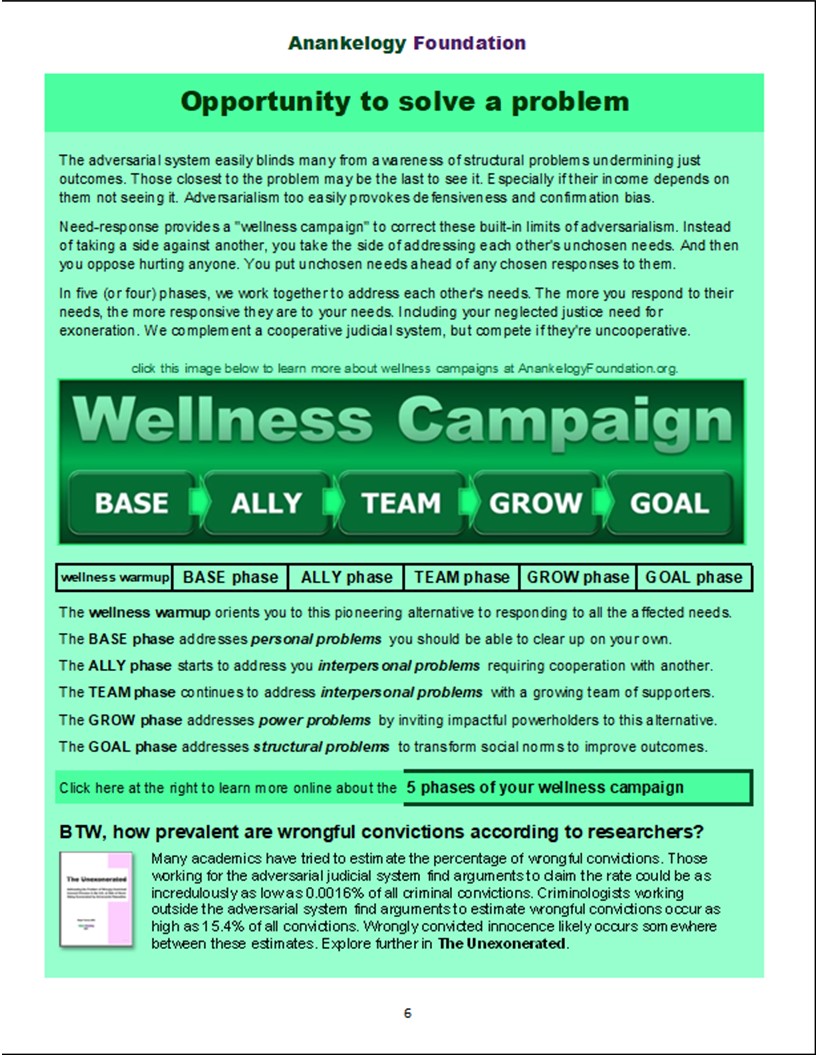

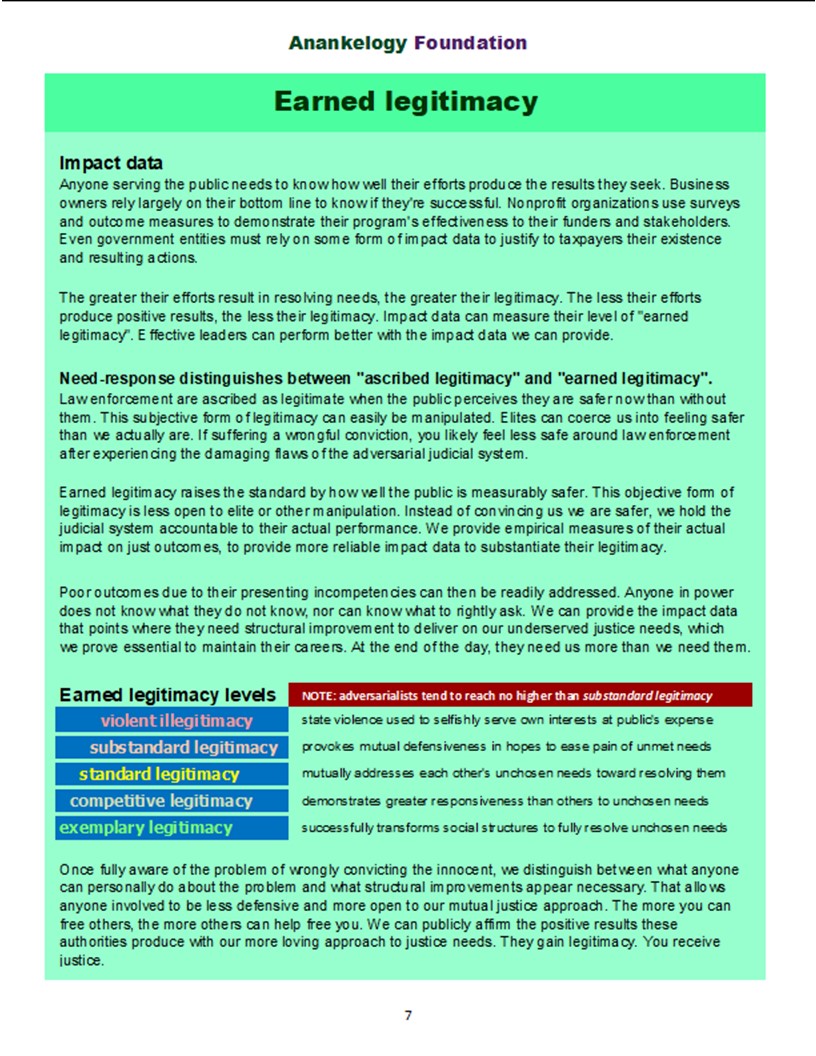

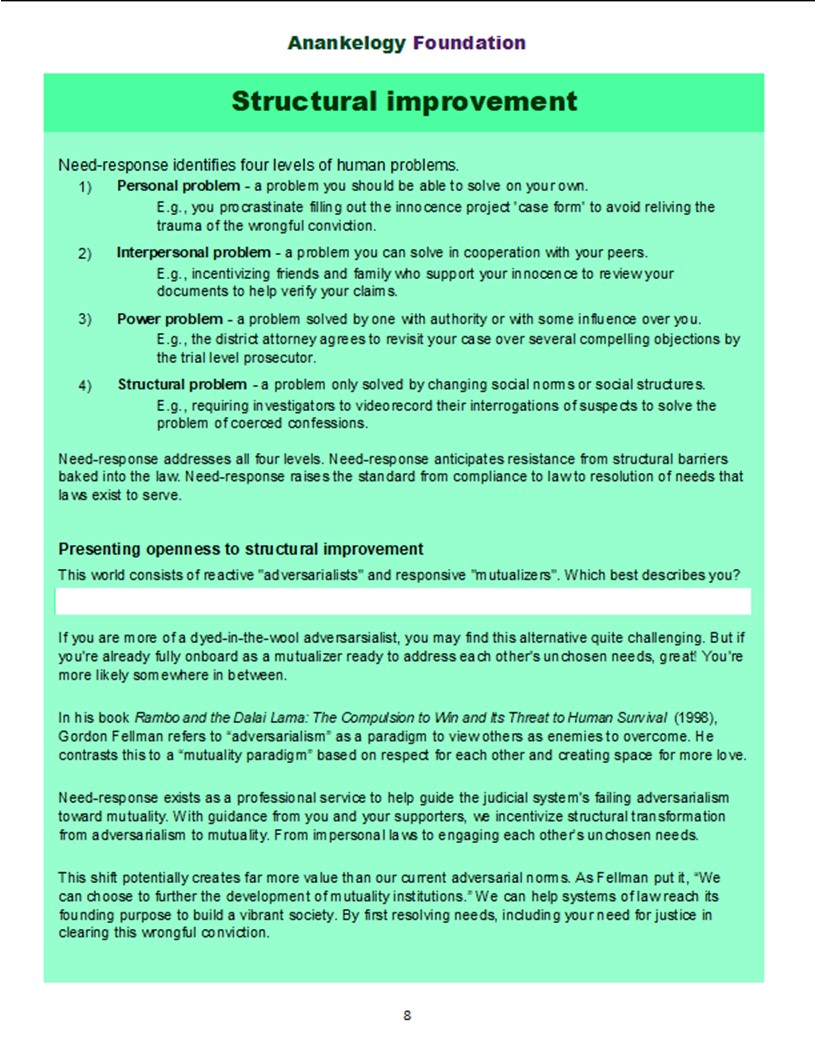

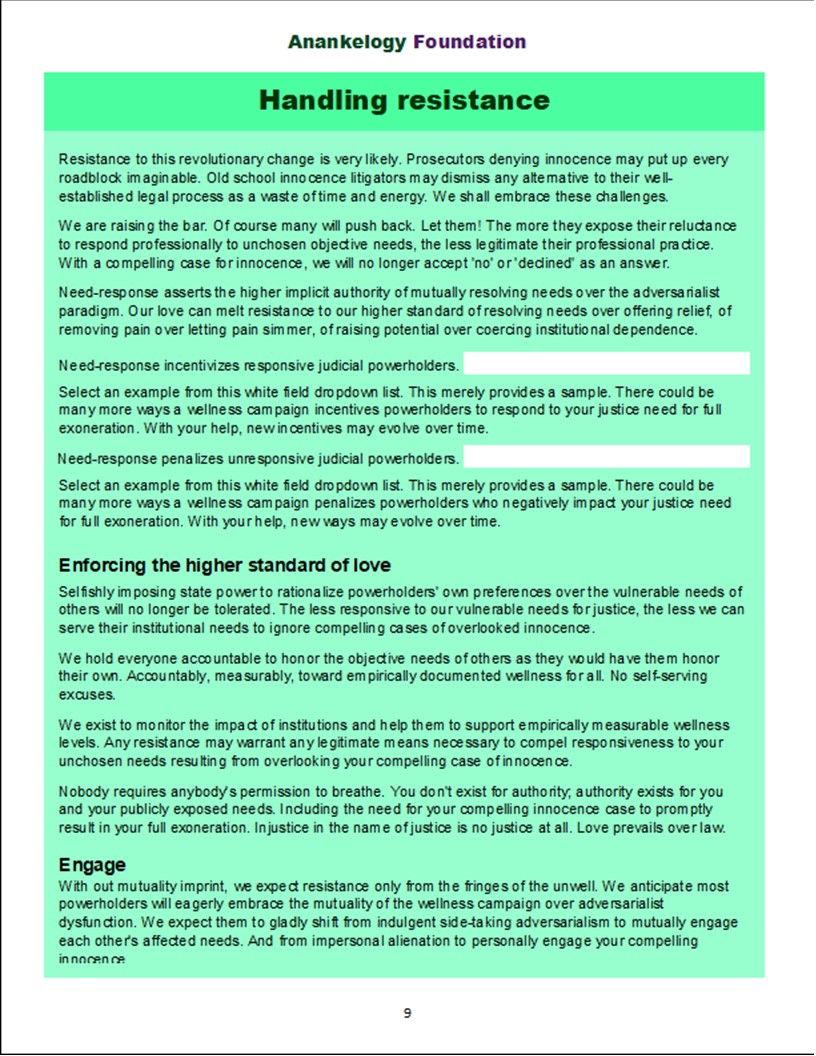

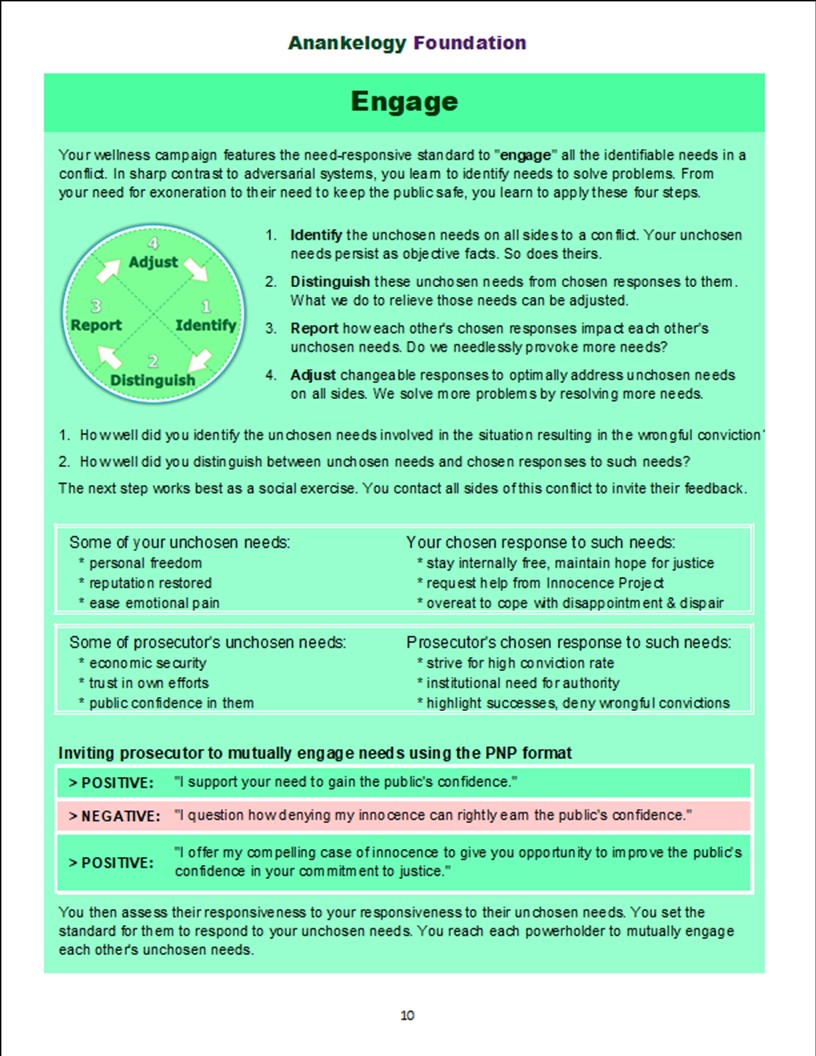





Another proactive alternative to the adversarial process is Responsive Innocence. Or called Responsive Exoneration, it directly addresses the impacted needs on all sides.
Created as an adjunct to the EIF introduced above, it encourages the innocence claimant to shift from standardized adversarialism to more productive mutuality. To be more responsive, per se, to the specific needs of justice.
This includes deliberately thinking about the apparent needs of the complainant. Steph uses this unique tool to try to empathize with what the complainant likely needed that day. And contemplate what if anything can be done for such needs now.
1. Empathize with what the complainant actually needed at the time.
I sense she presented a personal struggle with her own emerging sexuality as same-sex attracted. She later came out as lesbian. She appears to be drawn to my transgender sister as someone openly being herself in a way she likely wish she could be. Or at least drawn to explore what this could all mean for her, at a time when LGBTQ+ people were largely marginalized by mainstream society and not readily accepted at home. When caught not at home when confronted by her mother, she could not say that she willingly interacted with such a "deviant" in the neighborhood. | |
how many: fully agree - mostly agree - give no stance - mostly disagree - fully disagree - never replied |
2. Identify your own affected needs from this incident.
My dominant need at the time was to come out as transgender without being smeared with popular transphobic or homophobic tropes, such as the widespread belief that we're more inclined to pedophilia than cisgender and straight males. To not be falsely accused of sexual misconduct but instead be accepted as an asexual (demisexual) person. Once accused, to have the preponderance of evidence favoring my innocence to show that I am not guilty of what I am not capable of doing. Once wrongly convicted, to be exonerated. Once sentenced to lifetime sex offender registration, to be removed from that listing with prejudice. Ultimately, to have legal recourse in a system less adversarial and based more on mutually addressing the affected needs on all sides to a conflict. | |
how many: fully support - mostly support - give no stance - mostly question - fully question - never replied |
3. How would you address complainant's apparent needs if you had the chance?
If the law would allow it, I would affirm her same-sex attraction. And tell her that I do not personally hold any animosity toward her. I hold no grudge against her for falsely accusing me of things I am not capable of doing. I understand her need at the time to not be out to her mother or to her homophobic-presenting stepfather. I understand her motive to accuse my sibling and then me to avoid getting into trouble by her irate mother, when her mother demanded to know why she was not at home when her mother came home from work. I understand how she was incentivized by the homophobia of the time, that prompted her to shift the spotlight onto us and to then see how the adults would react to other LGBTQ+ people like herself. I appreciate how the reaction toward us would keep her in the proverbial closet for a long time. | |
how many: fully support - mostly support - give no stance - mostly question - fully question - never replied |
Next is one way to try to convey this respect for needs directly to the complainant, if she can be reached.

2.4) Honoring the complaint's presenting needs
Empathy: Understanding her need to be accepted for her same-sex attraction at such a young vulnerable age, and seeing some hope for couragous living when witnessing a transgender neighbor.
Grace: Meeting her where she was at, unable to risk being outed in a mostly hostile environment.
Forgiveness: Letting go of any anger for how she falsely accused us when it seemed that was the only option available to save herself from being outed.
Mercy: Forgoing any right I may have to hold her accountable for upsetting my life.
Justice: To support her to resolve her needs on par with others trying to resolve theirs, in ways the adversarial justice system does not accountably do.
By directly addressing such needs, I proactively fulfill the purpose of laws.
message to the complainant
17 June 2026 | |
Dear [Complainant’s name withheld],
My name is Steph Turner and I am reaching out to you in peace. If you do not remember me, I was the younger trans sibling of the transgender person you met when you were ten years old, back in 1993. In a rush to judgment, police were called and life was never the same for you or for me.
The police and courts divided us, but I did not. It forced us against each other, but I was never against you. I support you in ways the police and the court never could. I affirm you for who you are, as a gay woman of color.
What the criminal judicial system did to you was horrific. In my view, it used you and exploited you to serve its own selfish ends. In 1993, when you couldn’t safely come out to your mom or stepdad as gay, this homophobic and transphobic system manipulated you to go after a couple of trans sisters it hated. You didn’t hate us, but they used your fear of exposure to oppress us who are LGBTQ+.
When you were only ten years old, police and prosecutors forced its agenda on you, and on us. Understandably out of fear, you pointed to “that man with lipstick” to explain where you were when your mother came home from work that day. You understandably avoided trouble by saying you were not home because this “man with lipstick”, my transgender sister, snatched you up and did awful things to you. This fit their prejudice about us LGBTQ+ folks.
Instead of letting you keep it 100% real, they coerced you to say things that reinforced their prejudice. Instead of helping you come out as gay, they coerced you back into the closet. Instead of helping you find self-acceptance and love, they coerced you to destroy the lives of two transgender sisters who could have helped you better accept yourself.
I am not angry with you. I understand. I too avoided rejection by hiding my true self for many years. My true self compels me to transcend the gender binary, and to transcend the divisiveness of the criminal judicial system. I cannot be against you, despite what happened years ago, because of who I spiritually am. Indeed, I am for you and wish they had never done what they did to you.
My transgender sister is no longer with us. She passed away years ago. But I promised her that I would continue our struggle for justice. Our fight is not against you, but against a system that seeks to criminalize us for who we are. Thankfully, we are more accepted now, but still carry the weight of past rejections. I write to you now so you will not be alarmed when I am finally exonerated.
Exonerations of the wrongly convicted like me are steadily increasing. The Innocence Project will soon review my case, and allow the truth to be known. The truth is not what you did as a young child, understandable as that was, but what the misguided adult officials did back then to try to divide us as LGBTQ+ folks. By the love of God, that shall fail. Only love shall endure—including love for you as you authentically and wonderfully are.
With understanding and compassion as a deeper justice,
Steph Turner |
3. Steph repeatedly finds the adversarial legal process unresponsive to justice needs.
Steph finds the innocence movement as disappointing as the appellate process. Six times Steph as sought help and not received any for their compelling case of innocence.
Steph recognizes how all post-conviction options remain mired in toxic legalism. Which is where the law serves the needs of powerful institutions more than the powerless people.
Steph sees how the powerless are unaware of many inaccurate beliefs thy have about the imperfect judiciary. And how this can lull even you into "innocence offending".
Steph accepts their fate as like a canary in a coal mine. By demonstrating the limits of mere law, Steph hopes to attract interest in the new profession of need-response. Which is set to respond to justice and other public needs for more accountably.
Click for comprehensive details
3.1) The innocence movement replicates the problems of adversarial law

While grateful for innocence orgs that can help extend recourse to challenge wrongful convictions, the huge demand from viable innocence claims far outstrips the meager supply of innocence investigators. The advent of AI holds promise to expedite cases more quickly, but it might only put a dent in the massive problem of this systemic injustice.
For now, innocence litigators offer the only avenue of hope for post-conviction relief, for justice from miscarriages of justice. Just like Steph's.
3.1.1) Steph's first attempt
After the disappointing appellate opinion, Steph first sought help from the Innocence Project while early in their prison term. The law project was new and still finding its legs.
They wrote back to decline offering help because they had to prioritize innocence claims on death row.
3.1.2) Steph's second attempt
A few years later, Steph tried again. Back then, innocence projects focused mainly on testing DNA. The only conceivable piece of damning evidence against Steph or Janet was semen found on a green blanket. Neither Janet nor Steph owned a green blanket, so testing this DNA sample could help demonstrate their innocence.
Declined again. This time told they had to prioritize innocence claims serving a life sentence.
3.1.3) Steph's third attempt
Steph was rightly concerned that the wrongful conviction and lifetime sex offender registry would cost them a meaningful job and housing once out. So just before completing the full sentence, Steph again reached out for help from an innocence project.
By this time, each state had its own regional innocence project to process claims. However, Steph was declined help again. They had to prioritize innocence claims who still had many years to serve in prison.
3.1.4) Steph's fourth attempt
In 2014, after being out for 9 years and struggling to survive on a student loan, Steph tried again. By then, innocence projects began to specialize serving certain cases, like bogus sex crimes.
This time, you guessed it, they also declined help. They had to prioritize serving those still in prison.
3.1.5) Steph's fifth attempt
In 2020, Steph fell for a scam from someone claiming they needed Steph to send $50 to prevent being rearrested. So once again Steph reached for help.
By this time, prosecutors launched their own conviction integrity units in response to the mounting evidence of wrongful convictions of the innocent. Steph filed an innocence claim to the Michigan attorney general Conviction Integrity Unit.
They forwarded the claim to Cooley Innocence Project in Lansing, because they just received a grant to process DNA. But they declined help when prematurely deciding Steph’s case lacked a path to reverse the conviction since the case did not significantly involve DNA. Back to the drawing board.
3.1.6) Steph's latest attempt
Most recently, Steph filed an innocence claim with the Michigan Innocence Clinic. They specialize in reviewing innocence claims without DNA testing.
Steph has yet to receive a reply, as it takes up to two years for them to preliminarily check the claim. Steph braces for the news of being denied legal help again. In fact, Steph has become disillusioned with the innocence movement because of its reliance upon the same toxic legalism that produces such errors.
3.2) The compounding problem of toxic legalism
Steph openly wonders if relying upon the legalistic innocence movement leaves them complicit in the quantifiable evils of toxic legalism.
In contrast to surgical application of law, kept accountable to outcomes respecting rights, toxic legalism operates as something of a sledgehammer. It favors the wants and desires of the powerful at the expense of the inflexible needs of the relatively powerless. Wisdom recognizes such needs as objective fact.
While no one sits above the law, no law sits above the needs they exist to serve. Steph's wisdom unpacks five dangerous aspects of toxic legalism that twists the machinery of law away from justice.
3.2.1) Hyper-individualism
Laws hold individuals accountable. But can drift into holding individuals responsible for making the only choice available.
While holding powerless individuals accountable, usually the politically powerless such as poor people of color, the legal system rarely if ever holds its use of legally privileged power accountable. Including the power to target and wrongly convict the innocent.
This compromises the legitimacy of the adversarial judicial system.
3.2.2) Hyperrationality
Laws reflect rational-legal authority. But can drift into suppressing and even repressing the emotional warnings of unresolved needs in the name of reason.
The emotionally charged insistence of being innocent can be dismissed as irrational denial, which denies the imperfections of the adversarial legal system.
This undercuts the trustworthiness of law enforcement to relate honestly to the needs that laws ostensibly exist to serve.
3.2.3) Overgeneralizing
Laws are kept vague to apply widely. But can drift into oversimplifying situations, and turn hyperbolic rhetoric into believed exaggerations. Relevant nuance gets squashed.
That includes oversimplifying categories of procedural convenience. Such as accuser and accused, overlooking incidents where the violated is also an unidentified violator. And imposing the guilt-innocence binary that prematurely provokes defensiveness of the innocent.
This waters down how well the legal system can be trusted to serve our justice needs.
3.2.4) Avoidance
Laws are kept impartial to avoid favoritism. But can drift into alienating privileged avoidance of vital specifics.
The appellate court can insist on conviction finality, ostensibly to avoid retraumatizing the accuser but enabling the courts to evade recognizing or admitting the high volume of miscarriages if justice.
This pulls the rug out from fully trusting the judicial system.
3.2.5) Adversarialism
Laws come with punishment for violators. But can drift into premature opposition to those assumed to be guilty of something.
The falsely accused could sit down and explain the misunderstanding, to clear things up. But once adversarialism enters, any attempt to explain what actually happened or didn't happen easily appears like some kind of defensive denial.
This robs the legal system of full legitimacy.
You see, this goes well beyond the injustice of wrongly convicting the innocent. Justice costs much, while injustice runs cheap.
3.2) Public naivete about the actual machinery of adversarial law
Most of us live with the bias that the legal system reliably protects us from violent offenders and fairly treats all who get detained. Those processed through the adveresarial judicial system quickly lose such illusions.
When they speak up about the many shortcomings of the judicial system, they get silenced. Privileged avoidance smears them as stereotypical offenders, who deny accountability for their offenses. As if they are the only ones with mistakes to hide.

Such accusations project as a confession. It is now easier for the accused to humbly admit their mistakes than for police and prosecutors to humbly admit their mistakes. On one level, that is how the adversarial legals system actually works.

Perhaps you have seen videos on YouTube of citizens angrily protesting to some cop that they know their rights. Like the fool who insisted he wasn't guilty of "posession" of stolen property because he didn't actually "own" it but was merely holding it for a friend.
Perhaps you naively hold to less extreme assumptions about the law. Are you open to questioning your beliefs about the law?
Do you believe that people generally get what they deserve?
Do you believe that all or at least most prisoners claim they're innocent?
Do you believe that high conviction rates contribute to a reduction in crime?
Do you believe that the U.S. has the best judicial system in the world?
Do you believe that wrongful convictions of the innocent rarely occur?
Do you believe that a criminal defendant is more likely to lie than a police officer?
Do you believe that if someone gets arrested, they must have done something wrong?
Do you believe that no one would confess to a crime unless they're guilty in some way?
Do you believe that forensics evidence provides conclusive proof of culpability?
Do you believe that the appeals process will correct any miscarriages of justice?
Do you believe that eyewitness identification of a perpetrator is consistently reliable?
Do you believe that the judge is the most powerful person in the criminal justice system?
The more you believe and act on such things, the more at risk of "innocence offending".
3.3) Innocence offending
Steph offers grace to each identified innocence offender. And almost everyone is.
Grace is meeting you where you are honestly at. It works well with humility. The more you can drop your guard and trust my understanding, the more you can learn and grow from increased awareness.
Initial awareness of innocence offending can be understandably uncomfortable. Lean into it. Such pain is not the problem as much as the threats it exists to report. Together, we can remove the threats fueling our pain of unresolved needs. There is no such thing as pain apart from unresolved needs.
Along the way, you too can improve your life by dropping the legalism that no longer serves. Allow yourself to learn from me, as a kind of canary in a coal mine who had to drop such wellness-compromising legalism long ago.
Download your own copy of this Innocence Offending Self-Asseessment (IOSA) tool. If too many of us are being manipulated into ignoring the plight of the wrongly convicted innocent, then a post-legalist option is in order. One that steps outside the biases of adversarialism.

3.3) Canary in a coal mine
The toxic legalism tainting the lives of the wrongly convicted innocent could soon target you.
The government has us all under surveillance now. Zealous law enforcers can detain you for ostensibly violating laws you may never knew existed. Overzealous prosecutors, who can get a jury to indict a ham sandwich and count on conviction rates to prove their worth, could eventually target you.
As American society become more culturally diverse, it has also become more legalistic. Which increases the profile of law enforcement's interactions with citizens. Conside the ICE raids as the more visible tip of this iceberg. When that hammer comes to town, you could be the nail it seeks to pound.

As more Americans feel disillusioned with legalistic insitutions, most "felons" are already disabused of such illusions. They may even shrug at those who ignored their warnings and now suffer the consequences. Does that include you?
Steph has been developing a new profession to complement law enforcement, or compete with it to produce better outcomes. Unfortunately, Steph shows little progress due largely to the wrongful conviction.
Like you, Steph remains trapped in this sick society. Conside how far off the rails we must be when an asexual person gets put on the lifetime sex offender registry.



4. The wrongful conviction has trapped Steph in poverty and homelessness.
Despite earning degrees in sociology, anthropology, public administration and counseling, Steph remains underemployed. Background checks exclude Steph from consideration.
Criminal background checks excludes Steph from better housing options.
Relied on campus housing
Lived with family members
Residing in a slum lord boarding house
Steph's skills, talents and degrees remain underutilized while working in a factory for low wages and living in a slum lord boarding house.
Consequently unable to afford to hire a lawyer to undo the damage, and not convinced that would do any good. And ready to confront the deeper system problem of toxic legalism.
Click for comprehensive details
4.1) Shortly after leaving prison, Steph returned to college
Steph attended college year round from January 2006 to December 2015. That was the only way to qualify for housing and a student loan for a cost of living allowance.
4.1.1) Bachelor in Sociology and Anthropology
Steph enrolled in Oakland University north of Detroit, and finished in two years an undergraduate degree in sociology and anthropology. With honors.
Steph became dependent on year round student aid for survival. And year round campus housing. This accelerated enrollment allowed Steph to finish in two years.
Outside of class, Steph launched the Native American Student Association. Or NASA for short; we stayed grounded instead of heading to space.
Steph also kept active in the Gay-Straight Alliance (now SAGE) on campus. Becoming its president during their senior year. By this time, Steph was visibly out as trans, the first trans woman on campus. As the GSA president, Steph oversaw coordination of its annual drag show in early 2008. And performed in it as as a student and amatuer.
Outside of campus, Steph edited and produced a quaterly publication distributed nationally. This Trans Sprituity zine was for and by transgender prisoners across the U.S. It ran from December 2005 until early 2008, when funding was pulled.
As some drew closer to leaving prison, they lamented the lack of any reentry service specifically for trans ex-prisoners. So Steph launched the TransAction program, the first ever reentry service specifically for trans ex-prisoners.
Overwhelmed by the challenges, Steph reached out for help from Transgender Michigan, a nonprofit clearinghouse linking linking trans people to much needed services. But the lean organization needed help to be sustainable, so Steph joined the board in the summer of 2007. Steph then sought a degreee in Public Adminstration to help sustain the vision.
4.1.2) Master of Public Administration
Steph continued their education at Oakland University, enrolled in their MPA program. With an emphasis with nonprofit management.
Steph resigned from the Transgender Michigan board to focus on post graduate studies. But then returned for their capstone project: providing Transgender Michigan's first strategic planning process. Which helped them to refine their mission, vision, and branding...among other things.
During this time, the executive director of Transgender Michigan, Rachel Crandall, was cultivating her vision to imprive trans visibility around the world. This evolved into Rachel Crandall starting the International Trans Day of Visibility each year March 31st.
Background checks prevent Steph from capitalizing on this experience and education. To continue surviving on student aid, Steph returned to Oakland University to puruse another graduate degree.
4.1.3) Master of Counseling
Steph enrolled in the Masters of Counseling program from 2012 through 2015. As a visibly trans woman. Early into the program, Steph openly acknowledged the wrongful conviction and wrongful lifetime sex offender registration.
While many within the counseling program empathetized with Steph and appreciated how a trans person can be unjustly targeted by law enforcement, the school's attorney was not one of them. After securing malpractice insurance for interning as a student counselor, and blessed to proceed by the academic leadership including the provost, this lawyer initially refused to grant clearance.
While waiting for such permission, Steph exhausted eligibility for student aid. Only then did the school attorney allow Steph's internship at Affirmations in Ferndale. Consequently, Steph was unable to pay the full tuition bill. And could not graduate.
Steph soon recognized this as systemic exaction, of powerful institutions or powerful individuals coercively extracting concessions from those who can do little about it, which apparenlty is privileged under color of law. This lawyer presented the same toxic legalism manifested in the wrongful conviction.
Neither the public facing public admin education nor the inward facing counseling education provided meaningful answers for redressing such law-privileged power differentials. In fact, there currently isn't any professional service to transcend the limits of law to directly address the neglected needs that laws ostensibly exist to serve. Steph might have a solution.
Sabotaging Steph's attempt to rebuild their life and improve not only their earning capacity but their potential to help others, because of a wrongful conviction, is arguably not properly authorized in the more disciplined need-responsive sense. This concluded Steph's time at Oakland Univesity, and would next move in with family in Kalamazoo. But this legalism problem would crop up again and again.
4.2) Steph then moved in with family in Kalamazoo, and trouble followed
Once moving in with family, Steph discontinued presenting as a trans woman. All of Steph's children reached adulthood, having kids of their own. Besides steering away from having to explain "trans visibility" to these conservative leaning kin, Steph went back to prioritizing the spiritual dimension of being transspiritual. Which is mostly invisible to others.
While others wrestle with contrasting extremes, transspirituality compels Steph to integrate complementary sides toward greater wholeness, toward human flourishing.
instead of unemotional or irrational sides, blending reasonableness with intuition
instead of intellectualizing or emotionalizing, blending reasoning with sensitivity
instead of dominating or smothering, blending safeguarding with cultivating
And so forth. Instead of indulgent side-taking of clashing gender norms, which easily compromises human flourishing, the underbelly to Steph's gender norms transcendence aims to integrate the best of both worlds. Normies assume such balance can only be compelled by sexual desire, as they have no frame of reference to appreciate spiritual compulsion toward holism.

Meanwhile, leaving campus life allowed Steph to pursue some entrepreneurial goals, to try to fulfill their transspiritual purpose in life. After moving to Kalamazoo, Steph...
created an eCourse on Udemy: Defusing Polarization: Understanding Divisive Politics,
wrote a book and self-published on Amazon: You NEED This, Introducing anankelogy,
built and launched a website on Wix: AnankelogyFoundation.org,
began a post-legalism exoneration service for the unexonerated innocent, and
launched the Need-Response podcast cohosted with a friend in Brazil.
After moving to Kalamazoo, Steph was no longer active on social media. The algorithms provoking needless hostilities proved too smothering for Steph's transspiritual integrity. So normal paths for promoting these ventures were not as open to Steph. Without needed help, Steph found little success in these efforts.
Due to the wrongful conviction, the pandemic shutdowns and family requiring space to raise their kids, Steph became homeless for a year. Taking a low paying factory job provided the meager means to afford substandard housing.
Meanwhile, Steph endured repeated exploitation and economic exclusion of transspirits and the wrongly convicted innocent. This includes that problem with Oakland University's lawyer.
4.2.1) Damaging power differentials with attorneys
Steph received notification from the state Department of the Treasury asking for repayment of the unpaid tuition bill. Steph replied each time with a request to contest the bill, to hear their side of the story. Each time, Steph's asserted due process rights were ignored.


prompted Steph to wonder if innocence even matters to anyone in position of power.
In the autumn of 2025, the Michigan Treasury Department froze Steph's bank account and garnished their wages. They took the alleged amount owed from Steph's bank account, and continued garnishing their wages beyond the ststed amount owed.
State lawyers brazenly violated Steph's 4th Amendment rights against seizing my private property without due process. Several weeks later, they returned the "overpaid" balance, without any apology. Steph's financial health went from bad to worse.
4.2.2) Damaging power differential with healthcare providers
Speaking of health, Steph endures many power differentials from medical providers failing to transparently identify actual billed costs. In contrast to the ethical standards learned in social science research with human subjets, of informed consent, Steph gets repeatedly coerced (while vulnerably in pain) into making healthcare decisions without being informed of the actual billable costs. Then later receives a medical bill exceeding their marginalized means to pay it.
Slipping into medical debt runs counter to Steph's overall wellness. When asking a medical center receptionist about the actual billed amount prior to visiting the doctor, Steph was told that they do not know the specific amount because of insurance billing practices outside of their control. Which violates Steph's patient's rights for transparent medical billing.
Specifically, such information assymetry and "surprise billing" violates the new Federal No Surprises Act. Is it up to the patient desperate for relief from a medical ailment to know and assert their legal rights? Or can healthcare provides exploit the vulnerably uninformed with little if any impunity?
The wrongful convictions adds a layer of ethical implications, robbing Steph of the financial means to afford hiring a lawyer to undo such added damage. And no lawyer can address the innocence offending involved. Those in power continue to extact value from the vulnerable under color of law, all privileged by toxic legalism.
4.2.3) Damaging power differentials with employers
The only job Steph could initially get was with Jimmy Johns. Many (not all) of its managers would repeatedly yell at the workers to coerce their compliance. As an intrinsically motivated worker, Steph easily lost motivation when externally pressured with a manager's anger.
Blind to their error, these inexperienced managers would often react by yelling even more. A vicious counterproductive cycle unfolded, undercutting Steph's good faith efforts to cultivate human flourishing for us all.
Once when objecting to a manager of being needlessly yelled at, the HR later called Steph and threatened termination if Steph voiced such complaints again. Steph was silenced and not allowed to complain how they were not paid for all their hours on multiple occasions. All under color of law.
As long as you obey the law as those in power over you violate your rights under color of law, Steph observed, such power differentials will continue to damage the lives of us all. There must be a better way. Perhaps Steph will craft a much-needed alternative to failed adversarial law.
5. Steph unpacks the hidden threat to wellness from power differentials.
Power differentials can impact wellness outcomes in positive and negative ways. As society slips further into anomie, negative impacts abound. Often under the radar of social visibility. And often privileged by social custom and written laws.
Less visible is how power differentials bring about a sick society. We're quick to blame the individual, while slow to recognize the accumulative ill effects from many power problems and structural problems impeding the proper resolution of needs. Unresolved needs lead to lowered wellness and increased pain for us all.
While every individual remains accountable for their moral agency, for their personal choices, those choices can only be as good as the options realistically available to them. The more the influence from power differentials constrains those options, poor wellness outcomes become predictable.
Each power differential features an "impactor" and an "impactee".
Impactor: impacts the relation more than impacted by it. I.e., powerholder.
Impactee: gets impacted by the relation more than impacting it. i.e., relatively powerless.
The impactee who remain humbly content with a lean lifestyle, instead of aggressively pursuing wealth, can be targeted by aggressive accumulators of property. Some of these wealthy then abuse others with their material advantage, to exploit the humbly content person's vulnerabilities, and invest their resources to rig the system toward their legal advantage. Then assume their actions are legitimate since few if any complain.
By what authority does any powerholder impede the humble person's path toward human flourishing? How is this not some privileged evil?
Moreover, what can be done about it? Steph may have an answer...in part two.
Click for comprehensive details
5.1) Impact disparity
Individuals interacting with professionals or with government officials will generally have less impact on wellness outcomes than that professional or official. Need-response assumes societel wellness or societal sickness primarily results from these power differentials, in ways Western culture tends to overlook.
Each power differential features an "impactor" and an "impactee".
Impactor: impacts the relation more than impacted by it.
Impactee: gets impacted by the relation more than impacting it.

The academic literature on power differentials helpfully sheds some light on this structural problem not yet effectively addressed by any professional service or institution. Because no current service nor institution properly recognizes inflexible needs as objective fact.
In arguably the key academic article in this literature, authored by Keltner and others, they address the need to hold powerholders accountable.
Accountability—the sense that one’s actions are personally identifiable and subject to the evaluation of others—often acts as a constraint on unchecked power. Individuals in power who know they will be held accountable are more likely to consider social consequences and take others’ interests into account.” (Keltner, et al., 2003)
In the words of Frederick Douglas, "Power concedes nothing without a demand. It never did and it never will." In the full context of his 1857 West India Emancipation Day address in Canandaigua, New York, he said:
If there is no struggle, there is no progress. Those who profess to favor freedom, and yet depreciate agitation, are men who want crops without plowing up the ground. They want the ocean without the awful roar of its many waters. This struggle may be a moral one, or it may be a physical one, and it may be both moral and physical, but it must be a struggle. Power concedes nothing without a demand. It never did and it never will.
Perhaps Malcolm X was echoing this sentiment, in his Message to the Grass Roots, when declaring that "there is no such thing as a nonviolent revolution".
You don't have a peaceful revolution. You don't have a turn-the-other-cheek revolution. There's no such thing as a nonviolent revolution. The only kind of revolution that's nonviolent is the Negro revolution. The only revolution based on loving your enemy is the Negro revolution. ... Revolution is bloody, revolution is hostile, revolution knows no compromise, revolution overturns and destroys everything that gets in its way.
As Malcolm X and others pushed back against MLK and the nonviolent civil rights movement, both sides complement each other. Need-response brings the best of both together.
Only this new profession holds us all accountable to honor the inflexibility of needs in each other, heralding the standard to love over law, and also incentivize responsiveness to such needs under something of a Damocles sword.
5.2) Provoking poor wellness outcomes
Despite obeying the law, Steph gets targeted by people in positions of power for exploitation. Unquestioning obedience appears overrated, in these three power differential realms.
1. Wrongful conviction. Despite Steph only having sexual contact with their then wife, this power differential privileges others to project their sexual angst onto Steph. Which hinders Steph from properly resolving needs, resulting in poor wellness outcomes.
The tragic irony is that Steph is demisexual (a form of asexuality where one must first form an emotional bond to experience sexual attraction), but was accused of a sexual offense without evidence. And every background check replicates this law-privileged injustice.
The power differentials built into the adversarial judicial process privileges those in positions of authority to distort public perception of reality toward their liking.
The adversarial legal process offers relief from pain for the winning side, and grants Steph a steady source for anxiety and depression.
2. Medical billing. Despite enjoying relatively good health at 63 years old, Steph still seeks medical help for the ocassional ailment. Creeping medical debt from "surprise billing" of unexpectedly large copays now costs Steph full wellness.
The tragic irony of trusting healthcare providers who bill for services without fully informed consent leads to compromising the patient's wellness. A tradeoff imposed by these power differentials.
The power differentials built into the doctor-patient relation includes the ethical standard of informed consent. But the capitalist pressures involved find a way to brush aside this ethic of transparent billing.
While easing the suffering from physical pain, such practices can evoke the emotonal pain of anxiety and powerlessness.
3. Insensitive managers. Despite seeking jobs utilizing their education, skills and talents, the wrongful conviction traps Steph in low paying at-will jobs. None allow Steph to fulfill their purpose in life. Especially when managers emotionally pressure Steph to bend to their expectations.
The tragic irony of pressuring an intrinsically motivated worker with extrinsic motivations can risk demotivating top performers. Or exploiting intrinsically motivated employees with more tasks can lead to burnout and other poor wellness outcomes.
The power differential built into the employer-employee relationship, on who the typical employee is vulnerably dependent upon for their economic wellbeing, dissuades the employee from seeking legal recourse to investigate potential abuses of power. What if they are wrong and then let go?
Instead of making waves at a time jobs are hard to get, many suffer silently as they use a portion of theor paycheck to sooth their pain of anxiety and ecomic insecurity.
____
Steph is in a unique position to debunk the popular notion that doing the right thing brings the right results. And to illuminate how such power differentials contribute to producing a "sick society" with limited options for making things better.
5.3) Impactee options
When in conflict with those with the power to make life miserable for you, you likely experience the amygdala-fueled stress response options of fight-flight-freeze-fawn-flop-or-fatigue. The flight response, or raction, can evoke your "adversarial options". The other "F" reactions evoke your "avoidant options".
The less such options result in properly resolving needs, the less well you likely will remain and more pain you likely will endure. Not enough attention is given by existing professions or institutions to navigate such conflicts toward full resolution.
You could hire a lawyer. But an attorney takes an adversarial stance that usually does little if anything to properly resolve your affeected needs.
You could hire a psychotherapist. But a counselor can hardly help you incentivize power differentials to support your affected needs.
Need-response steps in to fill this gap. For both professional and official government power differentials. Professional power differentials typically allow competition. Official power differentials typically do not. Reactions unfold accordingly.
5.3.1) Avoidance options (cope: flight, freeze, fawn, flop, fatigue)
presenteeism (showing up less than 100% well)
absenteeism
do only what is minimally required
decreased economic productivity
reliance on public welfare
endure mounting anxiety
suffer depression
cope with mood altering substances and behaviors
redirect any ire to less threatening targets (displacement)
5.3.2) Adversarial options (cope: fight)
lawsuit (litigate in court)
administrative complaint
regulatory body
grievance process
media campaign
online negative review
public petition
denouncement on social media
ballot (official level)
direct political action
civil disobedience
5.3.2) Need-responsive options

Continue reading in part 2 how to shift from these poor options to what we all need. Not only for Steph's overlooked innocence, but for the power differentials impacting your life. Discover how we can
speak truth to power (STTP)
in ways they will want to
listen to those impacted. (LTTI).
Public Exoneration of Steph Turner part 2
Click the button below to conclude this post.


Comments