
.png)
Power Problem Options & Effects

Updated: Jul 5
The 4th step in the need-response process

A power problem occurs within power differentials. When one or both sides cannot meet their needs due to some conflict within the relation, need-response identifies this as a “power problem” with its own peculiar options and effects.
A power differential involves an impactor and impactee.
The impactor affects the relation more than gets affected by it.
The impactee gets affected by the relation more than affects it.

Illustrating the power differential
For example,
for professional power differentials:
Employer-employee
Supervisor-supervised
Doctor-patient
Teacher-student
Creditor-debtor
Counselor-client
Media outlet-viewer
Bill collector-unemployed customer
for government power differentials:
Police-civilian
Prosecutor-detainee
Politician-voter
City council-resident
Gov't case manager-service seeker
Zoning official-businessperson
IRS-taxpayer
ICE-immigrant
And many more.
The impactor typically enjoys more control over outcomes than the impactee. If a conflict emerges, the impactor tends to get their way more than the impactee.
Consequently, power differentials readily impact the wellness outcomes of impactees. Either positively or negatively. In ways widely overlooked in other professional options.
The more the power difference impedes the impactee’s ability to properly resolve their needs, their capacity to function swiftly declines. All too often, the impactor is not even aware of their harmful influence. Not only on the impactee, but also on themselves.
As the impactee’s wellness declines, the impactor’s trustworthiness (or legitimacy) correspondingly declines. This phenomenon is so pervasive that it fuels a significant portion of “societal sickness”.
Need-responders function like first responders on a mass scale, to try to heal society one power differential at a time. Their approach sifts through three main options.
Two that are sour and one that is sweet.
When the impactor’s pressure remains subtle and tolerable, the impactee typically opts to avoid confrontation. It can be easier to endure the inconvenience than risk bigger trouble.
When the impactor’s pressure becomes more opaque and painfully intolerable, the impactee likely will challenge the impactor. The risk of absorbing the blows becomes too great.
The new professional service of need-response introduces a viable alternative to those extremes. Instead of evading or confronting each other, need-response incentivizes mutual cooperation.
TABLE of CONTENTS
Click on the item to quickly get to that item covered below. Once there, click on its title to return to this table of contents.
I asked Claude: “What are all the adversarial options a vulnerable individual can take when their rights or their needs are being violated by those with more power?” The highlighted text is Claude’s reply to my prompt. I added the numbered outline for easy reference.
This is an important question about power imbalances and justice. Here are the main adversarial options available to vulnerable individuals:
I.1.1. Civil lawsuits — Sue for damages, injunctions, or specific remedies. Requires resources but creates a formal record.
I.1.2. Criminal complaints — Report violations to law enforcement or prosecutors. Victim advocacy organizations can sometimes help navigate this.
I.1.3. Administrative complaints — File with agencies like labor boards, housing authorities, civil rights commissions, healthcare regulators, or consumer protection agencies. Often free or low-cost.
I.1.4. Regulatory bodies — Report to industry-specific regulators (financial, environmental, healthcare, workplace safety).
I.1.5. Appeals and grievance processes — Within organizations, institutions, or government systems that have internal review mechanisms.
I.2.1. Media exposure — Documentaries, journalism, social media campaigns can shift public opinion and create pressure.
I.2.2. Organizing & collective action — Unions, tenant unions, worker organizing, community coalitions amplify individual voices.
I.2.3. Public testimony & comment — At city council meetings, regulatory hearings, school boards, or public forums.
I.2.4. Demonstrations & protests — Visible, organized public action to demand change.
I.2.5. Petitions & public campaigns — Build support, pressure decision-makers.
I.3.1. Legal aid organizations — Free or low-cost legal help.
I.3.2. Advocacy nonprofits — Groups focused on civil rights, labor, housing, immigration, disability rights, etc.
I.3.3. Pro bono attorneys — Lawyers working for free on civil rights cases.
I.3.4. Community organizing groups — Help build power and strategy.
I.3.4. Whistleblower protections — Some laws protect those reporting illegal conduct.
I.4.1. Documentation — Detailed records, photos, videos, contemporaneous notes (crucial for any case).
I.4.2. Demand letters — Formal written demands before escalating.
I.4.3. Negotiation & mediation — Sometimes third-party mediators can help resolve disputes.
I.4.4. Strategic lawsuits — Class actions amplify individual claims; precedent-setting cases create broader change.
I.4.5. Political engagement — Voting, lobbying, supporting candidates/policies that address the issue.
Claude added how adversarial options pack some chilling risks.
The effectiveness of these depends heavily on:
II.1.1. Resource access — Money for lawyers, time to pursue complaints, transportation
II.1.2. Power differentials — Systems often favor those with more resources and institutional backing
II.1.3. Systemic barriers — Discrimination, bias in institutions, retaliation risks
II.1.4. Type of violation — Different violations have different remedies
II.1.5. Geographic/jurisdictional factors — Available protections vary by location
In situations where formal channels are blocked or ineffective, vulnerable people sometimes:
II.2.1 Seek support from faith communities, mutual aid networks, or international human rights organizations
II.2.2 Document patterns to share with journalists or researchers
II.2.3 Build long-term community power for future change
II.2.4 Appeal to higher authorities (appeals courts, ombudspeople, international bodies)
The hard truth: Adversarial action requires sustained effort and often carries personal risk—retaliation, financial strain, emotional cost. Success is not guaranteed, and the most vulnerable often face the greatest barriers to justice, which is why collective action and institutional support are so important.

These all point to legal adversarial options. Under certain harsh conditions with desperate souls demanding prompt change, a violent revolution is not out of the question. If Thomas Jefferson wrote that we have the right or even the duty to replace illegitimate government, then what could happen if all legal options thwart such an agreed upon necessary change?
Both JFK and MLK illuminated this risk for violent revolution. And we know both lost their norm-transcending lives to the violence of a gun. MLK’s love-focused message warned of the costly risk of an adversarialist path.
Need-response identifies some additional limits beyond Claude’s helpful insights.
II.3.1. Provoked defensiveness – Adversarial options easily trigger mutual defensiveness. Instead of trying to mutually relate to each other’s affected needs, both sides raise their guard and avoid any meaningful dialogue. Instead of encouraging cooperation, both sides understandably get selfish. What you reactively resist you reflexively reinforce.
II.3.2. Cognitive contraction – Adversarial options consume more focus, as triggered defensiveness prioritizes threat removal or avoidance. Less space is available to reflect on better options. Each side is typically too busy looking out for themselves.
II.3.3. Toxic legalism – Adversarial options is featured in toxic legalism where the structure of law assumes oppositional parties, which presume each side must be categorized and processed (i.e., objectified) with rational-legal authority. Relief is offered to the winning side in a political or judicial contest, without accountably addressing all affected needs.
II.3.4. Squandered potential – Adversarial options wastes precious human potential to empathize with each other, to care about each other’s affected wellbeing, and to nurture the potential to love one another amidst conflict by honoring the inflexible needs of others as one’s own.
II.3.5. Elite coercion – Adversarial options grant more power to expert leaders who may impose their own imperfect solutions to those in a power differential conflict. Their top-down solutions rarely address every relevant detail necessary to fully resolve a conflict and restore each other’s wellness.
II.3.6. Coerced poor options dependence – Adversarial options pull each side into relying on suboptimal choices. Instead of being incentivized to identify and resolve each affected need, the opposition structure normalizes accepting the results as the best on can get, which often favors the more powerful impactor as the impactee is pressured into accepting some concessions compromising their wellbeing.
II.3.7. Damaged trust – Adversarial options undermine legitimacy in our institutions as the dismal results rarely improve the lives of those struggling in power differential. Especially if the power conflict is with a government official or with a government institution itself.
II.3.8. Societal sickness – Adversarial options compromise the wellbeing of individuals who are kept from properly resolving their affected needs. As such adversarial options become the normalized go-to for handling power conflicts, or even peer conflicts, the increasing volume of unresolved needs takes its toll on the whole of society. More of us then sink into symfunction. We then risk slipping into dysfunction and despair, unable to reach our lives’ full potential.
Let’s admit this merely scratches the surface. And AI remains imperfect. More could be said about adversarial options and effects, but let this serve as a grounding start and then move on.
A power differential with a professional is one thing. They typically enjoy access to greater resources to get their way at the impactee’s expense. They may even invisibly harm the impactee under color of law, such as cutting off much-needed service. But they do not claim an exclusive use of violence to compel your compliance.

A power differential with a government official or entity is quite another. They present the power of the government, with exclusive claim to violence, to impose their will upon the impactee. The affected impactee may concede to state pressure to avoid the threat of property loss (i.e., a fine) or loss of their freedom of movement (i.e., incarceration).

While appearing to be a solution, adversarialism can quickly devolve into a problem of its own. Consider the hidden problem of countless wrongly convicted innocents sent to prison. Including those who eventually are released and spend the rest of their lives without their full rights restored. I’m one, like some kind of canary in a coal mine.
Canary in a coal mine
What is the falsely accused impactee to do if the same impersonal legal system that wrongly convicted them is not properly incentivized to recognize or correct its costly mistakes? The estimated volume of wrongly convicted innocents runs into the hundreds of thousands.

The United States has the highest volume of prisoners in the world, due in part to an adversarial criminal judicial system that can indict a ham sandwich. Of the 14.5 million Americans with a felony record but no longer under state custody, most struggle from losing their rights—from what are called collateral consequences of criminal conviction.
Apply 3.5% to that population, and you get half a million innocent Americans without their rights. They are innocent in that they had no role in the reported crime. But continue to suffer privileged discrimination, under color of law. The current number of exonerees (about 4,000) presents a mere drop in the bucket to this devastating but mostly hidden problem.
There are not enough lawyers to utilize the adversarial options provided in the legal process to review every viable innocence claim. And not every viable innocence claim reviewed by a lawyer finds it way back in court. And not every viable innocence claim reheard in court gets this miscarriage of justice corrected.
You can think of these half million innocent Americans as canary in a coal mine. They know firsthand how easily adversarial options under law can fail them. Many of them are disillusioned with the adversarial judicial process. Some are even disillusioned with the innocence movement that was suppose to offer their last chance for justice.
Here’s some more bad news. If you naively trust the adversarial judicial system to correct its mistakes and then treat a wrongly convicted innocent as if guilty, then you could be guilty of legally privileged “innocence offending”.
Only need-response offers a post-legalist solution to this overlooked problem of lost innocence. They typically have been disabused of legalistic adversarial options. What failed them could likely fail you, and not only with criminal justice but with other uses of adversarial law. So you best brace yourself. You could be next.
Let’s admit this merely scratches the surface. More could be said about adversarial options and effects, but let this serve as a grounding starting point. Then move onto avoidance options,
Sonnet 5 medium
Next, I invited Claude to answer: “What are all the avoidance options a vulnerable individual can take when their rights or their needs are being violated by those with more power?” Again, the highlighted text is Claude’s reply to my prompt, and not the numbered outline which I added.
This is a real dynamic across employment, healthcare, government services, family systems, and institutional settings generally — when someone has structural power over you, direct confrontation isn't always safe or effective. Here's a fairly comprehensive map of the options, roughly from lowest to highest risk/visibility:
III.1.1. Minimizing unnecessary contact or exposure to the person/institution
III.1.2. Choosing settings with witnesses or recording capability (where legal) for unavoidable interactions
III.1.3. Seeking transfer, reassignment, or exit from the relationship/context entirely (changing jobs, providers, agencies, households)
III.1.4. Timing interactions to reduce vulnerability (avoiding one-on-one situations, scheduling during less volatile periods)
III.2.1. Limiting voluntary disclosure of information that could be used against you
III.2.2. "Gray rocking" — giving minimal, unremarkable responses to avoid escalation or giving the more powerful party material to react to
III.2.3. Compartmentalizing what different people/departments know
III.3.1. Keeping detailed, dated records of interactions, decisions, and communications
III.3.2. Requesting things in writing rather than verbally
III.3.3. Building a paper trail before any formal action is taken — this is often the single most useful low-risk step, since it preserves options later
III.4.1. Complying with what's required while avoiding going beyond it (sometimes called "malicious compliance" when used pointedly)
III.4.2. Buying time — asking for delays, clarifications, or "getting back to you" rather than immediate answers under pressure
III.5.1. Ombudspersons, patient/employee advocates, union representatives — people whose institutional role is to buffer power differences
III.5.2. Anonymous or confidential reporting channels where they exist
III.5.3. Peer support or informal networks (others who've dealt with the same institution/person often know what actually works there)
III.6.1. Internal grievance or complaint processes
III.6.2. External regulatory bodies or licensing boards
III.6.3. Legal consultation — sometimes just to understand rights, not necessarily to act
III.6.4. Whistleblower protections, where applicable
III.7.1. Coordinating with others facing the same power imbalance, since isolated individuals are usually easiest to dismiss or retaliate against
III.7.2. Public/media pressure as a last resort, where other channels have failed
III.8.1. Deciding what to engage with now versus later — not every violation needs an immediate response, and pacing yourself matters more than it might seem when you're depleted
III.8.2. Naming the asymmetry explicitly to yourself, even if you can't act on it yet — this itself protects against internalizing blame that isn't yours
A few things tend to matter across all of these: avoidance and confrontation aren't opposites so much as points on a sequence — documentation now often enables formal action later, and exit doesn't have to mean giving up on accountability, it can just mean removing yourself from harm while other routes play out. The right mix usually depends on how retaliation-capable the more powerful party is, and how much the vulnerable person has to lose in the short term versus the long term.
Unlike the adversarial options, Claude didn’t include the effects of avoidance options. So I put it to Claude to share some of the likely positive and negative effects of avoiding a direct confrontation with someone with more power. Formatted the same way.
Avoiding direct confrontation with someone who holds more power over you is one of the most common strategic choices people make, and it's genuinely a mixed bag depending on context. Here's a breakdown:
IV.1.1. Preserves your job, relationship, standing, or safety when the power differential means confrontation could lead to retaliation (firing, demotion, social exclusion, escalated conflict)
IV.1.2. Buys time to gather information, build allies, or find better leverage before acting
Lets you pick a better moment, channel, or method (e.g., going through HR or a paper trail instead of a heated conversation)
IV.2.2. Avoids triggering a defensive reaction that shuts down any chance of change — sometimes indirect approaches (asking questions, modeling alternatives, working through intermediaries) get further than a head-on challenge
IV.2.3. Preserves the relationship for future negotiation, which matters if you'll be dealing with this person long-term
IV.3.1. Prevents saying something in the heat of the moment that you can't take back
Reduces immediate stress and anxiety
IV.4.1. The underlying issue often doesn't get resolved — it just gets deferred or displaced
IV.4.2. Chronic avoidance can lead to resentment, anxiety, or a sense of powerlessness that compounds over time
IV.4.3. Can erode self-respect or self-trust ("I know what happened wasn't okay, but I said nothing")
IV.4.4. Sometimes the avoided problem gets worse, not better, especially if the powerful person interprets silence as approval
IV.5.1. Enables the power-holder to continue problematic behavior unchecked, since there's no feedback signal
IV.5.2. Contributes to a culture where speaking up feels unsafe, which can affect others besides you
IV.5.3. Institutional harms in particular tend to persist and even get normalized when nobody with firsthand experience of the harm pushes back
IV.6.1. There's a real risk of a self-reinforcing cycle: avoidance reduces confidence in your ability to confront, which makes future confrontations feel even more daunting, which leads to more avoidance [NOTE: Courage is not the absence of fear but acting while still afraid and learning one can indeed handle (and no longer avoid) what previously seemed too overwhelming to handle.]
IV.7.1. Reversibility — can the issue still be addressed later, or does delay foreclose options?
IV.7.2. Actual retaliation risk — is the power differential just uncomfortable, or is it genuinely dangerous (livelihood, safety)?
IV.7.3. Whether there are indirect paths — sometimes "avoiding direct confrontation" just means choosing a smarter route (documentation, coalition-building, formal channels) rather than avoiding the issue altogether
IV.7.4. Pattern vs. one-off — a single strategic retreat is very different from a general life pattern of never pushing back
If you're thinking through a specific situation, I'm happy to help reason through the particular tradeoffs.

IV.8.1. Anxiety – Anxiety builds up if having to handle an unknown threat from some source of power, or having to vulnerably deal with a powerful person or entity.
IV.8.2. Depression – Energy for the external social realm quickly dries up to compel attention to one’s neglected internal realm, often as a consequence of habitually appeasing the powerful in ways that undercut one’s capacity to keep functioning.
IV.8.3. Addictiveness – Unquenchable craving to fill an insatiable hole left open from not being able to replenish something depleted, which can result after conceding too much to those in power. Actual addiction does not need to occur to point to this ill effect from unresolved power conflicts.
IV.9.1. “Wear and tear on the body” can be measured with certain biological markers, such as cortisol levels. Constant subordination to power holders can trigger prolonged cortisol release. Which weakens immune systems. This can provide an independent measure of the ill effects to power conflicts, to validate or invalidate any self-report measures of anxiety, depression and addictiveness.
For the more advantaged side of the power differential, I invited Claude to explain: “How do those in positions of power knowingly or unknowingly take advantage of those without power?” With highlighted text for Claude’s reply and the same numbered outline.
Power imbalances shape outcomes in ways that don't always require bad intent — though intent varies across a real spectrum. Here's how it tends to work, from more deliberate to more unconscious:
V.1.1. Information asymmetry. The powerful party often knows more — about how a system works, what alternatives exist, what the "standard" terms should be — and can withhold or obscure that information to extract better terms. Landlords, employers, and institutions do this by making processes deliberately opaque or burying key terms in fine print.
V.1.2. Manufactured dependency. Structuring a relationship so the less powerful party has few exit options — company towns, non-compete clauses, visa sponsorship tied to a single employer — increases leverage even without any single dishonest act. See CoPOD.
V.1.3. Selective enforcement of rules. Rules applied strictly to some and loosely to others (or written vaguely enough to allow this) let power-holders reward compliance and punish dissent while maintaining plausible deniability.
V.1.4. Extraction of unpaid labor or compliance through fear. Implicit threats ("you don't want to be difficult, do you?") extract concessions without anyone having to state the threat outright.
V.2.1. Default assumptions treated as neutral. Institutions design processes around the needs, schedules, and communication styles of the powerful, then experience anyone else's needs as "special accommodations." No one intends harm, but the default itself encodes whose time and comfort matter.
V.2.2. Discretion without accountability. When officials, managers, or professionals have wide discretion and low oversight, small everyday choices — whose case gets attention first, whose tone gets read as "aggressive" versus "assertive" — compound over many interactions into large disparities, without any single decision looking unfair in isolation.
V.2.3. Empathy gaps. People in power tend to interact with the consequences of their decisions abstractly (spreadsheets, reports, occasional meetings) rather than directly experiencing them. This distance makes it easier to underweight the cost a decision imposes on someone else.
V.2.4. Self-serving narratives. People with power often genuinely believe the system is fair, partly because it's worked for them and partly because believing otherwise is uncomfortable. This isn't cynical — it's a well-documented tendency (motivated reasoning) that lets structurally unequal outcomes persist without anyone feeling responsible for them.

V.2.5. Professional norms that protect the institution over the individual. Norms like "don't admit fault," "follow protocol regardless of context," or "protect the organization from liability" can systematically disadvantage the person with less power, even when every individual professional is following the rules in good faith.
Most real situations combine both: a policy created for defensible reasons (case management efficiency, legal liability) gets enforced by individuals who benefit personally from not questioning it (less work, less risk, more approval from superiors), producing outcomes that are exploitative in effect even if no one along the chain intended harm. That's often what makes these dynamics hard to fix — there's rarely a single villain to hold accountable, just a structure that keeps producing the same result.
Perhaps you would prompt Claude or another AI differently, and get a completely different result. Or a complementary response. Let these serve as a starting point.

No totalitarian state has withstood the weight of its own making. The more it limits society to flourish, the less it can function well enough to last long enough into the future.
Even Hitler used the law as a vehicle for tyranny. Need-response sees law as a guide and not as some panacea. When left to rot under the unresponsiveness grip of power holders, law easily spoils into something we call toxic legalism.
Impactors lose legitimacy when imposing their will against impactees under color of law. Toxic legalism manifests in five key features harmful to impactees, each privileged by law.
V.4.1. Atomization – Removing the individual impactee from the social context, then assuming impactee responsibility beyond the impactee’s personal control; prematurely faulting the individual impactee.
V.4.2. Hyperrationality – Assuming the impactee should reason their way through everything without regard for how intensifying social pressures constrain their cognitive capacities.
V.4.3. Imposed generalization – Sidestepping specifics to get a wide shot of the impactee’s situation, then applying that broad view as literal reality in ways neglecting essential details.
V.4.4. Privileged avoidance – Evading anything uncomfortable about the impactee, or the impactee’s situation, or about oneself in regard to the impactee, which normalizes alienation with the impactee and invests little to no empathy or compassion toward impactee suffering.
.4.5. Premature opposition – Rush to assume impactee is at odds with another or with the impactor, then typically reacting defensively.
V.5.1. Misassumption – Impactor holds inaccurate beliefs about the impactee(s) or situation, leaves little to no room for correcting such assumptions, and acts upon such faulty notions in ways not good for the impactee(s). For example, assuming the impactee experiences the same problems as the impactor or suffers them in the same way (i.e., projection), and then acts upon this projected yet familiar belief in ways not good for the impactee(s).
For example, a manager assumes all of her subordinates are extrinsically motivated when in fact about half of them are intrinsically motivated and vulnerable to being disincentivized when micromanaged.
For another example, a juror assumes anyone indicted must be guilty of something and decides early to vote guilty unless something extraordinary comes up that can convince them to vote otherwise.
V.5.2. Compliance overreach – Impactor pressures impactee(s), knowingly or unknowingly, to conform to established rules beyond what is necessary to serve the purpose of such rules, but out of self-convenience does not inform impactees of their onerous conformity.
For example, medical staff has a patient in pain fill out a personal medical history form but does not X out items unnecessary to serve the patient’s urgent need that day.
For another example, medical staff has a pregnant new mother drink a full glass of glucose to fulfill a malpractice liability requirement to check for a risk of diabetes while implying the test is only for the good of the pregnant patient.
V.5.3. Self-serving dismissiveness – Impactor disregards the impactee’s expressed objection or raised concern, to avoid dealing with the discomfort, leaving the impactee underserved.
For example, a case manager denies program placement to a welfare applicant who made a correctable mistake on their application form, but the case manager insists they lack the time to revisit all such filing errors.
For another example, a landlord denies housing to a prospect tenant who cannot pass a criminal background check due to a wrongful conviction years earlier and can demonstrate their innocence, but the landlord dismisses such claims as stereotypical of all felons.
V.5.4. Depersonalizing objectification – Impactor applies convenient categories to process the served impactee, but then starts to treat the impactee primarily or solely in terms of that convenient category, overlooking context outside of such narrow categories. Sociology shows with labeling theory how impactees then get narrowly identified, and then may behave in ways reinforcing the perception of such convenient categories.
For example, law enforcement applying the category of “victim” who may also be a victimizer in the situation or adjacent situation in the comprehensive context.
For another example, an impactee presenting chronic anxiety may be labeled as “mentally ill” by an impactor who remains in the dark to how their privileged pressures contribute to the impactee’s unaddressed anxieties.
V.5.5. Coerced concessions – Impactor manipulates the impactee, knowingly or unknowingly, to unwillingly forfeit or extract something of value from the impactee, to benefit of the impactor. Another name for this is “structural exaction”, which occurs when a power relation legally coerces the impactee to involuntarily transfer something of value to the impactor, without accountably allowing for affected needs to properly resolve.
For example, when a boss “asks” a worker to commit to overtime and the worker grudgingly concedes to avoid the boss’s scorn or subtle retribution. Remember that scene in Office Space when Lumberg asks Peter to come in on the weekend?
For another example, when a local prosecutor offers a time served plea deal to an innocent defendant in jail who feels she must take the deal to avoid going to prison and losing her son.
V.5.6. Coerced poor options dependence (CoPOD) – Impactor pragmatically offers limited options to an impactee in need, who is compelled to accept such less-than-optimal options. But is then improperly faulted for not being able to fully function anymore. Which need-response identifies as “symfunction capture”. Which feeds into patho-pragmatism on a mass scale, shaping societal sickness.
For example, a physician prescribes pain relief medication for a persisting biological ailment without investing much time or effort to understand its psychosomatic roots, which could remove the cause for such biostructural pain.
For another example, an addiction counselor dependent on income from clients may unconsciously prolong the number of therapy sessions instead of promptly helping the client recognize and address the unresolved need(s) fueling their insatiable cravings.
V.5.7. Diminished awareness – Impactor’s advantage gains some benefit that harms the impactee, with little to no self-awareness, in what need-response recognizes as quantifiable evil.
For example, a politician exaggerates a national threat to evoke fear among impactee voters, who will then more likely support the impactor politician’s goals at the eventual expense of the voters’ freedoms.
For another example, an impactor pundit characterizes all asymmetrical warfare as a form of terrorism (i.e., using loaded language) to attract more impactee viewers who lack sufficient access to all the facts and whose potential empathy can be squashed.
V.5.8. Mission creep – Impactor posits the needs of an institution they serve over the needs of the people that institution exists to serve. Internal pressures coerce the impactor to neglect the external less influential impactees in favor of appeasing those to whom they immediately report, or to compelling political pressures.
For example, a prosecutor cites “conviction finality” to refuse revisiting viable innocence claims, ostensibly to not retraumatize the reporting victim but more accurately to not admit their conviction rate is based on miscarriages of justice.
For another example, a professor declines to offer helpful critique to a student’s work to avoid risking a lawsuit alleging unprofessional bias, resulting in grade inflation.
More could be added to this partial list. Let this serve as a helpful start.
Consider how each undermines the public’s trust in the impactor. Consider how the predictable effects can compromise impactor legitimacy.
![When the impactor manifests [AN ABOVE LISTED ITEM] in a power differential...](https://static.wixstatic.com/media/5d10a8_ee23617d314e4c2eae14842953be47c5~mv2.gif/v1/fill/w_980,h_61,al_c,usm_0.66_1.00_0.01,pstr/5d10a8_ee23617d314e4c2eae14842953be47c5~mv2.gif)
When the impactor manifests [AN ABOVE LISTED ITEM] in a power differential, especially if exploitive of impactees, the impactor loses the public’s trust. When not promptly corrected, it costs the impactor the legitimacy to keep impacting vulnerably impactees.
Perhaps the impactor’s particular leadership style can mitigate these risks. Problems will likely still seep through. Damage will inevitably continue to occur under the radar.
To each impactor: “You don’t know what you don’t know” and unlikely consider to ask. Life is busy, so you fall back on what you know. Your assumptions can mislead you.
You probably rely on impersonal rules to guide your interactions with impactees. Short of some violent pushback or threats challenging your comfort zone, you will likely continue to create more negative than positive impacts on the vulnerable.
Interpersonal trust decreases. The public loses faith in you. Your legitimacy declines. Their disappointment gives way to disillusionment, in many public quarters. Consider all the impactees…
Impactees sit on the frontlines of institutional decline of the legal and psychological professions, as they disappoint those in need of meaningful solutions. The former prematurely provokes mutual defensiveness. The latter neglects addressing external pressures from disappointing impactors and their institutions.
Consider those impactors now…
As employers realize how workers don’t quit their jobs as much as they quit their bosses, then provide leadership development to improve talent retention, the same or something similar could be done for other impactors. That’s what need-response seeks to do, one power differential at a time.
Need-response starts with the evidence-based premise that every natural need exists as objective fact. Which suggests that any option—adversarial, avoidant or otherwise—leads to more problems if it fails to result in properly resolving the affected inflexible needs.
Need-response is all about “solving problems by resolving needs”.
Need-response holds every powerholding impactor accountable to these resulting ill effects. And need-response offers to turn negative impacts into positive ones. One power relation at a time.
Need-response offers this illuminating insight: Any action neglecting the objective fact of natural needs will ultimately fail. But actions respecting such inflexible needs will more likely succeed in a sustainable way.
Like a grounding plumbline, need-response holds itself and all accountable to the objective fact of:
recurring needs,
fluctuating function (or wellness level), and
occurring emotions with subjective content of how to respond to such needs.

Unresolved needs objectively compromise wellness and objectively evoke painful emotions.

Need-response skips less objective social norms in favor of the scientific grounding of inflexible needs. And forgoes psychological efforts to persuade in favor of objective fluctuating of one’s capacity to function. And debunks the notion that needs and emotions are totally subjective by respecting the pain that unresolved needs predictably provoke.
Results matter more than empty promises. Maturity matters more than persuasiveness. Resolved needs matter more than feel good answers. Legitimacy shall now be earned.
Mirroring Kohlberg’s three levels of moral development, need-response brings you the three maturing levels of epistemic reliance. It helps to understand the frame of mind of each impactor and each impactee.
Preconventional “beliefer” – who cling to their ideas of what is true or untrue with little to no effort to challenge such beliefs. Certainty abounds.
o Such impactors are dangerous.
o Such impactees are most vulnerable to impactor exploitation.
Conventional “faither” – who accept as true or untrue what their identity group holds as true or untrue. Groupthink abounds.
o Such impactors risk becoming exploitive leaders.
o Such impactees may be drawn to personality cults.
Postconventional “truster” – who continually examine their understanding of what seems true or untrue. Critical thinking abounds.
o Such impactors are most trustworthy.
o Such impactees actively seek reality even if upending their cherished assumptions.

Whatever happened to that idea that one should never lower their standards to fit the immature? Why do we normalize immaturity in the name of politics? Or in the name of what seems easier to reach?
Impactors earn the scorn of impactees when complicit in holding them back. When doing little to nothing to support impactees struggling to break free from stifling institutions that measurably infringe on their lives’ full potential, if only because it seem as the more practical way to do things.
Need-response shifts from such pathological pragmatism to cultivate our neglected potential to be more than we are right now. By letting go of those compromise that no longer serve. And loving each other more, by measurably honoring the needs of others as one’s own.
Impactee maturity can lead to empirically measurable improved wellness outcomes, like less anxiety, less depression and less addictiveness. Which need-responses gages with well check instruments.
Impactor maturity can lead to improved responsiveness to impactee needs, enabling greater legitimacy. Which need-response vouches for with testimonials from helped impactees.
Impactees need meaningful solutions by resolving needs to solve problems.
Impactors need sustainable legitimacy by establishing their trustworthiness.

Each can give what the other requires by working cooperatively together. Need-response provides the supportive bridge of impact parity.
The need-response process has the impactee assess the quality level of the impactor's presenting trustworthiness, or legitimacy, to affect their power affected need or needs. A "power affected" need (or power problem) is one that cannot be resolved without the cooperation of the identified impactor or impactors.

Offensive illegitimacy: Harming impactees with one's authority or privileged influence, worsening their power impacted need(s).
Substandard legitimacy: Insufficient attention to the impactee's power affected need(s).
Standard legitimacy: Minimally doing no harm to vulnerable impactees, but also not doing much to enable them to resolve their power affected need(s).
Competitive legitimacy: More trustworthy than other impactors in enabling impactees to resolve their power affected need(s).
Transformative legitimacy: Solving structural problems by proactively transforming norms and practices.
After the impactee establishes their good faith demonstrating their own trustworthiness and good intent toward the impactor, the need-response process aims to convert the impactor's fragile legitimacy into one the impactee can vouch for with an inspiring testimonial.
The impactee then offers to suspend or waive their adversarial & avoidance options.
Once a foundation of mutual trust gets laid, the impactee offers to suspend or waive their adversarial and avoidance options. Both can then commit to mutuality options during their shared need-response process of impact parity.
Cause for either side to get defensive melts away. Instead of hostility toward each other, need-response incentivizes both sides to benefit from the cultivated good faith of the other.
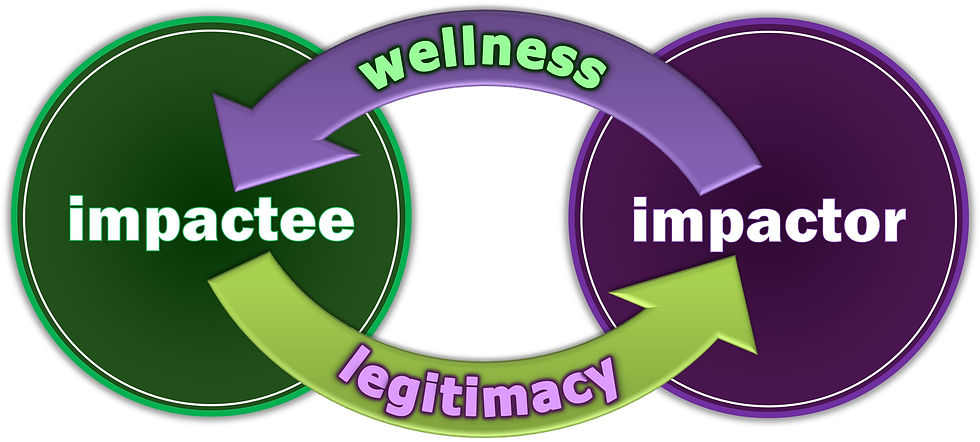
The impactee gains the impactor's support to improve their wellness, by enabling them to properly resolve their power impacted need(s).
The impactor gains the impactee's support to earn legitimacy, by vouching for their demonstrated effectiveness to solve public problems.
Need-response distinguishes between status quo legitimacy and a fact-based kind.
Ascribed legitimacy – Persuading impactees that the impactor is trustworthy, typically by providing little to no evidence. Impactor’s risk losing such trustworthiness.
Earned legitimacy – Measurably establishing responsiveness to impactee’s power impacted needs, toward improved wellness outcomes. Which is not easily lost.
The need-response process has the impactee itemize the endured costs from the intractable power problem. These get issued to the impactor as an "exaction invoice" documenting the transactional coerced concessions.
This invoice clearly identifies itself as NOT A BILL. But it can be used for documentation if the impactee feels forced to use their adversarial options. The invoice invites the impactor, who agrees they do indeed powerfully impact the impactee, to convert such listed costs into an opportunity to earn legitimacy by helping the impactor resolve their power impacted need(s). Along the way, they both enter into a new social contract less amendable to coersion.
The status quo social contract standard of “consent of the governed” gets easily exploited by impactors counting on ascribed legitimacy. Need-response offers a viable improvement.
Manipulated consent: The old social contract frequently fails impactees, and compromises the legitimacy of impactors. How long until this mess explodes into some violent backlash?
Measurably improved: The new social contract forges an explicit agreement between impactee and impactor: Impact me positively or do not impact me at all!
ascribed legitimacy | --> correlates with --> | manipulated consent | --> correlates with --> | negative outcomes |
earned legitimacy | measurable improvement | positive outcomes |
Jefferson’s words in the Declaration of Independence welcomes a revision of the social contract. If we fail to take him up on his words to collectively improve power differential results, all of society will continue to suffer with more negative outcomes. Like widespread anxiety, loneliness, family estrangement, alienation, and addictions. We can no longer regard these as merely individual calamaties.
Since needs and affected wellness levels occur as objective facts, and fewer of us can fully resolve all of our needs and return to optimal functioning, society as a whole gets dragged down. Look around and we can see that we live with a “sick society”.

Need-response helps impactors earn legitimacy, and boost their professional profile, by guiding them to shift away from the patterns pulling us in societal sickness and toward societal wellness. Which features shifting away from toxic legalism and to the responsivism of personally supporting each other’s power impacted needs.
Under the higher social contract standard of "improved wellness", the impactee does not earn legitimacy until their impact on impactees correlate with the impactee's measurably improved wellness. The process makes sure the impactee exhausts their internal means to improve their wellness. Butt also recognizes that their internal efforts may stumble without proper external adjustments supporting their progress. Wellness is psychosocial.
Sure, there will be problems shifting to this new approach. For one, finding reliable wellness measures that are also readily available will be one challenge. Compared to the chaos unfolding from the lower manipulated consent standard, we think that is a much better problem to have. Or challenge, cast as an opportunity for greater human flourishing. Individually and societally. By responding better to each other's needs.
Society and individuals cannot reach their peakfunction potential while reacting to each other more than responding to one another’s factually existing needs. Need-response recognizes the hold of cultural norms privileging more reaction than responsiveness.
Need-response calls this “react culture” or “reactive culture”. Anything that does not address each other’s specifically affected needs falls under “react”. For example…
Faulting the individual for external matters beyond their personal control.
Expecting reasoning alone to fix a problem with taking responsive action.
Oversimplifying complex problems to evade the discomfort of a complicated reality.
Opposing others without relating to the unmet needs fueling their questioned behavior.
Addressing each other’s specifically affected needs in good faith falls under “response”. Which should produce better outcomes than reacting. For example…
Asking each other if they have exhausted all of their options to solve a problem
Listening empathetically to each other express the feelings evoked by a problem.
Exploring the nuance beyond immediate generalizations to better relate to each other.
Cultivating mutual understanding instead of provoking mutual defensiveness.
Need-response incentivizes both impactee and impactor to cultivate that untapped human potential to love each other. To honor the needs of the other as one’s own.
For the impactee to honor the impactor’s need for sustainable legitimacy by vouching for their support to help them resolve their power impacted need(s).
For the impactor to honor the impactee’s need for meaningful solutions to intractable problems held back by power structures.
Win-win. Better outcomes. And let’s our love potential flourish. Who wouldn't want more of that?
Employer-employee: at-will employment (Pro A)
Workers navigating difficult employment dynamics under at-will contracts often choose between confrontational or protective actions. Here are the adversarial and avoidance options available to employees dealing with an overwhelming environment or insensitive management.
PA-1. Avoidance options (Disengagement and Withdrawal)
Avoidance options focus on self-preservation, minimizing contact with the source of stress, or exiting the situation entirely.
PA-1.1. Quiet Quitting: Performing only the exact duties outlined in the job description to conserve mental energy.
PA-1.2. Internal Transfer: Applying for a different role or department within the same company to escape the specific boss.
PA-1.3. Resignation: Leaving the job entirely, either with a standard two-week notice or quitting effective immediately.
PA-1.4. Mental Absenteeism: Emotionally detaching from work outcomes and treating the job purely as a financial transaction.
PA-1.5. Presenteeism: Working while sick, with ailments likely due in part, or in whole, to the toxic work environment.
PA-1.6. Sick Leave Utilization: Taking accumulated paid time off, mental health days, or FMLA leave to gain temporary space.
PA-1.7. Communication Minimalization: Using only written channels like email or chat to limit direct, real-time verbal interactions with the boss.
PA-1.8. Diminished productivity:
PA-2. Adversarial options (Confrontation and Resistance)
Adversarial options involve directly challenging the behavior, authority, or systems maintaining the toxic environment.
PA-2.1. Formal Grievance Filing: Submitting documented complaints to Human Resources regarding hostile work environments or policy violations.
PA-2.2. Whistleblowing: Reporting illegal activities, safety violations, or regulatory breaches to external government agencies.
PA-2.3. Constructive Pushback: Setting strict verbal boundaries regarding workloads, deadlines, or communication styles during performance conversations.
PA-2.4. Legal Action: Consulting an employment attorney to sue for discrimination, wage theft, or harassment.
PA-2.5. Collective Organizing: Rallying coworkers to demand better working conditions, higher pay, or managerial accountability.
PA-2.6. Documentation Logging: Keeping private, chronological records of toxic interactions to use as leverage or evidence.
PA-2.7. Bad Publicity: Posting scathing reviews online, such as at Glassdoor and at Indeed.com. Complaining on social media and hoping it goes viral. Recommending others to boycott the business.
PA-2.8. Abruptly quitting: Whether finding another job or not, leaving without notice. Maybe in the middle of a shift. Deciding to not show up when the employer is most busy and in desperate need of trained labor.
PA-2.9. Incite termination: Intentionally getting fired, short of misconduct, in order to qualify for unemployment benefits. Which can free up time to look for a new job.
PA-3. Mutuality options
PA-3.1. Need-response alternative: Mutual support for each other's identified need. Impactee then puts all these avoidance and adversarial options on hold. Shift from alienation to cultivated rapport.
Employer-Employee: at-will employment |
Doctor-patient: medical billing/debt (Pro B)
Avoidance options
Adversarial options
Mutuality options
PB-3.1. Need-response alternative: Mutual support for each other's identified need. Impactee then puts all these avoidance and adversarial options on hold.
Doctor-Patient: medical billing/debt |

Prosecutor-innocence claimant: public exoneration (Gov A)
Avoidance options
Adversarial options
Mutuality options
Prosecutor-Claimant: public exoneration |
Politico-voter: politically homeless (Gov B)
Need-response service types
Employer-employee: at-will employmeent | Healthcare Provider-Patient: medical debt | Innocence offending: public exoneration | Politician-voter: politically homeless |

Comments