
.png)
Anankelogy science of needs: testable correlations

Updated: Jul 23
First recognize every need as an objective fact

.
Introduction
Anankelogy first recognizes how needs occur as objective facts, independent from our subjective experiences. You require water whether feeling thirsty or not. You need social connection despite any thought or belief about it.
Anankelogy defines need as essential to function. If you can function without it, then it is not literally a "need". For example, you never literally need a bottle of water. If you can access a resource in different ways, such as water from a drinking fountain, then anankelogy does not count that as "essential to function".

To get more specific, anankelogy breaks down the experience of need in a four-part funnel.
core need - optimal homeostatic balance, essential to functioning
resource need - something necessary to restore homeostatic balance
access need - how to get the necessary resource, or any substitutes
psychosocial need - who is to access it, yourself or someone else
Anankelogy differentiates between the inflexible core and flexible external aspects of our experience of needs. You have no choice about requiring something like water, solitude or social connection to restore equilibrium. You have choices how to address such needs. As objective fact, independent of awareness.
The objective fact of needs
Anankelogy invites us to discover the many significant correlations with our objective needs. Proper use of social science can test the veracity of these theorized relations. The findings can give credibility to our efforts to resolve more needs, which then removes more pain and restores more wellness.
Anankelogy isolates these objective dimensions of needs

And anankelogy can help us scientifically predict the result of unmet needs.

If put under the microscope of social science research, you may find high correlations between the objective fact of needs and predictable outcomes of how such needs get addressed and experienced.
With near-100% correlations, I can confidently guarantee…
the less your needs resolve, the less fully you can function;
the less you resolve your need or function, the more in pain you will be; and
the more you relieve the pain of your unresolved needs without getting to its source, the more pain you ultimately experience as your body persists in warning you of the threat not yet fully removed.
1. Needs recur as an objective fact. Anankelogy fundamental principle 01.
A need is an essential requirement to function, independent of subjective experience. Needs require resources to be accessed in order to restore functioning, independent of subjective experience. The bodily requirement for water, for example, sits outside any belief or feeling.
Testable hypothesis: The more we must have something particular to stay alive or to function, and the less we can function without that particular something (or someone), the more that essential requirement exists outside of subjective experience.
How this can be tested has yet to be designed. One way is to operationalize the observable distinction between the "what" of a need's objective occurrence and "how" that need gets subjectively experienced.
2. Function fluctuates as an objective fact. Anankelogy fundamental principle 03.
When a need is not resolved, capacity to function gets reduced independent of subjective experience. For example, if the need to handle a threat is not resolved, one's function goes down regardless of feelings, beliefs or behavior. Fear predictably rises, outside of subjective experience.
Testable hypothesis: The less we can function when a particular need is not met, and the better we can function when that need is met, the more removed that function (or wellness) exists from subjective experience.
How this can be tested has yet to designed.
3. Emotions occur as objective events. Anankelogy fundamental principle 04.
The content of emotions is generally subjective, like how to deal with one's fear. But the conveyance of fear as a warning when faced with something one cannot handle occurs independent of subjective experience. Sure, the details of that fear are subjective, such as the belief that the threat can't be handled or the belief it must be handled alone. But the occurrence of fear to warn of a possible threat always emerges outside of subjectivity.
Testable hypothesis: The more we identify the same emotion to a particular need, the more removed that emotion from subjective experience.
Here are five survey questions to test if emotions predictably occur as objective events. We could add more items, perhaps a total of ten.
Respondent instruction: Identify the emotion that best characterizes your response.
Q1: When stumbling upon a skunk and it starts to lift up its tail, I feel ___.
curious
bewildered
afraid
amused
Q2: When running late to an appointment because traffic is unusually thick, along with new road construction, I feel ____.
exasperated
frustrated
annoyed
disappointed
Q3: When learning my neighbor lied to me about why my trash cans came up missing, I feel ____.
betrayed
angry
irritated
exploited
Q4: When losing a loved one to a sudden death, I feel ____.
sad
depressed
grief
lonely
Q5: When caught lying to my friend about something I was too embarrassed to admit, I felt ____.
exposed
vulnerable
irritated
guilty
Operationalized hypothesis: The more agreement among respondents (i.e., inter-rater reliability) identifying the most likely feeling, the more likely the identified emotion occurs independent of subjective experience and outside of personal biases. Emotions can then be characterized as occurring as objective fact.
Null operationalized hypothesis: The less agreement among respondents, with diverse labeling of a corresponding emotion, the more likely the identified emotion points to subjective experience and personal biases. Emotions then cannot be characterized as occurring as objective fact.
Democratizing science
Anankelogy democratizes social science with what it calls relational knowing. Abbreviated RK, it empowers you to relate more accurately with your experienced needs. As you observe two things change in apparent association with each other, you frame your own testable hypotheses.
You naturally entertain the notion of one "variable" causing the other. But scientific discipline encourages you not to rush to that conclusion.
Know the four types of associations
The discipline of social science reminds us to put the descriptive over the normative. We delay the gratification of acting upon our initial assumptions. We carefully describe all that can be observed, to ensure the greatest accuracy.

We look at four different ways the association could be correlated.
more-more: more of this, then more of that (“positive relation” as both move in same direction) "The more generous with your time, the more others test your patience."
more-less: more of this, then less of that (“negative relation” as both move in opposite directions) "The more defensive you get, the less others open up to you."
less-more: less of this, then more of that (“negative relation” as both move in opposite directions) "The less you eat well, the more easily you get sick."
less-less: less of this, then less of that (“positive relation” as both move in same direction) "The less honest you are, the less others will trust what you say."
Consider these knowable correlations in the testable hypotheses below. Each can be tested with the tools of social science, such as surveys, interviews, experiments, and the like.
While suggesting a relationship between the two identified variables we observe changing at about the same time, we recognize how correlation is not necessarily causation. Even a spurious relationship can illuminate further inquiry.
Embracing ambiguity
Consider these five degrees of certainty using 'relational knowing'.
Appears or seems - worthy of further investigation, exploration, but low to no certainty until tested
Presents - can identify a way to test and measure this apparent association.
Demonstrates - preliminary measures suggest a significant correlation.
Demonstrates as indicated by - reliable measure points to a significant correlation.
Demonstrates as verified by - reliable measure independently used that results in about the same findings.
Any suggestion of absolute certainty ought to ring alarm bells. The more we feel certain about something, the less we seek to know further about that item or topic. Our dynamic understanding then risks crystallizing into beliefs that often cannot hold sufficiently true over time in newer situations. The less we feel certain...the more we seek...topic.
Defining need
Definition of need: something necessary to function.
Or more simply a necessity to function. That "something" could be variable and therefore dependent on perception and culture. The raw necessity to function occurs prior to, and independent from, any perception or any human culture.
Function occurs independent of subjective experience. If you do not receive sufficient nutrients, for example, your ability to function will objectively decline.
I present these testable correlations in two complementary veins.
PART A: Predictable results of resolving needs
PART B: Predictable consequences of unresolved needs
Social science accountability
These assertions could be verified or invalidated using social science research tools. Keep in mind that science seeks to invalidate plausible but unsupportable assumptions more than it seeks to prove anything.
I anticipate strong correlations in each of these. But such anticipation increases the risk of confirmation bias. Appropriate application of science mitigates this risk, such as using the null hypothesis to try to invalidate an untested theory and using double-blind experiments where neither the tester nor the tested know the anticipated results. With all research involving human subjects vetted through an IRB.
Format
Each entry below follows a simple pattern.
The testable need-based hypothesis (sub header).
Summary introduction to this testable hypothesis.
Testable assumptions.
Reasonable connection.
Theorized hypothesis.
Null hypothesis.
Implication.
Hypothesis in reverse.
Quick caveat:
I admit my grasp of statistics and academic research has grown a little rusty in the decade since completing two graduate degrees. I welcome critique to improve my suggested use of such research to invalidate or validate these wisdom-inspired correlations.
Anankelogy suggests a high correlation can be found in these associations.
The more a need resolves, the less pain there can be to suffer.
The sooner you remove a threat to functioning, the quicker your pain fades.
The more your needs fully resolve, the better you can function.
The more your needs fully resolve, the more you can reach your full potential.
The more your needs fully resolve, the less drawn to unhealthy habits.
The more you refill what your life requires, the less you crave unhealthy substitutes.
The more you can fully resolve their needs, the easier to sustain peakfunction.
The more you replenish what your life requires, the better you can function.
The more fully replenishing what’s required, the easier to overcome addiction.
Part B looks at each of these in reverse, at correlations of needs not resolving,

After working a couple hours straight under a tight deadline and drinking coffee, you desperately need a restroom break. As soon as you go, you feel immediate relief. That applies to any other physical or emotional need you experience.
As soon as your friend positively replies to your request for their help, your anxiety subsides. When you still cannot get everything accomplished as you had hoped, some anxiety persists. Your emotions faithfully report the level of your objective needs.
Testable assumptions: This hypothesis rides on these guiding anankelogical assumptions.
Anankelogy recognizes a need as an objective fact, which we subjectively experience after the fact of reduced function, occurring independent of awareness.
This study of need also recognizes emotions exist to personally convey those needs, and that there is no such thing as pain apart from unresolved needs.
Apart from the body compelled to warn of a perceived threat, it is impossible to experience any pain. No perceived (or vicariously felt) threat means no felt pain.
Reasonable connection: Because every need exists as an objective fact for objective functioning, and pain only exists to report a threat to functioning (i.e., unresolved need), there should be a high degree of predictability. This theoretical correlation is to be tested to determine its veracity.
Theorized hypothesis: The more a need resolves, the more the accompanying discomfort fades. The less a need resolves, the more intense the accompanying pain.
Null hypothesis: The more a need resolves, there will be no significant decrease in the intensity of its pain. The less a need resolves, there will be no significant increase in the intensity of the pain.

Operationalized: The more your air conditioner cools you down to an optimal body temperature on a hot day, the more your uncomfortable sweating goes away. The less your body can return to your optimal temperature, the more uncomfortably you sweat.
IMPLICATION: If sufficiently validated, all services and institutions addressing needs of a populace could better relate to their pain. They can anticipate higher levels of reported pain likely points to lower rates of resolved needs.
This also suggests that offering or providing long-term pain relief risks perpetuating pain. The body must continue warning of a threat to functioning until that perceived threat gets fully unremoved.
B1 expresses this hypothesis in reverse.
When you arrive at the public restroom, you find you must wait in line for an available stall. Your body faithfully reports your need to go, however uncomfortable that message. But as soon as you finish what you came there for, that discomfort rapidly goes away. Your body loses reason to report such a threat to functioning once your bladder gets emptied.
Testable assumptions: This hypothesis rides on these guiding anankelogical assumptions.
The more one resolves a painful need, the less cause for the body to signal a threat.
The sooner the removal of a reported threat, the sooner the body ends its painful warnings, allowing the accompanying pain to fade.
Reasonable connection: Because every perceived threat that materializes negatively impacts functioning, and every removed threat removes cause to warn with pain, one can predict that removing a threat also removes the warning message of pain. This theoretical correlation is to be tested to determine its veracity.
Theorized hypothesis: The more one respects pain to report threats, the more endurance to the sharp pain of reported threats. The more they endure such sharp pain of reported threats, the more effectively they can remove such threats. The sooner they remove these threats, the quicker their pain gets removed. The more pain removed, the more they can respect their pain and appreciate it to report threats, cycling back to the first relation.
Anankelogy adds two types of testable correlations: reflexive and cyclic.
To complement standard social science correlations, anankelogy introduces two unique types of testable associations. Its nature-based paradigm anticipates not only linear links, but reflexive and cyclic relations.
Reflexive correlations. An empirically observable association between two or more variables that seem to change each other. While correlation is not necessarily causation, social science research typically anticipates one variable (the dependent variable) to change as an apparent consequence of another preceding variable (the independent variable). Anankelogy recognizes the possibility of variables reflexively impacting each other. This can point to a cyclic correlation between a string of variables.
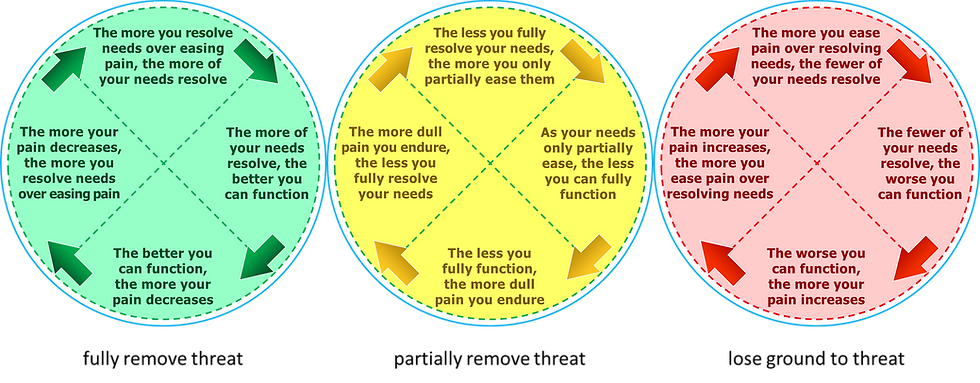
Cyclic correlations. The nature-based paradigm of academic anankelogy anticipates a string of dependent variables looping together. As variable A changes along with B, B changes with C. Then as C changes along with D, those changes in D link to changes in A. Each independent variable gets identified as a dependent variable to its preceding variable, in that part of the ongoing cycle. This suggested correlation can illustrate such cyclic correlations using the 4-part cycle of discomfort avoidance. (Start in the eastern quadrant.).

Respect pain. The more you respect pain to report threats, the more you can endure the sharp pain of reported threats.
Endure pain. The more you can endure the sharp pain of reported threats, the more you can effectively remove such threats.
Remove threats. The more you remove these threats, the more of your pain gets removed.
Remove pain. The more of your pain removed, the more you can respect your pain to report threats.
Null hypothesis: The sooner one removes a pain-reported threat, there is no significant change in the timing of that pain’s decrease or removal.
IMPLICATION: If sufficiently validated, clients and patients complaining of physical or emotional pain could be better understood as perceiving a threat to be removed. Instead of focusing on relieving their symptoms or pain, more attention could be given to the threats prompting the pain. The pain serves to warn against the threat constraining their lives.
Anankelogy recognizes how pain is not the problem as much as the threat any pain solely exists to report. Instead of always trying to ease each incident of physical or emotional pain, we may be better served by removing the actual threats prompting such pain.
Anankelogy suggests each of us has one can be called an “easement orientation”. We either embrace the discomfort of realizing there’s a threat to be removed or we avoid the discomfort and likely overlook a threat that persists to prompt more warnings with pain. We either present a resolve-over-relieve or a relieve-over-resolve easement orientation. The more overcome with pain, the more likely oriented to relieve the distress.
Lessen your pain’s intensity by engaging the message of your pain. Unless overwhelmed by pain from too many unmet needs, your pain can fade before fully resolving the need. Instead of reacting to your pain by trying to avoid it, go toward your pain and make it serve you by taking these mindful steps.
Acknowledge your pain. Recognize it is only there to warn you of some apparent threat to remove. Feel your pain lose its agonizing edge once you face it down.
Identify what that threat may be doing to limit your wellbeing. Feel your pain start to fade as soon as you get its message about what you need in that moment.
Do anything to try to remove that threat, or distance yourself from such a threat, and start restoring your functioning. As you perceive the threat going away, your pain loses its intensity.
Partially remove a portion of that threat, or significantly distance yourself from the threat, so you can get back to fuller functioning. Your pain then loses cause to exist.
Mostly remove the threat or remove yourself from that threat, to restore most of your lost functioning. You now only feel mild discomfort, reminding you how that threat is not yet totally gone but is mostly out of the way.
Fully remove the threat, or fully remove yourself from that threat, to restore full functioning in that area. Your pain fully dissipates and then gives way to feeling relief.
Moving promptly through these steps greatly reduces the risks of slipping into unhealthy habits. Failing to identify and remove threats significantly increases the risk of addiction, as coping mechanisms for dealing with the objectively occurring pain of objectively unmet needs.
Short-term relief may be necessary. But the pain will return, often in a different form, if you continue to neglect the threat. As soon as possible, identify the threat and take steps to remove that threat, or remove yourself from it. But remain attentive to the underlying threat. Or that pain will find another way to compel your attention, and possibly pull you into some debilitating addiction. Let your pain serve you instead of you serving it.
B2 expresses this hypothesis in reverse.
One day you're fine. You wake up the next day feeling like warmed over death. You feel too sick to go work. Did you cross over some invisible line overnight?

Wasn't there some phase between being well and waking up unwell? Anankelogy suggests there indeed is such a phase. Between the wellness of "peakfunction" and the unwellness of "dysfunction" lies a phase called "symfunction". But then what exactly is function?
Anankelogy defines function as the level of ability to continue existing and doing things as naturally possible. Anankelogy identifies four distinct levels of such functioning:
peakfunction - prioritize resolving all needs fully; completely well
symfunction - prioritize easing needs pragmatically with others; mostly well
dysfunction - prioritize relieving pain of unresolved needs; increasingly unwell
misfunction - prioritize surviving under threat of demise; totally unwell
Testable assumptions.
According to anankelogy, a need is a requirement of something or someone in order to function. Consider this: Every instance of not accessing what's required to function always diminishes the capacity to function.
The more one replenishes what's been depleted, and removes threatening excess, the more their functioning returns to a more optimal level.
Apart from this necessity to function, we have no needs.
Reasonable connection: What academic anankelogy defines as function generally equates with accessible anankelogy's concept of wellness. A colloquial way to phrase this hypothesis could be: The more your needs fully resolve, the more well you will be. Inversely, the less your needs resolve, the closer your slide toward being unwell.
Theorized hypothesis: The fewer needs demanding attention, the more one can fully function. The more needs demanding attention, the less one can fully resolve.
Null hypothesis: The fewer needs demanding attention shows no significant change in one's ability to function.
IMPLICATION: If a service provider, like a doctor or counselor, only helps you ease your pain, they risk limiting your full potential. The more professionals help you identify and address such needs, to ultimately resolve them, the greater the chances to reach more of your life's potential.
Need-response sets itself apart from standard pain-relieving options by focusing on the needs causing such pain.
B3 expresses this hypothesis in reverse.
Everything feels fine for you this day. Nothing hurts. Your mind entertains some ways to stretch your horizon.
Testable assumptions.
When all of your needs fully resolve, you enjoy the capacity to more freely pursue more of your life's potential.
As soon as you experience a need demanding your attention, you cannot focus as much on pursuing your life's full potential.
When suffering the emotional strain of too many unmet needs insisting on your attention, you rarely can afford to pursue your life's potential.
Reasonable connection: If you must attend to basic needs, then you likely cannot afford as much attention to addressing the higher growth needs like interpersonal intimacy, mutual trust, developing competencies, nurturing economic stability and the like.
Theorized hypothesis: The more your needs resolve, the better you can function. The better you can function, the more your attention tends to get pulled toward reaching more of your life's potential. The less your needs resolve, the less you can fully function. And the more your focus shifts away from pursuing your full potential and toward doing something about the mounting emotional strain warning you of these unmet needs.
Null hypothesis: The more your needs resolve, there is no significant difference in your capacity to function, nor in your ability to pursue your life's full potential.
IMPLICATION: If sufficiently validated, more attention can be given to ensuring needs properly resolve, instead of increasing access to resources or relying on reasoning, or any of the other less effective modes for pursuing one's potential.
B4 expresses this hypothesis in reverse.
When your needs properly resolve, you suffer less emotional pain. Since you suffer less pain, you typically do not seek as many comforting distractions.
For example, when your need for social connection gets routinely satisfied by the quality time you spend with your closest friends, you feel little to no reason to seek validating "likes" on social media.
Anankelogy recognizes three levels of resource needs for redressing your emotionally felt needs.
Primary resource: What our body has evolved to utilize to restore optimal balance. E.g., water for thirst, interpersonal connection for loneliness, empathy for resolving conflicts. Primary resources fully resolving needs correlates with peakfunction.
Alternate resource: What can allow a need to at least partially resolve. E.g., sweetened juice, casual friends, sympathy or pity toward those opposing you. Alternate resources partially easing needs correlates with symfunction.
Substitute resource: What can only provide relief from the pain of the unresolved need. E.g., alcohol, social media “friends”, apathy or antipathy toward hostile foes. Substitute resources relieving pain correlates with dysfunction.

Testable assumptions.
Without the emotional strain warning you of unmet needs, you unlikely seek ways to distract yourself.
While your daily routine results in properly resolving needs, you leave little to no room to slip into unhealthy habits.
As you establish a routine that results in healthy living, you experience no incentive to indulge in unhealthy habits.
Reasonable connection: As your needs remain mostly resolved, you can sustain the inertia to maintain healthy habits. Your raised capacity, and absence of emotional strain, can incentivize you to steer clear of poor habits. As you enjoy eating a healthy diet, for example, you feel less tempted to indulge in junk food on a regular basis.
Theorized hypothesis: The quicker your needs fully resolve, the quicker your emotional strain warning you of the evoked need starts to fade. The sooner your identify the need, the less emotional strain you will suffer. The quicker you attend to the need, the less drawn to ways to distract you from the mounting discomfort from the painful need.
Null hypothesis: The quicker your needs fully resolve, there will be no significant difference in the level of emotional discomfort you will experience.
IMPLICATION: The sooner you can fully resolve a need, the less of a chance for emotional strain to build. Without mounting emotional strain from unmet needs, there is less of a chance to slip into unhealthy habits to cope with such pain.
Anankelogy recognizes how there is no such thing as pain apart from unresolved needs. Once a need gets fully resolved, your body has no reason to signal any emotional discomfort about that need. You then experience pleasure or relief.

Pain is not the problem as much as the threats your pain exists to report. When feeling pain, thank your body for warning you of an apparent threat to remove. In other words, instead of habitually shrinking from that discomfort, move toward it to identify and address the need. Flee from pain and it will chase you; chase pain and it will flee from you. Then feel that pain go away.
Flee from pain and it will chase you; chase pain and it will flee from you.
B5 expresses this hypothesis in reverse.
Let this build upon the previous hypothesis. Slipping into unhealthy habits begins with feeling satisfied with pain-relieving substitutes. The more you can reliably access primary resources to properly resolve your needs, which your life requires, the less likely you habitually indulge in unhealthy substitutes.
You eat a healthy meal, so your hunger goes away. Or you grab a quick snack, but the hunger won't go away. You cope by eating more junk food, which leaves you craving for more. Then you find you lack the energy to prepare a healthy meal.
You spend quality time with a friend who truly listens to you, so your loneliness fades. Or you call a friend, but they don't have the time to give to you. So you browse social media, hoping for 'likes' to your posts to give you that feeling you're being acknowledged. No amount of such shallow affirmations will actually satisfy you.
Testable assumptions.
The more responsive to your inflexible needs, by promptly replenishing what your life requires and promptly removing any threats, the less you seek to "replenish" with substitute resources.
Desiring what is unhealthy almost always begins when not being able to access what is healthier. When alternate or substitute resources are more readily available than much-needed primary resources, we tend to be like electricity and take the shortest path.
We grow dependent upon what is most readily available, whether that satisfies our needs (primary resources) or reliably eases our needs (alternate resources) or satisfies our desperation to get rid of the persisting pain of unmet needs (substitute resources).
Reasonable connection: You can maintain a healthy habit only as long as primary resources remain available to you. Once you must adjust to lesser resources and then find them consistently accessible, your risk goes up to becoming emotionally attached to such lesser resources. As your life accommodates such compromised wellbeing, you become attached to the familiarity of lesser resources. You then rarely if ever seek primary resources anymore, and may lack the energy to do so.
Theorized hypothesis: The quicker you replenish whatever your your life requires, which typically refills what has become depleted, the more likely you maintain a good habit of continually accessing such primary resources. The more you faithfully resolve your needs with healthy options, the less likely you crave any unhealthy options.
Null hypothesis: The quicker you replenish whatever your your life requires, there will be no significant incentive to maintain healthy habits. Slipping into unhealthy habits could routinely occur regardless of promptly resolving needs.
IMPLICATION: Social norms anticipate the predictable availability of resources. Wherever primary resources remain consistently accessible, social norms may cast lesser resources as taboo, or even forbidden. For example, Islamic and other cultures forbid alcohol because of its known damaging effects on personal and social wellbeing. The robust accessibility of healthier options like water, tea and juice make it easier to curtail access to alcohol.
Wherever primary resources remain persistently inaccessible, social norms may normalize lesser resources as acceptable, and even preferable. For example, the adversarial judicial system and politics normalizes the lesser resource of dealing with conflicts with antipathy between both parties, leaving little if any room to encourage empathy for each other's affected needs. If no institution exists to resolve all needs of all involved in a conflict, we will understandably crave the less healthy substitute of offering pain relief to the winning side in a court or ballot contest. Yes, it is still better than violently attacking one another.
In any distorted economy where a few can horde access to the best resources, and social systems can manufacture scarcity despite an abundance of primary resources, the number of people who slide into craving less healthy option will naturally rise.
Anankelogy identifies the problem of excessive resourcing, where access to primary resources gets horded or wasted. Which spills over into manufactured discontentment. Instead of supporting each other to access much-needed resources, we find ourselves in a consumerist society of cutthroat materialism fueling hyper-individualism and alienation.
This cultural climate normalizes the excesses of capitalism norms. Consequently, an increasing number must resort to lesser resources and accommodate compromised wellbeing along with mounting pain. Even the materially wealthy become spiritually poor in the process, who never find meaningful contentment unless they find purpose in sharing their excess wealth. But that doesn't heal society's disconnected materialistic sickness.
Current norms tend to perpetuate this imbalance, with a marketplace willingly serving up unhealthy substitute resources. "We're just providing what the market wants," serves up as a convenient yet clueless excuse, rationalizing away complicity in diminishing our personal and collective wellbeing.
A society that ensures all can access what they require in life may seem too socialistic or communistic. Or perhaps cast as too Pollyanna, too unrealistic, too impractical. Meanwhile, the complicit pay the price with their taxes that goes to public services to bail out those trapped in craving unhealthy substitutes.
B6 expresses this hypothesis in reverse.
Resolving your needs enable you to sustain your capacity to function. As Abraham Maslow noted, resolving your basic needs (like security) sets a foundation for your to attend to your higher needs (like intimate connection with others). Indeed, as your more basic needs feel resolved, your higher growth needs awaken.
But if you must suddenly defend yourself from a permeating threat, those growth needs typically get put on the back burner. Promptly removing that threat frees your focus to reach more of your life's potential. You can then sustain peakfunction capacity.
With your needs consistently resolved so you can continually functioning optimally, you may reach a state of flow enabling you to reach more of your life's potential. Which enables you to remain more attentive to the presenting needs of others. Helping them resolve their needs serves your own higher need for meaningful purpose in life, as an aspect of peakfunction.
Testable assumptions.
Fully resolved needs serve as a prerequisite to fully function, to optimal wellness.
Partially resolved needs leaves you functioning at a less than optimal level.
Promptly and fully resolving needs as they occur provides you the inertia to pursue your optimal goals.
Reasonable connection: You don't have to seek optimal wellbeing to experience this pull toward reaching your full potential. As your needs somehow get fully resolved, you naturally feel pulled to attend to higher needs tapping into your full potential.
Theorized hypothesis: The longer you maintain wellbeing by promptly resolving every need that arises, the greater your capacity to reach and sustain peakfunction.
Null hypothesis: Promptly resolving your needs has no significant impact on your ability to function. If at a higher level of functioning, there will be no significant change in your likelihood of reach or sustaining peakfunction.
IMPLICATION: We may assume reaching our full potential demands developing a unique set of skills. Or having the luck or talent to go where few if any have gone before. Instead of emphasizing individual prowess, with out Wester bias, we could cultivate a sociocultural climate incentivizing the proper resolution of our needs, and then see our potential for human flourishing blossom.
Much of what hinders our full potential is symfunctionality, fed by divisive social norms anchored in adversarialism and privileged alienation of toxic legalism. Anankelogy considers this rigid conformity to familiar social norms as cisconventionality. And recognizes how nature fills this void with a corrective transconventionality. Those spiritually compelled to transcend divisive social norms to connect deeply with life's full potential are recognized as transspirits.
Where cisconventionality prioritizes compliance to social norms, to fit social expectations even if they lead us astray from life's full potential, transconventionality prioritizes the proper resolution of needs to reach life's full potential. "Ciscons" tolerate the gradual debasing of symfunctionality and dysfunctionality, like the boiling frog of creeping normalcy. Transspirits get compelled to directly resolve the needs which norms emerged to serve, but not to settle on partial resolution or on pain relief but to fully resolve needs to remove pain and reach more of life's full potential.
Instead of appreciating such norm-challenging transspirits yearning peakfunction for us all, ciscons often cling to the familiarity of acclimated symfunction. And then deride transspirits, who could potentially liberate their full potential, as outlaws and outcasts. (I speak from experience.)

For example, ciscons cling to the divisive norm of labeling asymmetric warfare participants as "terrorists" while conveniently ignoring how their own side has engaged in violent acts that can be characterized as terrorism, as targeting noncombatants. Yes, Palestinians who resisted Israeli settlers with deadly violence is disgusting. So is the deadly violence of the Sullivan campaign that killed hundreds of noncombatant Iroquois during the American Revolutionary War, with General Washington's blessing.
The transspirit recognizes both sides as asserting their inflexible needs for security and self-determination. Many a ciscon falsely claim empathy for each side's needs as a kind of moral neutrality. They have bought into the zero-sum myth of excessive resourcing, that only one side gets to claim the land or whatever resource being fought over. Their symfunctionality tends to blind them (i.e., diminishes awareness) from the quantifiable evil this normalizes. Which suggests they think at a lower level of epistemic reliance of available facts.

Divisive norms compromising full potential can be organized by culturally established gender traits. Blending these traits can liberate life's full potential. And that's exactly why some transspirits (like myself) experience a transgender dimension. Not as a gender identity, but compelled spiritually to integrate all complementary sides of humanity to reach our full potential. As a demonstration of epistemic maturity at the postconventional level. Which includes honoring the inflexible needs of others as one's own, as an act of social love.
B7 expresses this hypothesis in reverse.
Good science offers satisfying answers. Great science produces better questions to ask and test, to continually dive deeper into the realms of meaningful reality.
All desires begin as an emotional signal to replenish something depleted that is essential to function. For example, thirst for water after your body's water level has fallen beneath its optimal level. Or desiring friendship to satisfy the need for social connection after feeling some loneliness.
Once adequately replenished, your body signals your satisfaction with a feeling of pleasure. Your thirst feels quenched. Feelings of loneliness shift to feeling affirmed. These satisfied desires enable you resume optimal functioning. Resolving needs improves wellness.
That assumes you replenish what's depleted with a primary resource. Water for thirst. Trustworthy friends for loneliness. When resorting to alternate or substitute resources, such as alcohol to alleviate thirst or social media "friends" to pacify loneliness, you cannot resume optimal functioning.
When not resuming optimal functioning, your body continues to signal with emotions to attend to such needs. Anankelogy recognizes how emotions personally convey needs.
Anankelogy also recognizes how your emotions prioritize your self-continuance.
When suffering needs not fully resolved, your emotions "biases" your compromised wellness, your constrained ability to function. In short, your biases prioritize your needs. You can hardly concentrate on other matters while your capacity to focus or stay well remains constrained.
Once your needs fully resolve, your capacity opens up to your life's potential for profound growth. You can think more clearly, empathize more easily with others, and see beyond your previously self-absorbed myopia when struggling with unmet needs. You can then focus more freely, without your scope narrowed by biases. Basically, resolved needs improve your understanding.
The more your needs resolve, the easier to sustain your wellbeing. The quicker you replenish with primary resources anything depleted, the better you can focus on matters outside of yourself. You can care more for others, be more empathetic to their pain, and do more for what others need. You can more freely honor the needs of others as your own, to inspire others to honor your needs as their own. Love unleashes our lives' potential.
Testable assumptions.
All natural needs sit equal before nature. Nobody's needs matter more than anybody's else's needs. No one can function optimally at the expense of others.
Natural needs never clash with each other. Your need for solitude, for example, never competes with another's need for your friendship.
The problem of excessive resourcing, of demanding access to resources beyond what is proper for living a contented and meaningful life, can trick us into believing myths of scarcity. Needs could never evolve if actually clashing with other needs.
Reasonable connection: While emotions personally convey needs, laws impersonally convey needs. But social norms can never fully or accurately convey your needs to others who may affect them. Translating your emotions into loving ways to invite other's empathy and care can go a long way to sustain your wellbeing.
Theorized hypothesis: The more you properly resolve your needs, by replenishing what's depleted with primary resources and removing threats, both while imposing as little if anything upon others, the more your capacity to function optimally will remain sustained.
Null hypothesis: The more you properly replenish primary resources when they become depleted, or remove threats, no significant change will occur to your capacity to function.
IMPLICATION: Illicit desires emerge only when we cannot properly replenish resources when they get depleted. Illicit sexual desires, for example, emerge as a consequence of not being able to properly satisfy the benign desire for meaningful intimacy. All desires start as benign or even benevolent longing for something to restore wellbeing, as life has evolved for such needs to be fully and properly satisfied.
When situations compel us to settle for alternate or substitute resources, our emotions persist to warn us of not meeting our full wellness. Biases then creep in, to prioritize our attention to address whatever may be lacking. And often with little regard for what others need, to prioritize our own self-continuance.
The tendency toward cognitive bias correlates with unresolved needs. Your body easily overrides your best attempt to remain rational or impartial when it compels you to give your full focus to redress unresolved needs.
Bias prioritizes addressing unresolved needs. Apart from unresolved needs, or the habits developed from experiencing them, you experience little to no cognitive bias.
The scientist struggling with bias should self-reflect on their pressing needs in the moment. The scientist whose needs promptly resolve fully tends to be freer to focus on their work. Since their body is not compelling them to prioritize attention to a necessity to sustain functioning, their thinking can remain open to processing more data. Including disconfirming evidence challenging their pliable assumptions.
When weighed down by unresolved needs, they tend to cling to assumptions that can offer some semblance of relief. Even if only because of their familiarity, at a time their mind gets contracted to focus on what can be trusted to provide relief.
When needs fully resolve, the mind can then turn more of its attention to untapped possibilities. Ideas can flow freely, independent from what one's life requires. Theories can then reflect more of reality outside of oneself. Boundless epiphanies may emerge, as one discovery sheds light on another.
Good science offers satisfying answers. Great science produces better questions to ask and test, to continually dive deeper into the realms of meaningful reality. Science is well served by the scientists whose needs promptly and properly resolve, to sustain their optimal functioning. Which then helps us all to function better.
B8 expresses this hypothesis in reverse.
If you maintain a healthy diet and do not feel stressed out by life's demands, what are the real chances of you getting addicted to junk food? If you do find yourself indulging too much processed foods, then take proactive steps to prepare healthy meals as you get your life in order, can you see your risk of addiction to junk food significantly decline?
Addiction typically emerges as a coping mechanism to deal with unbearable emotional pain. The numbing effect of alcohol, for example, helps distract us from emotional pain like overwhelming meaninglessness, perpetual loneliness, and devastating discouragement.
When unable to replenish what your life requires to sustain your wellbeing, your may begin to desire alternative or substitute resources. You placate agonizing feelings of loneliness, for example, by seeking "likes" from social media "friends" who barely know you, if at all. If you never connect deeply with a trustworthy friend, you risk becoming emotionally attached to your shallow social media "friends". The ease and familiarity serves as low hanging fruit, as your diminishing capacity to function makes it harder to emotionally invest in true friends.
For most of us, the pain we feel is preferable to the pain we fear. We know how to handle the low grade, albeit gradually climbing, level of familiar pain. It's generally easier to cope with the mild discomfort of being occasionally annoyed by a foe, for example, than risk triggering their painful rage if shouting some complaint.
Creeping normalcy sets in. We acclimate slowly to increasing pain and decreasing capacity to function. As capacity shrinks, along with collapsing cognitive bandwidth, we become less equipped to handle the less familiar discomfort that often accompanies the resolution of stubborn needs. While addictions on the surface seem bad, they may actually be better than suffering overwhelming agony and allowing oneself to become functionally paralyzed.
Removing that pain by resolving your needs with primary resources creates meaningful steps to liberate from any attachments to alternate or substitute resources. You can then focus better as your capacity improves, as your cognitive bandwidth allows more room for better planning and decision-making. Desiring what you actually require and can access replaces your Illicit desires.
Testable assumptions.
There is no such thing as pain nor desire apart from unresolved needs.
Illicit desires typically emerge as a fallback to an apparent absence of primary resources.
Satisfying your needs with what it actually requires tends to break any attachments to what only placates your feelings, which were signaled when those needs were unmet.
Reasonable connection: Access to primary resources to fully resolve needs often depends upon the cooperation of others. Western culture risks overemphasizing what the individual should do to overcome addiction to substitute resources. This approach does not limit itself to what individuals can do but includes what others can do to affect addictive behavior. As anankelogy notes, wellness is psychosocial.
Theorized hypothesis: The more you can fully resolve your needs with reliable access to primary resources, the lower your risk for becoming emotionally attached (i.e., addicted) to readily accessible alternate or substitute resources.
Null hypothesis: The more you can fully resolve your needs with primary resources, there will be no significant difference in your risk to becoming addicted to alternate or substitute resources.
IMPLICATION: Efforts to help individuals overcome their addictions could be greatly enhanced by identifying and addressing socioenvironmental barriers to primary resources. After exhausting attempts to change internally, persisting dysfunction indicates likely external factors to change.
When seeming to blame society for their personal problem of addiction, the addict's frustration sheds light on the psychosocial reality of human wellness. Instead of reacting by countering with the hyper-individualism extreme of personal responsibility, we would do well to address both internal and external factors fueling dysfunction and addiction.
We can start by recognizing the path from symfunction when settling on wellness-compromising alternate resources that slides into dysfunction when resorting to pain-relieving substitute resources. Symfunction comes with constant emotional reminders of unresolved needs, which takes up some of your cognitive bandwidth.
The less your needs resolve, the less cognitive bandwidth to contemplate and reflect on other matters. Poor moral choices often begins with an inability to see or find primary resources necessary to fully resolve needs. Often beyond one's personal control.
This leaves you susceptible to relying upon generalizations, even overgeneralizations, that overlook vital specifics for resolving needs and solving problems. Which feeds a vicious cycle, of avoiding more essential specifics.

As emotional discomfort increases, avoidance typically sets in. You then cling more tightly to comforting generalizations. Which pulls you deeper into painful symfunction, and potentially into dysfunction.
Following simple rules, like only try to change what you can change which is yourself, becomes attractive. It eases your pain, but unlikely removes all pain after neglecting its external contributors. Legalism then serves as another addiction.
Sustainable liberation from addiction must integrate internal changes with proper external changes. Or we all risk slipping further into symfunction, then down into dysfunction. With the social science of anankelogy, we can find the discipline to meaningfully liberate far more from the blight of addictions.
B9 expresses this hypothesis in reverse.
"You never change things by fighting the existing reality. To change something, build a new model that makes the existing model obsolete." - Buckminster Fuller
Anankelogy suggests a high correlation can be found in these associations.
The less resolved a need, the more intense the accompanying pain.
The longer it takes to remove a threat, the more the pain intensifies.
The less your needs resolve, the less you can reach your full potential.
The more in pain from unresolved needs, the more drawn to pain coping behaviors.
The less you refill what your life requires, the more you crave unhealthy substitutes.
The less you can fully resolve a need, the greater your risk for dysfunction.
The less you can replenish what your life requires, the less you can function.
The less replenishment of what’s required, the harder to overcome addiction.
Anankelogy recognizes a need as an objective fact, which we subjectively experience after the fact of reduced function, independent of subjective awareness. This study of need also recognizes emotions exist to personally convey those needs. Furthermore, it anticipates that the more urgent the need for one's functioning, the more intense that emotion.
Not just randomly, but with a high degree of predictability. This theoretical correlation is to be tested to determine its veracity.
Reasonable connection: When pain persists, including emotional pain, there is likely some need or needs not being adequately addressed.
Testable assumptions.
Anankelogy recognizes a need as an objective fact, which we subjectively experience after the fact of reduced function, occurring independent of awareness.
This study of need also recognizes emotions exist to personally convey those needs, and that there is no such thing as pain apart from unresolved needs.
Apart from the body compelled to warn of a perceived threat, it is impossible to experience any pain. No perceived (or vicariously felt) threat means no felt pain.
Reasonable connection: Because every need exists as an objective fact for objective functioning, and pain only exists to report a threat to functioning (i.e., unresolved need), there should be a high degree of predictability. This theoretical correlation is to be tested to determine its veracity.
Theorized hypothesis: The less a need is resolved, the more intense the accompanying pain. The more a need resolves, the less intense the accompanying pain.
Null hypothesis: The less a need is resolved, there will be no significant increase in intensity of the pain. The more a need resolves, there will be no significant decrease in the intensity of the pain.
IMPLICATION: If sufficiently validated, services addressing pain could focus more on the underserved needs that likely fuel the pain. The finding could help need-responders serve clients with the assurance their emotional and physical pain will likely decrease the more the service can help them to fully resolve their identified needs.
This could be tested using the tools of social science research.
This correlation could be tested using a survey in a clinical setting.
Select a common need that conveys a specific need of a client.
For example, fear or anxiety. "Apart from your need to handle something menacing, you feel no fear." Clients seeking the services of need-response are expected to report anxiety as a key feature.
Survey how much they experience the need and accompanying emotion.
For our example, add the level of anxiety a client experiences when experiencing the need to handle something they report as menacing. Use a Likert scale to assess their level of anxiety, from the most intense to no anxiety felt at all.
After helping them handle the menacing threat and they demonstrate an ability to actually handle it, resolving their need, assess their level of anxiety again.
Give this survey to a population of at least 400, anticipating a 50% response rate.
After receiving usable data from at least 200 respondents, to improve the reliability of the findings, collate the data using SPSS software.
Apply linear regression analysis.
Process the data in a chi square table. Let this table show how much changes appear at random (supporting the null hypothesis) and how much follows a predictable pattern (supporting the theorized hypothesis).
Write up the results for peer review.
Follow any actionable critique to improve this testing process. Rince and repeat these steps above.
A1 inverts this hypothesis.
Pain is faithful. It consistently warns you of a perceived threat. Short of mood altering interventions, it will not abandon you until your body perceives all threats are removed.
If it wasn't so unpleasant, we perhaps would be more grateful for pain's faithfulness.
Thankfully, pain's predictability can be anticipated with these testable correlations:
The less a threat gets removed, the more their pain persists.
The more one suppress their pain, the more their pain persists
The longer it takes to remove a threat, the more pain intensifies.
Anankelogy adds the research tool of reflexive correlations. When a correlation suggests an accompanying relationship, and that relationship points to another association, back to the first examined correlation, we can recognize the cyclic nature of our needs.

Testable assumptions.
Both physical and emotional pain only occurs when perceiving a threat to one's ability to function.
Pain consistently warns of a perceived threat until perceiving that threat is removed.
The more such pain is ignored, the more it likely persists to faithfully warn the body of the perceived threat.
Reasonable connection: Pain serves its purpose by maintaining the warning of an apparent threat to functioning, to wellbeing.
Theorized hypothesis: The longer a perceived threat persists, the more pain the body measurably sends to evoke a self-protective response.
Null hypothesis: As a perceived threat persists without abatement, there will be no significant change in the measurable level of pain.
IMPLICATION: After a long while, such residual pain switches to biostructural pain to pull all stops to insist the threat gets removed, or to remove oneself from the threat. Then eventually the accumulating pain emerges as a threat itself, resulting in metapain.
When a primary resource to remove the threat remains unavailable, an alternate resource offers some partial relief. But that may merely delay the pace of mounting pain, if the hypothesis is correct. A substitute resource may momentarily stall the alarm of pain. Which may prove necessary to reclaim some focus. But reliance on substitutes risks addiction.
A2 inverts this hypothesis.
Anankelogy links inflexible needs (like water, social connection, security, self-determination, and belonging) to functioning, or more colloquially known as wellness. The less you can satisfy your thirst, or remain lonely, or left insecure, or controlled by others, or rejected from any group, the less you can function. Unresolved needs compromise wellness.
Anankelogy recognizes how wellness is psychosocial. Your wellness, or capacity to function, depends both on internal psychological and biological factors as well as external cultural, social and environmental factors.
Western culture emphasizes the internal to the risk of neglecting external factors. Which risks blaming the individual for not properly resolving their needs because of factors beyond their personal control. For example, the judicial system blaming a Black youth for offensive behaviors after that adversarial system previously denied the youth a stable childhood with his father for dubious reasons.
The pattern unfolds in these reflexive correlations along three separate yet complementary paths.
G: Picture being able to fully meet your childhood needs with your father's guidance.
Y: Then picture your dad being taken away at a time you are too young to understand.
R: Finally, imagine seeking guidance and only finding it among similarly impacted peers.
Testable assumptions.
One's capacity to function depends on both internal and external factors.
Western bias can cast a blind spot on such impactful external factors.
The less one can function, the more powerless to contest this destructive bias.
Reasonable connection: If anyone should be able to resolve their needs with their given social environment, then incidents of lowered wellness (like anxiety, depression and addictiveness) would be statistically low. Mounting rates of poor wellness outcomes (or "mental illness") indicate otherwise.
Theorized hypothesis: The less one can access primary resources to fully resolve their needs, the less they can function.
Null hypothesis: The less one can access primary resources to fully resolve their needs, there will be no significant change in one's capacity to function.
IMPLICATION: If verified, this phenomenon can serve as the process for symfunction capture. Which can predict outcomes when something other than primary resources (i.e., less-than-optimal resources) gets repeatedly used to react to felt needs.
Symfunction creep. Having to occasionally settle for less-than-optimal resources.
Symfunction strain. Acclimating to less-than-optimal resources.
Symfunction trap. Having to rely mostly upon less-than-optimal resources.
Symfunction capture can pull one into dysfunction. Which serves as a precursor to addiction. Which can have profound implications for addressing the problem of addictions.
A3 inverts this hypothesis.
"Empty stomachs have no ears," goes the African proverb. As economic inequality widens under current norms, fewer can now access the essential primary resources to enable them to function optimally. They likely struggle with increasing pain and illness.
Economic norms, in our alienated consumerist culture, incentivize the public market to cater to the manufactured demand (i.e., exploitive advertising) of mollifying alternate and pain-relieving substitute resources. The increased demand for less-than-optimal resources can drive down costs and prices, fueling this vicious cycle. Essentially, keeping the average Joe from living his dream could mean big business.
Testable assumptions.
Availability of a necessary primary resource gets shaped by market forces beyond the individual's control.
Affordability of resources tend to favor less-than-optimal resources.
Routinely accessing less-than-optimal resources compromises the capacity to function enough to pursue human flourishing.
Reasonable connection: The equitable availability of primary resources, to fully resolve needs, is affected in part by what anankelogy recognizes as excessive resourcing. The more economic norms privilege accumulation of wealth in the hands of the few, the less the marketplace gets incentivized to enable us all to properly resolve needs. Not only material needs, but emotional needs as well.
Theorized hypothesis: The more the consumerist marketplace makes less-than-optimal resources more affordably available than expensive (or scarce) primary resources, the less consumers who cannot readily access primary resources can effectively function to pursue their full potential.
Null hypothesis: The more the consumerist marketplace makes less-than-optimal resources readily available, there will be no significant impact on the consumer's capacity to pursue or reach their full potential.
This could be easily tested with publicly available data
This could be tested by comparing sales data of products with high-fructose corn syrup and health data of obesity and type 2 diabetes rates. Can it be assumed that those suffering such health effects are not reaching their full potential?
Does this inexpensive sweetener incentivize those struggling with the pain of unmet needs to "self-medicate"? Foods laden with HFCS offer virtually no essential nutrients and displace nutrient-dense, whole foods in your diet. And does that undermine their capacity to pursue any human flourishing? If so, what does this imply about the ethics of food sellers using HFCS?
IMPLICATION: Current economic norms readily serve the status quo social contract standard of manipulated consent of the people. The less this results in resolved needs or fewer people reaching their full potential, the more need-response challenges this status quo standard with a new one: measurably improved wellness outcomes.
A4 inverts this hypothesis.
"Just because the pain is in my head," you could say, "doesn't mean I can do much about it." Unreplenished resources insist attention with obsessive desires. Unremoved threats persist in warning with pain. Your emotions don't care if such resources remain out of reach.
If you can do little if anything about the lack of accessible resources to address such needs, then the resulting emotional strain can become unbearable, and overwhelming. Much like electricity seeking the shortest path, you will opt for substitute resources just to cope with the agony.
This can devolve into your new normal. You may have to accommodate getting by somehow with less. You acclimate to an apparently manageable level of constant emotional pain. You survive on less than healthy coping behaviors, but at least you get to see another day.
You might even find yourself emotionally attached (i.e., addicted) to social norms as a preferred way to cope with all of that emotional pain. As long as others act predictably according to the laws, you can trust you'll avoid harsher pains.
Testable assumptions.
Rising pain prompts the most readily available form of relief.
Relieving pain can easily feel more important than patiently removing the cause of pain.
Laws provide one way to cope with the subtle emotional pain of unresolved needs.
Reasonable connection: Besides coping with addictive substances or behaviors, relying on legalistic solutions provides another way to cope with unresolved needs. Coping with illicit substances or questionable behavior taxes one's self-image. Coping with toxic legalism appears for more noble and socially supported.
Theorized hypothesis: As the pain of unresolved needs mounts, one's coping behaviors also rise. The less one's needs fully resolve, the more one relies upon laws to manage their risk for more pain.
Null hypothesis: As the pain of unresolved needs mounts, there is no significant change in one's coping behaviors. The less one's needs fully resolve, there will be no significant change in one's reliance upon laws.
IMPLICATION: The aim of the legal system is not to properly resolve needs of all involved in a conflict, but to offer relief from pain for the winning side. Both the adversarial judicial system and the adversarial political system relies heavily on manipulating public perception that the law is the best and only option available to deal with unmet needs.
Need-response challenges the legitimacy of such legalistic solutions, by raising the standard from "consent" of the manipulated people to measurably improved wellness outcomes. Any social structure holding us all accountable to improving wellness outcomes, by properly resolving needs, will produce far fewer offenders, addicts, or annoying legalists. And cultivate more space to nurture our potential to love each other better.
A5 inverts this hypothesis.

There is no such thing as desire apart from unreplenished primary resources. Drinking water removes thirst. Meaningful social connection removes loneliness. Finding meaningful personal space removes feeling socially smothered.
When the water your body requires feels out of reach, you understandably will settle for a soft drink. When your friends cannot be found, you understandably settle for social media "friends" affirming your posts. When the solitude you crave eludes you, you understandably shut out the noise with your ear phones and favorite music while in a noisy crowd.
If all you can find is something that can help numb the pain, you understandably will settle for such an unhealthy substitute. Spread over time, you may end up craving such unhealthy substitutes. And lose hope of being free from pain, as you acclimate to the familiarity of this consistent discomfort.
Testable assumptions.
When a primary resource cannot be attained to replenish something depleted, to sustain or restore wellness, more accessible alternate to substitute resources may emerge that can lessen or stop the discomfort of obsessive craving.
When lived experience normalizes the easier accessibility of such less-than-optimal resources, while unreplenished needs prompt desire for anything to fill the hole, one may believe they are innately prone to having such bad desires.
Hyper-individualism of Western thinking (which often discounts external contexts for lived phenomena) can cast those trapped using substitute resources (i.e., addicts) as "bad people" while overlooking the "bad" of societal sickness that limits their options.
Reasonable connection: Assuming addictions emerge simply from individuals making "bad choices" overlooks the psychosocial dynamics that increase the likelihood for having to opt for less-than-optimal resources to cope with the consequential agony of not being freely able to fully replenish what has been depleted or fully remove threats prompting pain.
The problem is not that so many people fall through the cracks. The problem is that there are so many cracks. - James Hightower
Theorized hypothesis: The less one can replenish what their life requires, the more they fall back on using substitute resources to mollify their obsessive craving.
Null hypothesis: The less one can replenish what their life requires, there will be no significant behavior that chooses to settle for identifiable substitute resources.
IMPLICATION: No one spontaneously desires illicit drugs, junk food, social media "likes" over meaningful connection, or a host of other unhealthy cravings. These all emerge as something of a backup plan to try to fill that hole with something. Which serves as the etiology of almost every addiction.
In short, moral agency is only as good as the real options available. And not simply a cost comparison rational choice. Yes, everyone is responsible for their own consequential choices. But no one is responsible for the actions of another or a system that removes all of the oxygen from a room.
Public policies overlooking the equitable access to primary resources risks reinforcing the problem of addictions. The less the people in a population can fully resolve their needs with stable access to primary resources, the more discomfort they will endure, and the more of their wellness will be compromised. Which slips easily into a vicious cycle.
A6 inverts this hypothesis.

Having to opt for a less-than-optimal resource to abate emotional pressure means your evoked need cannot be fully resolved. At least not right away. Some level of emotional message will return to insist this impact on functioning gets addressed.
Anankelogy illustrates this with its focal range diagram.
Aware. Emotions prompt awareness of a need, then accessing the relevant resource promptly results in relief from pain or pleasure from desire.
Alert. Emotions alert the risk to functioning if the need is not fully resolved, as the threat to one's functioning persists.
Alarm. Emotions scream out a painful alarm if the threat to functioning risks damage, when the vital resource remains elusive.
To manage such persisting pain or incessant desire, we naturally organize our lives to limit how much we suffer. Getting by with a limp is better than not getting on at all.
Testable assumptions.
Unresolved needs prompt pain, to warn against the threat to one's functioning.
We naturally prefer to avoid the displeasure of persisting pain and unfulfilled desire.
We typically prefer a lowered capacity to function over mounting discomfort.
Reasonable connection:
Theorized hypothesis: The longer one adjusts their life to a norm of fewer needs resolving, the more likely they slip into dysfunction.
Null hypothesis: The longer one adjusts their life to a norm of fewer needs resolving, there will be no significant risk of slipping into such dysfunction.
IMPLICATION: Anankelogy recognizes a process between wellness and sickness. Called symfunction capture, it helps to explain how we can slip almost invisibly into dysfunction.
This process recognizes three key phases.
Symfunction creep from fully resolving needs to partially resolve some needs.
Symfunction strain from partially resolving some to most needs.
Symfunction trap from partially resolving most needs to not resolving any need fully.
Without reliable social supports to endure discomfort, for the discipline of accessing vital resources to fully resolve needs, one tends to slide into this symfunction capture process. As more of us struggle with loneliness and alienation, we depend more upon impersonal rules to convey each others needs. Which results in fewer of our needs being properly addressed. A vicious cycle ensues.
Public policies neglecting this reality risks perpetuating the problem by offering legal relief over addressing the unresolved inflexible needs behind the troubling pain. Which fuels growing disillusionment with legalistic institutions.
Need-response moves beyond such dangers of toxic legalism to incentivize more responsiveness to our vulnerable needs. If the hypothesis can be verified, then the need-specific approach of need-response can close the "cracks" to this gateway to dysfunction.
A7 inverts this hypothesis.
Desire only exists to replenish something depleted in your life. Once refilled, and short of psychological habit, you experience no desires.
Sure, you can feel attracted to something or someone at any time. But this is not the same as the emotional obsession to fill some internal hole that we know as desire. A casual wish can be dismissed, unlike a pressing desire.
If not getting what you need in water, nutrition, social connection, personal space, or any other requirement when required, you will not be able to function as well. You will become increasingly unwell.
Testable assumptions.
Desire only exists to replenish something depleted in your life.
Desires can be mollified with substitutes that do little to aid functioning.
This shift from healthy to unhealthy desire is largely invisible.
Reasonable connection: The notion of willpower and perhaps discipline to withstand some questionable desires fails at the weight of life compelling behavior to fill that hole.
Theorized hypothesis: The less one can replenish the vital resources one's life requires to wholly function, the more exposed to illness outcomes.
Null hypothesis: The less one can replenish the vital resources one's life requires to wholly function, there will be no significant increased exposure to illness outcomes.
IMPLICATION: Redressing problems best begins by thoroughly addressing the unresolved needs fueling problems. Public policy tends to react more than respond to such needs.
Need-response starts with inflexible needs, for which flexible laws and flexible policies ostensibly serve. Any law or authority that compromises wellbeing, which is necessary to fulfill the purpose of law, lacks legitimacy. The less one can function, the less capable to compy with every law or norm.
While no one sits above the law, no law sits above our natural needs for which laws exist to serve. Desires cannot be constrained by mere law. Inflexible needs will spur desires in ways no law can change. Only how we respond to such needs and desire, never the needs or desires themselves.
Need-response incentivizes us to honor the needs of others as own own, to properly resolve each need so they do not sink into improper desires. Which leads to noble authority. There is no greater human authority than resolving needs with love.
A8 inverts this hypothesis.
If unable to find meaningful connection with trustworthy friends or family, it can be next to impossible to break free from relying on social media to seek some affirmation. Or to stop binge eating junk food if unable to restock nutrients with healthier foods beyond reach.

But let's think beyond such personal addictions to address society's addiction to toxic legalism. Our societal sickness gets rooted in large part to normalizing the neglect of each other's vulnerably affected inflexible needs.
If our social structures and cultural norms do little to support properly resolving needs, then dysfunction and addictions will predictably abound.
Testable assumptions.
Dysfunction prioritizes relief from pain, not getting to the source of such pain.
Addictions typically emerge as a way to cope with continual pain.
Restocking what the body requires tends to negate illicit desires.
Reasonable connection: Widespread addictions to social structures that are privileged to remain unresponsive to inflexible needs undermines sustainable attempts to address personal addictions.
Theorized hypothesis: The longer one feels they must opt for discomfort-easing options, including legalism, the more prone to becoming addicted to such options.
Null hypothesis: The longer one feels they must opt for discomfort-easing options, including legalism, there will be no significant risk to becoming addicted to such options.
IMPLICATION:
Any public policy overlooking any affected need will fail. In fact, legalism's offer to relieve pain for the winning side in a public conflict reinforces dysfunction and addictions, by deliberately neglecting painful needs.
If adversarial law is the only official option, then emotional attachment to such legalism likely emerges. Instead of restoring wellbeing by resolving affected needs, adversarial law in politics and the judiciary evolves as unhealthy substitute resource.
Many are drawn to legalistic solutions that rarely resolve needs. Adversarial options usually prevent us from resolving needs, from restoring wellbeing, and from removing pain. Which ironically reinforces widespread dependence upon legalistic authority as the familiar way to cope. Until disillusionment upends it all.
Disillusionment abounds with many current institutional options.
Many are disillusioned with lawyers.
And many are disillusioned with psychotherapy.
There a growing number of lawyers disillusioned with being a lawyer.
There a growing number of psychotherapists disillusioned with being a psychotherapist.
Those disappointed by the courts are disillusioned with the adversarial judicial system.
Wrongly convicted innocents are disillusioned with the legalistic innocence movement.
Much of this comes down to power differentials provoking poor wellness outcomes. Power holders lacking a track record of positive wellness outcomes tend not to be trusted as much, which compromises their legitimacy. Especially when they benefit from the harm that traps us in dysfunction and addictions. Current norms rarely incentivize them to empathize and relate to the specific needs they impact in subordinates.
Need-response dares to raise the social contract standard from manipulated consent of the governed, held down by dysfunctional legalism, to measurably improved wellness outcomes, anchored in love for one another. Need-response incentivizes us to socially love one another, to honor the needs of others as one's own. Then we can replenish what life requires in us all, to properly resolve needs with the power of love.
A9 inverts this hypothesis.
BONUS: Theory explaining what shapes our political views
The second foundational principle of anankelogy recognizes the priority of one's needs as objective fact. This applies to the basis of one's political views. Anankelogy recognizes political orientation as the outward flexible expression of one's inward inflexible psychosocial orientation.

WIDE oriented: When your self-needs get more resolved over time than your social needs, you naturally develop a "wide" psychosocial orientation.
You tend to guard your resolved self-needs, like guarding your turf.
You generalize how others are to respect your less resolved social needs.
In the American political spectrum, you likely favor progressive policies. You guard your unconventional individuality, while championing social policies like equal rights and social justice.
DEEP oriented: When your social-needs get more resolved over time than your self-needs, you naturally develop a "deep" psychosocial orientation.
You tend to guard your resolved social-needs, like guarding your turf.
You generalize how others are to respect your less resolved self-needs.
In the American political spectrum, you likely favor conservative policies. You guard the social cohesion of your family, while championing individual rights like personal property and personal protection with you your own firearm.

This understanding challenges the widely accepted reductive view that political beliefs can be debated and readily changed. Because "political beliefs" outwardly express an inward inflexible orientation, any challenge can feel like an existential threat.
The meaningful difference here is not lateral; it is not between the political left and political right. Neither side can change their priority of needs, lest they compromise their wellness and suffer pain.
The vital distinction is vertical: between immature and mature development. Or what anankelogy identifies as one's epistemic reliance level.
The immature preconventional gravitate toward overgeneralized political views, correlating with high incidents of dysfunction.
The maturing conventional benefit from the wisdom of the crowd but risk groupthink, correlating with stifling symfunction.
The matured postconventional can readily empathize with all sides, correlating with the liberty to reach peakfunction and enjoy human flourishing.
Current politics tends to pull down from optimal peakfunction and into more familiar zones of symfunction and dysfunction. Unfortunately, the familiar pain we feel is often preferable to the growth pain we fear.
If politics was more about honoring the priority of needs in ways with the least negative impact upon the needs of others, political conflicts would naturally clear up. As more politicized needs resolve, personal and collective wellbeing could improve. And less pain suffered.
To dive deeper into this need-focused appreciation of politics, check out this video and post on Let's Unpack Politics.
Conclusion (but not necessarily conclusive)
Why Steph Turner?
I bring to the table a fresh perspective for better understanding and resolving our needs. As an indigenous person, I am less socially conditioned into Western constructs.
For example, I am inclined to maintain a holistic view while examining minute details. I am less prone to disconnecting the parts from the whole of nature. Or objectify people. Or slip into reified reduction.
With my indigenous background and spiritual gift of wisdom, I am intuitively compelled to brainstorm ideas and intuitively experience epiphanies, independent of pouring through available research on the subject matter. Which has opened my eyes to see what others generally miss, like the objective fact of needs.
By earning degrees in education, theology, anthropology, sociology, public administration and counseling, I bring something of a holistic view to this new social science of anankelogy. But my lived experience of being marginalized has yet prevented me from bringing this new social science to the academic world. Perhaps that can soon change.
Another social science
Until the Anankelogy Foundation can establish its own research department, these correlations will have to rely on clinical findings when testing our new need-responsive interventions. Anankelogy aims to build upon the shoulders of the other established social sciences. And add to their findings.
Anankelogy adds the insight that bias results primarily from unresolved needs compelling attention for their relief. The more a researcher or scientist stays atop of their needs, the less prone to confirmation or other forms of bias. Without unattended needs compelling their attention, they remain freer to recognize more of reality. They experience more epiphanies, as ideas can instantly blossom out of intuitive connection unimpeded by emotionally charged unmet needs. In short, resolved needs mitigate risks of bias while freeing up the scientist's cognitive bandwidth.
All the other social sciences tend to neglect the centrality of need to the human experience. Its literature often oversimplifies this motivating factor as simply "goals" or mere "interests", as if free will could alter what a person or community factually requires. Appreciating the plumbline of need can demystify much of the human experience.
Anankelogy seeks to complement the other social sciences by adding this overlooked perspective. All the social sciences—psychology, sociology, anthropology, political science, and economics—exist to address our needs. Now we have a social science to better understand and address the needs themselves.
The author invites your input
Leave a comment below.
Drop a line in our inbox.
Let's start a dialogue about our needs.


Comments