

The quality of politics

Updated: Sep 24
Vertical and not lateral differences compromise our politics
TLDR: click here for the text to this short video above.
"The Quality of Politics"
HOOK
Left or right? Wrong question. The real divide in politics isn't sideways. It's vertical. It's quality.
THE TWO ERRORS
Political elites on both sides benefit when we stay divided, because division keeps us dependent on low-quality options. And they rely on two errors.
One: treating one side of the spectrum as better than the other. Every side's prioritized needs carry equal weight. How to address them is debatable, but the needs themselves are not.
Two: treating name-calling, lying, and demeaning the opposition as no different from empathy for an opponent's needs. Those are not the same.
THREE LEVELS
First, let’s define politics: Politics is the art of generalizing how to agreeably address needs in differing social situations. Done well or badly, it lands on one of three levels.
Standard politics negotiates agreeable policies: self-interest, rational debate, safe generalizing, necessary but short evasion, and mutual opposition.
But when needs go unmet, pain narrows our thinking, and standard slides into toxic politics. Self-interest becomes selfish demands. Debate becomes petty arguing. Opposition becomes mutual defensiveness.
Optimal politics flips each of these five elements: a selfless offer instead of a demand, emotional honesty instead of petty arguing, relevant nuance instead of rigid generalizing, bold engagement instead of avoidance, and mutual understanding instead of defensiveness.
FOUR MORE UPGRADES
Optimal politics adds four more. Lead with the positive, using the praise sandwich. Describe before you prescribe. Replace "consent of the governed" with earned legitimacy: measurably improved wellness outcomes. And put liberty over legalism, resolving needs directly, with courts and politics as the backup.
CLOSE
The bottom line: the less responsive a politics is to real needs, the more it fails. So stop asking which team a leader is on. Ask how good their politics is, and rate them on evidence. The highest standard is love: honoring others' needs as your own.
For more on improving the quality of politics in your life and community, follow Politically Homeless.
Click to view full table of contents
The more political elites divide us, the more they hold us down. Both Democratic and Republican leaders benefit when hindering us from resolving our politicized needs.

Typically, they remain unaware of this quantifiable evil of benefiting from such harm. They generally lack awareness of how they enslave us to depend upon low-quality options.
They trick us into thinking our ideological differences matter more than the quality of our interactions. They likely believe this demonstrable falsehood. Both parties unethically benefit from two unchallenged errors.

Error #1: Treating the lateral POLITICAL SPECTRUM as vertical
Regarding one side of the political spectrum as better than the other when actually each side's prioritized needs exist of equal value. How to address them is debatable, and not the fact that they exist.
Error #2: Treating the vertical POLITICAL QUALITY as lateral
Regarding low-bar political behavior (like name-calling, lying, and demeaning the opposition) as no different from more noble political behavior, such as empathy for an opponent's needs.
I previously unpacked politics to explain how our political differences span a lateral spectrum of equally valid prioritized needs. No political stance is more important than another, as all of our needs sit equal before nature. All of us require public respect for our public-facing needs to function properly.
Now I dive into the vertical spectrum of political quality.
Optimal Politics
Where quality optimizes the resolution of needs
Standard Politics
Where quality enables agreeable policies
Toxic Politics
Where quality gets severely degraded
Wisdom guides me to appreciate what politics actually is.

This definition suggests three inherent ranges within politics, not of equal lateral value but of unequal vertical quality. Both conservatives and liberals (or progressives) suffer from decreased political quality, as public policies equally neglect their objectively existing prioritized needs.
Consider how politics is...
the art of generalizing (from generalizing to specifics)

how to agreeably address needs (from avoiding to engaging others' needs)

in differing social situations (from polarizing to unifying options).

Consider how this speaks to the quality of our politics.
The more we cling to political generalizations, the less we address our specific needs.
The more we avoid others' affected needs, the less they engage our affected needs.
The more we polarize over our differences, the less unity to properly resolve needs.

Let this illuminate what is obviously wrong with today's politics. And then let it guide us to something far better: Optimal Politics.
Let's start with "standard politics" and how it continues to slide into dysfunctional "toxic politics". Then let that put a fire under us to shift to "Optimal Politics".

Creeping normalcy may blind us to how politics was once mediocre instead of toxically bad. Let's compare the two.

A. Standard Politics
Intent to form agreeable public policies, negotiating what fits the most interests.
Societies emerged to formulate policies to address needs that individuals cannot address on their own. Like securing a community's water supply and defending the society from external threats.
Factions naturally emerged among those with different priorities of needs. Politics emerged as the social mechanism to sort out these differences. Standard politics evolved to shape a society's agreeable norms.
The above definition points to five areas where politics can grow stale. Besides the three ranges identified, it suggests two more shaping our political landscape.
1. Self-interest: Western emphasis on the individual
What you particularly need from public policies can differ sharply from what others require. In Western culture, we learn to define these different priorities as our self-interest. Standard politics expects you to vote according to what benefits you. And this arguably benefits others as well.
2. Rational debate: Rational-legal authority
For shaping public policies, Western culture also favors rational arguments over emotionally charged demands. Standard politics owes much to what Max Weber called rational-legal authority. We prefer our public policies grounded in shared reasoning and not personal will.
3. Provisional generalizing: Laws kept vague
Each law must apply widely. It must fit diverse situations. It cannot be too specific to fit one situation more than another. Standard politics generalizes in two senses of the word. First, it avoids disagreeable details that could compromise unity in a fragile coalition. Second, what applies to one is generalized to apply to all. Each generalization can then lead to relevant specifics on a more personalized level.
4. Temporary avoidance: Laws kept impartial
Each law must avoid any favoritism. Or even the appearance of partiality. Legitimacy depends on what is required of one is equally required of all. Standard politics ensures we avoid slipping down the rabbit hole of partiality in our public conduct. We can temporarily avoid overemphasis at the start, but then engage where more emphasis is needed.
5. Mutual opposition: Laws kept punitive
Each law typically includes some enforcement mechanism. Those of a different priority must not violate those for which a law exists to serve. Standard politics provides a process for ironing out these differing priorities. Sides then coalesce into competing blocs to attract majority support for their preferred public policy priorities. Mutual opposition is expected to keep each other in good faith to champion their own side.
Consider how each of these elements can sour into what can be called "toxic politics".

B. Toxic Politics
Intent to get the most out of public policies, even if at others’ (and own) expense.
Indigenous wisdom recognizes how a society can lose wellness much like an individual who gets sick. The less a society's politics helps to resolve needs, the sicker that society usually becomes.
As the members of a community respond less to each other's personal needs, the role of law emerges as supreme. Too much law is not much better than no law at all. As Aleksandr Solzhenitsyn put it:

Toxic politics mirrors the dire social problem of toxic legalism.

This toxic legalism turns the five elements listed above into unhealthy norms.

It tends to spring from a vicious cycle. Poor political quality begets more poor outcomes, which begets more poor political quality.

Consider how each of these five degraded elements features in today's politics.
1. Selfish demands
Emphasizing self-interests while enduring the emotional pain of unmet needs tends to sink into selfish demand. Emotional pain narrows your cognitive bandwidth to prioritize prompt relief.
Toxic politics normalizes this downward shift into self-absorption. If everyone suffers at least some pain from unmet needs, then it must be okay for anyone to demand public policies provide them some personal relief.
2. Petty arguing
Rational debate becomes a veneer for emotionally charged petty arguing to insist that public policies provide some relief. Instead of staying open to learn anything from the other, toxic politics lets you shut down and guard your emotional pain from accusations of irrationality. Toxic politics normalizes such motivated reasoning.

Clinging tightly to an ideology is more than identity fusion. Missing from the social science literature is an account of how emotional pain prioritizes attention to unmet needs.
Bias exists to prioritize attention to painfully underserved needs. And no amount of reasoning can tame the nature of your brain to bias you to put your painful needs ahead of others' needs. We can mask it with petty arguing, but we may end up only fooling ourselves.
3. Rigid generalizing
Generalizing becomes less provisional while coping with the pain of unresolved needs. Your shrinking cognitive bandwidth cannot afford to look far beyond your trusted generalizations.
Toxic politics normalizes this disregard for specifics outside your accepted generalizations. You dare not bring up any specifics that could risk your coalition of political support.
4. Discomfort avoidance
The more you suffer pain from unresolved politicized needs, the more you naturally seek to avoid any further discomfort. Temporary avoidance slips into long-term and permanence.
Toxic politics normalizes pain avoidance. Others go along with easing cognitive dissonance, despite leaving you vulnerable to more pain as your needs continue to be ignored or neglected.
5. Mutual defensiveness
Mutual opposition easily devolves into mutual defensiveness. The opposition appears to prevent you from resolving your painful needs. They seem like the cause of your pain.
Toxic politics normalizes mutual enmity and mutual defensiveness with ideological outsiders. These apparent culprits to your mounting pain must be your sworn enemies. It must be their fault that you can no longer function as well as before.
From
coerced political dependence
to
liberating political independence
From coerced political dependence to liberating political independence
Let go of the idea that your stuck because you made poor political choices. And wake up to the realization that political elites imposed poor options. By limiting your actual choices, they coerced you into settling for less than your needs require.
Too much gets made in the media and elsewhere about reasoning your way to a better future. Anything that skips the objective reality of your inflexible politicized needs is guaranteed to fail.
Optimal Politics starts with your objectively existing needs. By instilling an ethic of love—of honoring the needs of others as one’s own—Optimal Politics lays out a path of equitable liberation. By leveraging the power of LOVE to resolve more politicized needs.

C. Optimal Politics
Intent to optimize social norms so that all can reach more of their life’s potential.
Optimal Politics emerges from a wisdom grounded in the indigenous appreciation for nature. Specifically, nature's role in your politicized needs.
This speaks to a depth of reality that neutralizes the role of self-serving persuasion. You can never be persuaded to not honestly need what you objectively require to function.
Optimal Politics also restores the role of love. The more you support your political opponents to properly resolve their needs, the more inclined they will reciprocate to respect your needs.
Political quality correlates with a level of wellness
Wisdom guides me to appreciate three salient levels of our personal and collective wellness, or functionality. Plus a fourth level less applicable here.

Peakfunction: When you can prioritize fully resolving your needs, you can reach more of your full potential and function extremely well. Optimal Politics nurtures your potential to reach peakfunction.
Symfunction: When you can only partially resolve your needs with others, you adequately get by in life and function at something of a mediocre level. Standard politics tends to pull you into the mediocrity of symfunction.
Dysfunction: When you must increasingly relieve the pain of your unresolved needs, you can hardly function at all and tend to function at a level of constant coping. Toxic politics emerges out of standard politics that no longer effectively addresses our needs.
Wisdom further shows me three correlating degrees of what can be called “epistemic reliability”. Or how confident we are with what we think is true or untrue. These correspond with Kohlberg’s levels of moral development. And correlate with these quality levels of politics.

Postconventional “trusters” keep an open mind when learning the “facts” and stay ready to engage new and disconfirming data. They do not cling to what they hold as true but instead engage more of reality by cultivating a high degree of ethical integrity. They position themselves to reach peakfunction. Optimal Politics moves past conventional beliefs and practices of status quo politics, to get to the purpose of why politics exist: to properly resolve politicized needs.
Conventional “faithers” tend to agree uncritically with others in their group. They tend to hold tighter to such views if attacked by outgroup members. They find comfort in the symfunction of their shared experiences. Standard politics gravitates toward the low hanging fruit of easy agreement, and for the lowest common denominator members of a dumbed down coalition.
Preconventional “beliefers” cling rigidly to whatever makes simple sense and eases cognitive dissonance. They often react to critique as their beliefs form a foundation of their sense of security. They sink into the dysfunction of relieving pain of unmet needs. Toxic politics caters to falsehoods popular among those desperate for relief from the grinding pain of countless unresolved needs, especially if necessary for the numbers to reach an uncritical majority.
conventional "faithers"
preconventional "beliefers"
postconventional "trusters"
If standard politics of conventional "faithers" slips into the toxic politics of preconventional "beliefers", Optimal Politics can pull us up into the peakfunction of postconventional "trusters". Consider how this works for each of the five cited elements above.
self-interest
selfish demands
selfless offer
Instead of selfishly demanding what you think (and likely) is best for you, Optimal Politics incentivizes you to know how your preference affects others of a contrary preference.
Instead of demanding your policy preference be served over others' policy preference, you ask, "How does my policy preference affect you and your inflexible needs?" We state this either from a conservative to a progressive view, or from a progressive to a conservative view. Let's use the issue of immigration to illustrate.
*I use progressive instead of liberal as most Democrats have basically become centrists.

"If you support open borders to let in unvetted immigrants, how does my stance on closing the border and carefully vetting every entrant personally affect you?"

"If you support closing the border and carefully vetting every entrant, how does my stance on open borders to let in unvetted immigrants personally affect you?"
The intent here is for you to know how you politically affect others. Stretching beyond your own self-interests and beyond selfish demands does more to shape policies toward a meaningful solution.
Status quo politics
Focus on self and remain dissatisfied.
Responsive politics
Respect others and find more satisfaction.
rational debate
petty arguing
emotional honesty
Instead of masking your rich emotional content under the veneer of rationality, Optimal Politics cuts to the chase by welcoming and embracing your emotional honesty. Not to indulge in what you feel but to fully appreciate what your emotions honestly tell you about the current state of your needs. The risk of emotional bias is greatly overstated.
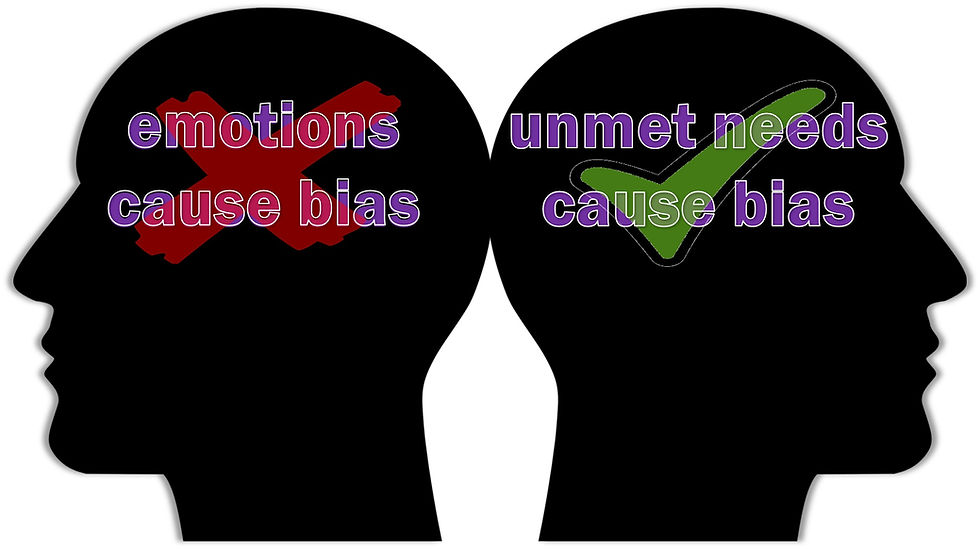
Emotions do not directly cause cognitive biases; unmet needs do. Your unresolved needs use your emotions to prioritize your attention to address such needs. The less you can function because of that unmet need, the more intense that emotion.

Suppressing such emotions to appear socially acceptable as "rational" or "reasonable" actually fuels your bias. Shooting the messenger does nothing to stop the message that you cannot fully function because your needs remain unresolved.
Your emotions exist to convey your needs. While the contents of your emotions remain subjective, they occur as objective fact independent of subjective choice. Once you perceive a threat, for example, you predictably and quite objectively experience fear, to be aware of that threat to your wellbeing. Removing that threat, or removing yourself, removes the fear. Not rationality on its own.
Cultivating emotional honesty subjects reasoning to serve objectively occurring needs. Instead of suppressing your emotions to fit reasonable sounding arguments, you humbly express how the other's stance emotionally affects you and your prioritized needs. Let's use the issue of abortion to illustrate.
"I feel a strong need to honor the sanctity of all life, including the yet to be born, who will never get to reach their life potential if voicelessly aborted by her seemingly selfish mother."
"I feel a strong need to freely access health care for my oft-controlled female body, including safe space to make the ultimate decision to end an unbearable pregnancy."
The intent here is not to persuade with emotion, but to invite connection to how each other experiences the politicized need. Increasing awareness of how each side experiences their politicized need does more to facilitate a solution than petty arguing or a rational debate.
Status quo politics
Argue and keep pushing others away.
Responsive politics
Share feelings and incentivize respect.
provisional generalizing
rigid generalizing
relevant nuance
Instead of generalizing that excuses exaggerations, Optimal Politics promptly shifts from stated generalizations to whatever nuance that is relevant to the needs of all involved. The quicker we detach from helpful generalizations to address the messy details of each other's affected needs, the sooner we can find a political solution satisfying to all.
We cannot solve our specific problems from the level of generalizing that created them. The problem with most generalizations is that they skip over reality. Every generality best serves as a starting point to search and engage relevant nuance.
Hyperbole may grab much needed attention to a matter. But can rarely scaffold a good argument. Your needs cannot cater to other's overgeneralizing. So you best not expect others to fit your generalities.
Your safest generalization is to love. You can safely generalize how others are worth your respect as you are worth their respect. Optimal Politics lets you quickly get to the other details that matter most. Let's use the issue of healthcare access to illustrate.
"I see my health as between me and my private providers. I believe state run healthcare will lose quality in the hands of administrators less accountable to market forces. But I can see how government helps to ensure the public good of our individual health needs."
"I see healthcare as a birth right, not just a privilege for those who can afford it. I believe government exists to guarantee this right to all much like providing for the public’s safety. But I can see how too heavy a hand from bureaucrats can risk the quality of healthcare deliverables."
The intent here is to make sure any generality serves as a stepping stone to vital details, and not become a stumbling block to needed awareness. Paving a path to turn useful generalities into drawing attention to relevant specifics can go a long way to mutually finding meaningful solutions.
Status quo politics
Generalizations risk obstructing awareness.
Responsive politics
The specifics of reality is what matters most.
temporary avoidance
discomfort avoidance
bold engagement
Instead of habitually evading the avoidable and risking shock by sudden surprises, Optimal Politics incentives you to boldly engage what you otherwise would prefer to avoid. Instead of habitually fleeing pain that chases you, Optimal Politics prompts you to chase pain and force it to flee from you.
The sooner you remove all threats to your wellbeing, the sooner you remove all pain. There is no such thing as pain apart from unresolved needs. Removing all threats, or distancing yourself from all threats, removes cause for pain.
Status quo politics in either its standard or toxic form rarely addresses the source of your pain. Winning at the ballot tends to offer more pain relief than meaningful solutions. Most politics drag your function level down despite the best of intentions.

Only when all sides can freely and fully resolve their needs can political solutions sustain themselves. We must not fall trap to zero-sum thinking. Needs would never evolve if vulnerable to only one side gaining at another's cost. That is a reality we must not avoid.
Sure, there can be some tradeoffs. Such bargains typically involve preferences and not at the cost of fully resolving a need—unless a bigger problem stands in the way. Which can lead to a meaningful political solution with the proactive dimensions of Optimal Politics.
Sure, you may have to endure some discomfort amidst the interim. Let that build your resilience and your equanimity. After all, pain is not the problem as much as the threats to wellbeing that pain exists to warn you to remove.
Remember, courage is not the absence of fear but the result of doing what is right and realizing you can handle it after all. Optimal Politics can help build up your courage. And reward you with meaningful political change. So you won't have as much discomfort to avoid.
Avoiding your pain tends to leave you in more pain. If you hate and avoid pain, you typically avoid resolving the needs prompting the pain. Which can leave you in a vicious cycle.
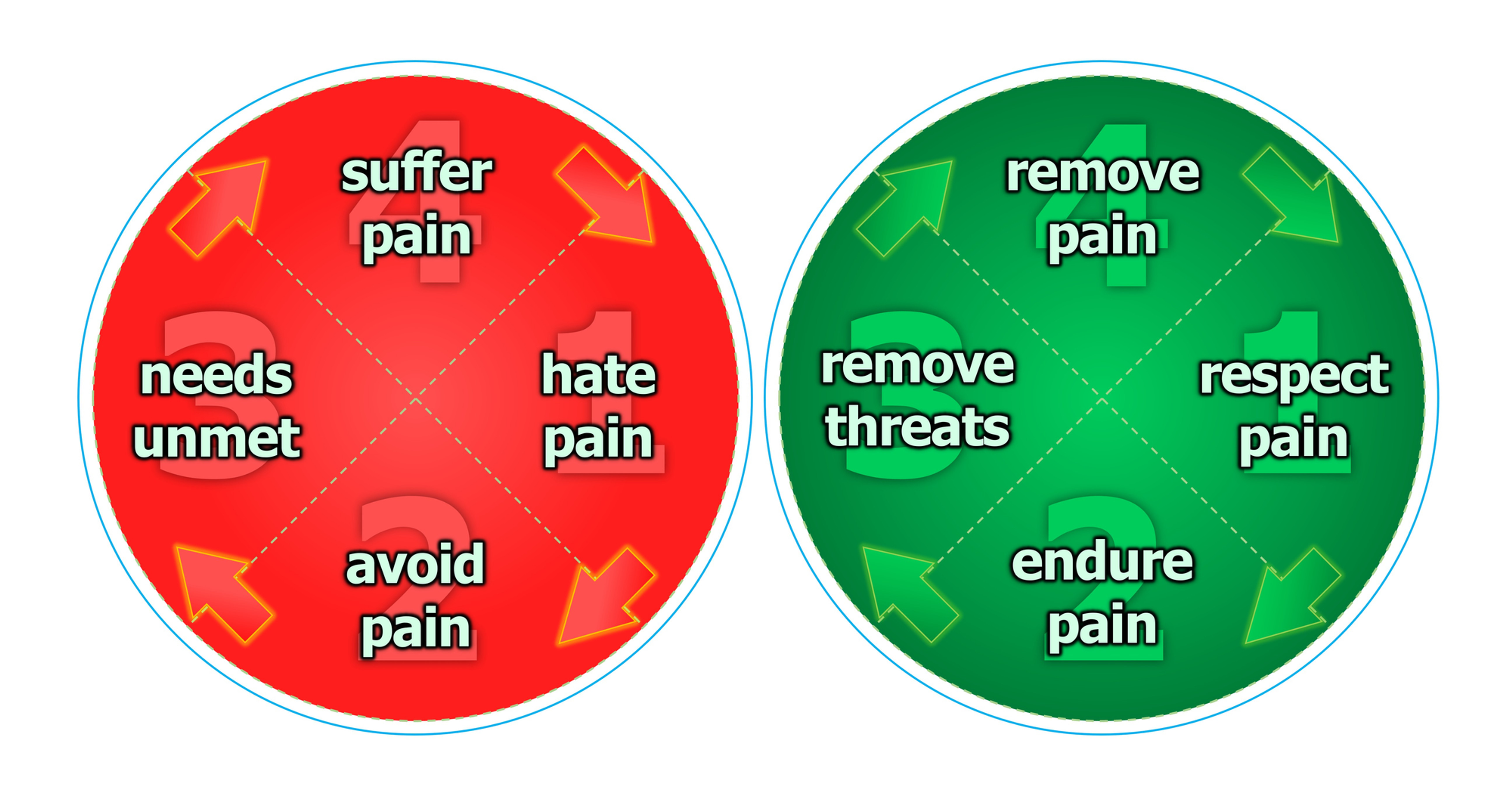
Optimal Politics guides you to respect pain with bold engagement. You learn to endure pain as you discover you can handle more discomfort than you likely give yourself credit. This includes the discomfort of affirming the needs of your political foe while wondering if they will ever affirm your needs in return.
You learn you can function just fine while stretching your comfort zone. Along the way, you remove more threats to the point you remove cause for your pain. Let's use the issue of gun safety to illustrate.
"I endure the agonizing dread of the government interfering needlessly in my life. I can provide my own localized safety from both random acts of individual violence and encroaching threats of collectivist tyranny. But I can understand why many on the left mistrust the fact I own a gun."
"I continue to cope with the trauma from mass shootings. I need to be kept safe in public from unpredictable acts of individual gun violence, often by xenophobes targeting the vulnerably different like me. But I appreciate why many on the right insist on carrying their own firearm."
The intent here is honor the real emotional pain of others. The more you respect their pain around politicized issues, the more inclined they will respect your pain.
Status quo politics
Avoidance easily misses the boat.
Responsive politics
Boldly engage them before they engage you.
mutual opposition
mutual defensiveness
mutual understanding
Instead of normalizing mutual differences that can sink into mutual hostilities and defensiveness, Optimal Politics rewards mutual understanding. How much does each side truly know about the affected needs of the other?
The urbanite can learn about the challenges of the rural farmer. That farmer can learn about the challenges confronting the urbanite. The more each side understands each other's challenges and needs, the more they realize political generalizations about the other is mostly hot air.

The left leaning urbanite experiences the opposite priority of needs than the rural resident. The city dweller relies more on environmental codes than the folks living in some local town, for example. One benefits from increased regulations while the other from decreased regulation.
Both can be true. One can find improved inclusion for their LGBTQ+ experience while the other still enjoy their family's more traditional cohesion. One can favor public policies protecting consumer rights while the other favor policies honoring producers large and small.

Optimal Politics holds open the communication channel to give no occasion for mutual defensiveness. For example:
The left can champion trans rights while respecting the right's concern about the impact of trans athletes on the competitive opportunities for their daughters, and perhaps suggest gradient categories much like boxers use.
The right can champion traditional gender norms to sustain family cohesion while recognizing that trans people do exist to upend those norms without necessarily compromising family cohesion.

What appears to contradict on the surface, when clinging to avoidant generalizations, often lose their bite with improved mutual understanding. We tap deeper into our human potential when empathizing with those we wished would empathize more with us. Let's illustrate this with the issue of criminal justice.
"I seek to provide police and prosecutors with better tools to serve and protect the public from those lacking personal responsibility. But I understand how you prefer to hold police and prosecutors personally accountable for their many abuses of discretion, or just revamp the whole system."
"I seek to hold police and prosecutors personally accountable for their many abuses of discretion, or just revamp the whole system. But I understand how you prefer to provide police and prosecutors with better tools to serve and protect the public from those lacking personal responsibility."
The intent here is to skip the risk of mutual defensiveness. Optimal Politics has you embrace every opportunity to properly resolve your politicized needs by understanding those with an apparent contradictory set of priorities. And increase the chance to turn assumed foes into potential allies.
Status quo politics
Stay stuck in mutual suspicion and hostilities.
Responsive politics
Know your foes and let yourself be known.
Besides these five exceptional improvements above to political thinking and behavior, add these four features to soar far above status quo politics. All of these stay anchored to the objective fact of your inflexible needs over the arbitrary nature of flexible laws. And heralds love (i.e., demonstrably honors the needs of others as one's own) as the ideal and reachable standard for us all.
See the separate article on parsing politics to learn how these elements affect a politico's scored political legitimacy.
Instead of starting with disagreements, OP (or Harmony Politics) has you start with good faith efforts to understand each other, to know what each other needs. It is always counterproductive to disagree with someone's need. No one can change what they inflexibly require to function.
Disputing what another needs instantly triggers their defensiveness. Utilizing ideological parties to oppose what each other's needs pits us against each other, needlessly. Who wants that?

Who benefits from this polarizing partisan divisiveness? Which political elites are kept in "power" by all this manufactured outrage? Who gains from us constantly hating each other?
OP incentivizes each side of a political issue to first affirm the other side's affected needs. Only after affirming their need can you properly and effectively address how they are addressing their need in a way that negatively affects you and your needs.
We can have good faith debates around how to properly resolve our politicized needs, to minimize or remove any negative impact on others. But disputing the what of the needs themselves never leads to anything good, unless you're an exploitive political leader.
When connecting first to the needs that they cannot alter, you give little to no cause to provoke their defensiveness. They have no grounds to provoke your defensiveness. Instead, you both can cultivate mutual rapport. You utilize the "praise sandwich" format.
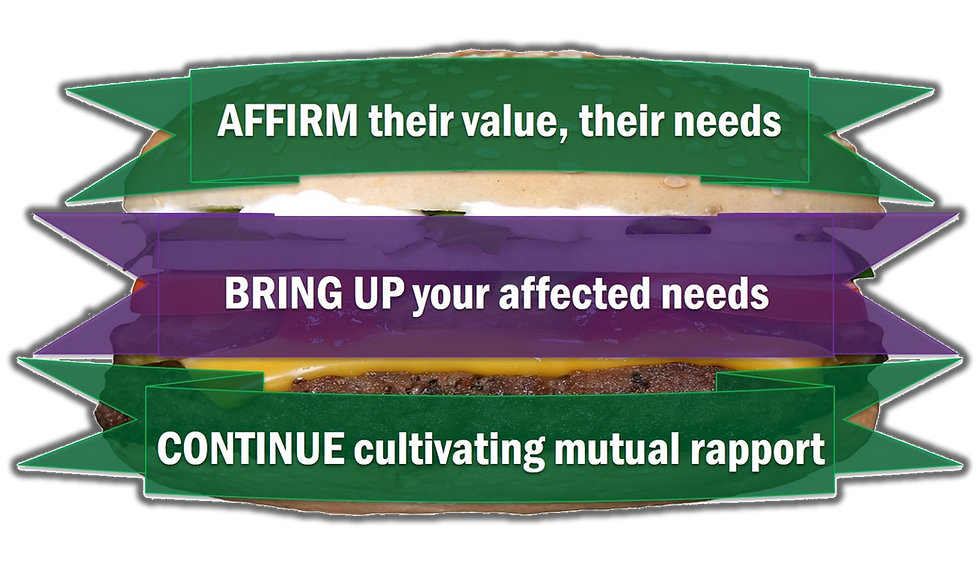
You see this same professional business communication format in a late payment notice.
A = "We value as a loyal customer." A positive slice of news.
B = "We notice you have not paid for last month's service." A negative slice buried between two positives.
C = "If you have already sent your payment then disregard this notice. And have a good day." The message closes on a positive note.
Issue by issue, OP changes the script, the talking points, from divisive politics to "harmony politics" by replacing bad political habits.
Replace arguing with listening. Look for the need they cannot change.
Replace rejecting with affirming. Respect their prioritized psychosocial needs.
Replace demanding with offering. Model how they are to respect you.
Apply this to each politicized issue. Click through these eight examples and envision how you can turn ideological differences into mutual understanding and meaningful connection.
Anchor your attempts to connect with proven character principles. Melt any tendency toward divisiveness with principles like discipline, honesty, generosity, trustworthiness, and love. Depolarize politics with the power of love. Who doesn't need for more love?

No one is perfect, of course. Not even our leaders. Let their humility warrant our grace and mercy. To give them another chance. Let them model the empathy and resilience we all need. Let their positivity improve their political quality. Let's all depolarize politics together.
Status quo politics low quality
Repeated disappointment with failed negativity.
Optimal Politics higher quality
Encouraging results with positivity.
1) Mutually depolarizing: connection over divisiveness
Instead of starting with disagreements, OP (or Harmony Politics) has you start with good faith efforts to understand each other, to know what each other needs. It is always counterproductive to disagree with someone's need. No one can change what they inflexibly require to function.
Disputing what another needs instantly triggers their defensiveness. Utilizing ideological parties to oppose what each other's needs pits us against each other, needlessly. Who wants that?
Who benefits from this polarizing partisan divisiveness? Which political elites are kept in "power" by all this manufactured outrage? Who gains from us constantly hating each other?
OP incentivizes each side of a political issue to first affirm the other side's affected needs. Only after affirming their need can you properly and effectively address how they are addressing their need in a way that negatively affects you and your needs.
We can have good faith debates around how to properly resolve our politicized needs, to minimize or remove any negative impact on others. But disputing the what of the needs themselves never leads to anything good, unless you're an exploitive political leader.
When connecting first to the needs that they cannot alter, you give little to no cause to provoke their defensiveness. They have no grounds to provoke your defensiveness. Instead, you both can cultivate mutual rapport. You utilize the "praise sandwich" format.
You see this same professional business communication format in a late payment notice.
A = "We value as a loyal customer." A positive slice of news.
B = "We notice you have not paid for last month's service." A negative slice buried between two positives.
C = "If you have already sent your payment then disregard this notice. And have a good day." The message closes on a positive note.
Instead of sparking mutual divisiveness, OP utilizes this effective format to pave a path for mutual understanding of each other's needs. To turn animosity into social connection.
Issue by issue, OP changes the script, the talking points, from divisive politics to "harmony politics" by replacing bad political habits.
Replace arguing with listening. Look for the need they cannot change.
Replace rejecting with affirming. Respect their prioritized psychosocial needs.
Replace demanding with offering. Model how they are to respect you.
Apply this to each politicized issue. Click through these eight examples and envision how you can turn ideological differences into mutual understanding and meaningful connection.
Anchor your attempts to connect with proven character principles. Melt any tendency toward divisiveness with principles like discipline, honesty, generosity, trustworthiness, and love. Depolarize politics with the power of love. Who doesn't need for more love?
No one is perfect, of course. Not even our leaders. Let their humility warrant our grace and mercy. To give them another chance. Let them model the empathy and resilience we all need. Let their positivity improve their political quality. Let's all depolarize politics together.
Status quo politics low quality
Keep letting alienation divide and polarize us.
Optimal Politics higher quality
Apply proven principles to connect with others.
Instead of first declaring what should be done about some politicized situation, OP takes the effort to first thoroughly observe the situation. It first carefully describes what is observable and can be tested. Then be better informed about a proper course of action.
This is basically the social science equivalence of having the discipline to delay gratification. This includes the discipline to frame any claim in a falsifiable way, as much as possible, so that the truth claim can be independently validated or invalidated.
This can help end the habit of politicos overlooking our needs in favor of rational argument, or explanation. It's pointless to expect better ideas to improve lives when we need better ballot options. Their normative reactions could use a descriptive overhaul that better accounts for our unresolved politicized needs amidst poor options from which to choose.
OP can first apply this social science feature to identify and describe what is called "mass institution mission creep".

Every public serving organization tends to shift from prioritizing its originating purpose to prioritizing its own self-continuance. The mass legal institutions of the judicial system and of politics are no different.
Mounting distrust in such institutions betray the perception of the public who recognize how political (and judicial) leaders tend to hold onto power to serve their own interests while showing little if any progress toward fulfilling its originating purpose to serve the public's needs.
OP observes and carefully describes this shift. Not to shame our leaders. But to show where they can improve their trustworthiness, their legitimacy.
Status quo politics low quality
Degrade trust with premature claims.
Optimal Politics higher quality
Build trust with testable claims.
Instead of passively relying on the social contract standard of the "consent of the governed", OP raises the stakes to "measurably improved outcomes". OP introduces a new social contract standard (MIWO) to outperform the old (MCOG).
MCOG = Manipulated Consent of Governed - ascribed legitimacy: legalistic
MIWO = Measurably Improved Wellness Outcomes - earned legitimacy: responsive
Our consent gets too easily manipulated. While an improvement on the old social contract of kings keeping feudal lords in check, limited ballot options coerce us to accept less ideal outcomes. Democracy can then get coopted by those of greater influence.
OP challenges the "ascribed" legitimacy of our political leaders who manipulate voter perceptions, often with propaganda techniques like fearmongering, without grounding their trustworthiness in empirical terms. Exploiting voter fears points to a lower degree of political quality. Or to a lesser degree of political legitimacy.

OP helps candidates running for office to "earn" legitimacy in measurable terms. Independent voters and many partisan voters will accept no less. By establishing their empirical bona fides, candidates can gain an advantage over old school candidates still relying on ascribed legitimacy that counts on sounding persuasive.
Optimal Politics reduces or even removes the role of persuasion. By contrast, candidates trying to get votes by using propaganda techniques like fearmongering can appear quaint and outdated. Besides, ascribed legitimacy is easier to lose than earned legitimacy.
Once in office, the ballot winner gets held to the high standard of results. If constituent lives improve, legitimacy increases. But if their lives stagnate or quality of life declines, legitimacy decreases.
Sure, each constituent has personal agency to improve their own life the best they can. But OP affords no excuse for leaders who cannot show improvements in a majority of their constituents' lives. The leadership owns any lack of improvement.
OP keeps such leaders accountable to results by incentivizing them to remain evidence-based. Instead of persuasion and hoping for the best, office holders learn to use the social science marker "as indicated by" when backing up a claim.
The more our political leaders earn their legitimacy, the more society and its individual members can resolve their needs and improve their wellness. And the less we all suffer.
Status quo politics low quality
Persuading voters to trust them.
Optimal Politics higher quality
Empirically earning voters' trust.
Instead of always depending on legal processes to address every public-facing need, OP advantages individuals to directly resolve needs themselves. Legal institutions of the judiciary and politics work largely as backup plans.
Both the judicial system and the political system are tainted with legalism. Application of the law is not explicitly designed to properly resolve needs. Trusting the law alone can pull you into dysfunction.
Both rely on convenient categories to objectify us (defendant, liberal). Exceptions to those categories tend to get overlooked.
Both offer pain relief to the winner of a legal battle (court or ballot). The losing side faces more pain. Neither side receives help to restore full wellness.
Both assume and then pull us into an adversarial relation with each other. Alienation from each other is assumed. Divisiveness tends to follow.
See how these three correspond to the ranges identified above:
generalizing,
avoiding pain, and
opposing each other.
We intuitively know this is bad for our lives, and terrible for our communities. So we typically prefer a different route. OP offers such an attractive alternative.
You can confidently say to your leaders: "You don't know what you don't know." Their legalistic application of top-down politics usually presumes we are rational actors who are extrinsically motivated.
Many of us are actually bounded rationality individuals who are intrinsically motivated. What is the difference?
rational actor: makes choices calculating maximum benefits at minimal costs | extrinsically motivated: behavior incentivized by fear of punishment |
bounded rationality: makes choices based on perception of limited available options | intrinsically motivated: behavior incentivized by internal satisfaction |
Political leaders lose efficacy (and legitimacy by extension) if assuming one thing while we exist as quite another. You perhaps care more about helping Palestinians than the risk of losing your job; you are more intrinsically than extrinsically motivated. But you don't how you would pay your bills if fired and consider the safest form of protest: you are more a bounded rationality person than a rational actor.
Both can be true at the same time. Political leaders tend to operate on the simplest behavior models. To be frank, such low political quality can then bite them in the ass. But we suffer as well, if not more.
OP assesses political leaders assumptions. The less measurably responsive to our factual needs, the less legitimate. And if intransigent, we assert the liberty to resolve needs outside of their adversarial legal process.
Yes, we exhaust opportunities to address our affected needs independent of lawyer-filtered processes. We place the burden of proof on lawyers and the government if assuming a need for their extrinsic motivation options. We have them exhaust all intrinsic motivation before imposing their legalistic extrinsic motivating options.
OP grounds this bold challenge in the inspiring words of the Declaration of Independence, where it asserts that
...a new form of politics. One more accountably responsive to the people's needs, and not for serving raw power that readily neglects our needs.
Status quo politics has turned "consent of the governed" into acclimating to poor quality ballot options. I for one do not consent to be manipulated into accepting their poor quality options. Political elites degrade democracy with "coerced poor options dependence" (or CoPOD for short).
OP counters by raising the social contract standard from "consent of the governed" to "measurable outcomes among the governed". We do not consent to be manipulated to trust their unaccountable promises. Trust (i.e., legitimacy) cannot be manipulated; it must be earned with evidence.
Political leaders can earn that trust the more our politicized needs resolve. Whether helping us with the tools of law or granting us the liberty to resolve the needs ourselves. The objective fact of our needs does not bend to law or to politics. Our needs respond better to the power of love.
Status quo politics low quality
Focus haphazardly on legalistic policymaking.
Optimal Politics higher quality
Focus directly on properly resolving needs.
There is no greater human authority than resolving needs with love. The more I support you to properly resolve your politicized needs and you reciprocate and support me to properly resolve my politicized needs, the less we need politics or government or lawyers.
Love your enemies, as Jesus urged. Love your political foes, whose needs persist as inflexible as yourself. Address kindly how the way they address their politicized needs affect you. Listen to how they complain about your impact on their inflexible needs. Be the quality and integrity we seek in our lesser quality leaders.
Offer your political leaders the opportunity to earn your trust. OP incentivize these political leaders to cultivate trustworthiness by having independent voters like you continually rate their political quality based on evidence. Let others decide how to vote based on these published scores.
The bottom line is each resolved politicized need, as indicated by improving wellness outcomes. Not only measured by self-reported decreases in anxiety or depression, but also by independent measures like decreasing allostatic load levels.
As top-down politics continues to shrink in relevance, let OP provide a meaningful grassroots alternative based on evidence of resolved need. And fueled by cultivated mutual love for one another.
Let the power of our love clean house. Worry less about how democracy has turned shallow. And gives room to some ugly alternatives also unhinged from properly resolving needs.
partisan extremism | techno-feudalism | centrist mediocrity | populist authoritarianism | neofascism |
Watch all of these melt under the power of love. It's about the quality of our politics. Not our ideological differences. I believe Dr. King was on a path to instill more love in our fractured politics, when he was brutally taken from us in 1968. Let's take up that mantel, with OP.
Yes, it's time for a revolution. Sorry, Malcom X, some revolutions are bloodless, including this one. His point is well taken, that we must not turn the other cheek when we run out of cheeks to turn. In other words, we cannot keep putting our faith in the next election when the ballot repeatedly fails to provide a meaningful path to effectively resolve needs.
But let's get back to love. There is no greater revolution than to revolve back to love. OP will have you love your faulty political leaders until they see the wisdom to act, or simply leave. Quality matters. Results matter. Love...or else!
TLDR: The less responsive to actual needs, the more a political response will fail. Political quality matters. The greater the political quality, such as with Optimal Politics, the better we all will be. Compare the options and then choose wisely.
Standard politics | Toxic politics | Optimal Politics | |
1. | self-interest | selfish demands | selfless offer |
2. | rational debate | petty arguing | emotional honesty |
3. | provisional generalizing | rigid generalizing | relevant nuance |
4. | temporary avoidance | discomfort avoidance | bold engagement |
5. | mutual opposition | mutual defensiveness | mutual understanding |
1) | alienation | divisiveness | connection |
2) | normative | imposing | descriptive |
3) | ascribed legitimacy | illegitimacy | earned legitimacy |
4) | standard legalism | liberty to resolve needs |
NOTE: Earlier versions of Optimal Politics called it Harmony Politics. They are basically the same. |
Responsive Depolarization
Respond better to political differences with understanding and love.


Politically Homeless
Follow more at the Politically Homeless show on YouTube. Learn how to improve the quality of politics in your life and community. Model a life of love!
Comments